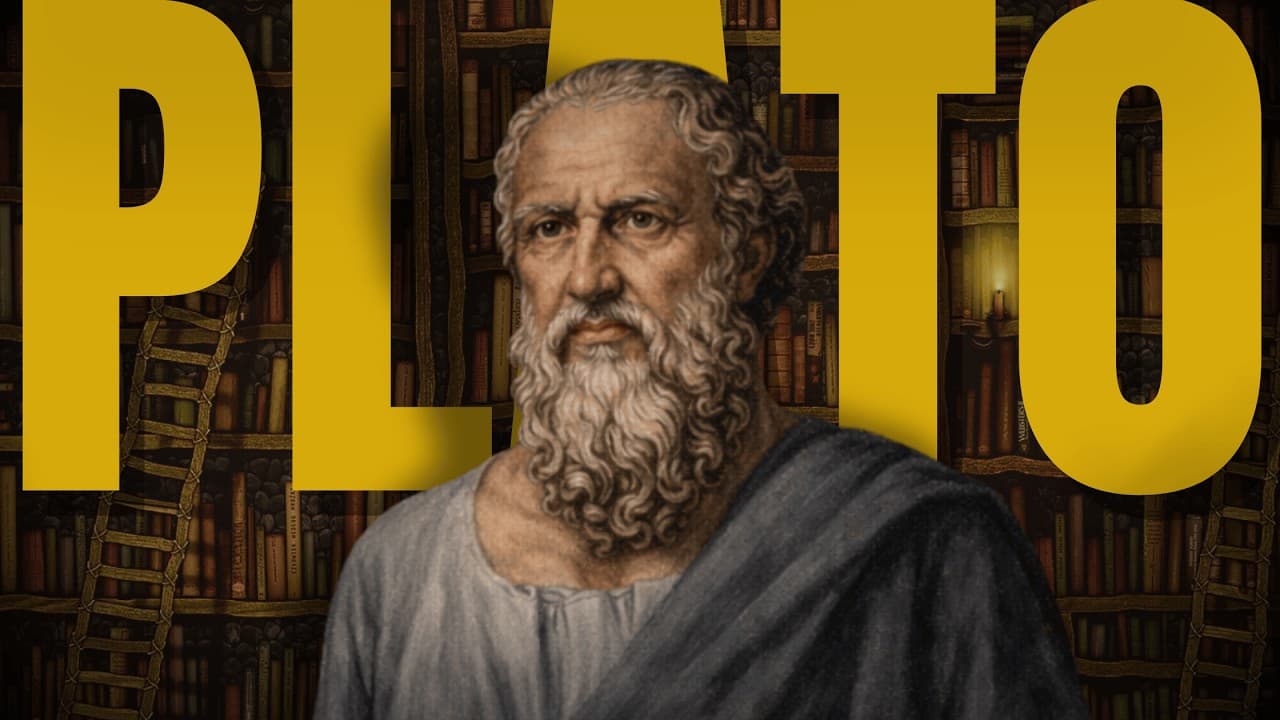
On Plato and the Cave You Never Left
Forms, the Cave, the Republic & the Soul | 3 Hours
Enjoying the episode?
Occasional letters on philosophy, reading, and the examined life. No spam, ever.
Chapters
- 00:00:00Plato's Life, Athens, and Socrates
- 00:21:00The Theory of Forms, Reality Beyond Appearances
- 00:41:56The Allegory of the Cave, Enlightenment and the Human Condition
- 01:00:27The Republic, Justice, the Ideal City, and the Philosopher King
- 01:21:03Knowledge vs. Opinion, Epistemology and Recollection
- 01:38:55Love, Beauty, and the Symposium, Diotima's Ladder of Love
- 01:58:30The Immortal Soul, Arguments from the Phaedo
- 02:18:33Ethics and the Examined Life, Virtue, Happiness, and the Good
- 02:35:05Dialectic and the Socratic Method, Philosophy vs. Sophistry
- 02:51:58Plato's Legacy, 2,500 Years of Influence on Western Thought
Full Transcript
CHAPTER 1: Introduction — Plato's Life, Athens & Socrates
[0:00:00]
few figures in human history cast a longer shadow than Plato. Born into aristocratic privilege in fifth century Athens, he would transform his advantages into something far more enduring than political power or military glory. Through his writings, his school, and his vision of reality itself, Plato established the vocabulary and questions that would define western philosophy for more than two millennia. To understand his achievement requires returning to the world that shaped him, a city at once glorious and troubled, poised between democratic experiment and catastrophic war.
Athens in the late 5th century, before the common era, stood as the cultural and intellectual centre of the Greek world. The city had repiled the Persian invasions, built an empire through the Dealyen League, and presided over a golden age of drama, sculpture, architecture, and thought. The path and on gleamed on the Acropolis. Soffacles and euripides staged their tragedies impact theatres. Citizens gathered in the Agora to debate policy and hear the speeches of skilled orators. Democratic institutions, however imperfect by modern standards, gave male citizens unprecedented voice in their own governance. Philosophy emerged in this climate of free inquiry and contestation. Yet this same Athens suffered from deep tensions. The long-peller-pennesian war against Sparta were drained the city's resources and eventually lead to humiliating defeat. Democratic politics could turn volatile and vengeful as the trial of the generals after Arjuna sigh demonstrated. ambitious young men sought power through rhetoric rather than virtue. Traditional religious priorities co-existed un-easily with new forms of critical thinking. Into this complex world, around 427 or 428 before the common era, Plato was born. His given name was Aristocles. The nickname Plato, meaning broad, may have refered to his physical build or the breadth of his forehead or intellect. He came from distinguished lineage on both sides. His mother, Peric Tion, claimed to sent from Solon, the legendary Lawgiver. His father, Ariston, traced ancestry to early Athenian kings. His stepfather, Pirilampay, served as an ambassador and friend to Pericles. Such connections placed the young Plato at the heart of Athenian political life and afforded him the education befitting his class. We know little of Plato's early years with certainty. Ancient biographers provided details, but many seem fanciful or designed to prefigate his later achievements. He likely received instruction in gymnastics, music, poetry and mathematics. He may have studied with the Heraclidian philosopher Crattellus or encountered Pythagorean ideas through various teachers. He showed literary talent and supposedly wrote poetry and dramatic works in his youth. His family expected him to enter political life to take up the responsibilities of his station in the governance of Athens. Everything changed when he met Socrates. The exact circumstances of their encounter remain obscure, but tradition places Plato's association with Socrates beginning around 410 or 409, when Plato would have been in his late teens or early 20s. Socrates, already in his 60s, had made himself both famous and notorious through his distinctive practice of philosophical questioning. Unlike the softests who charged fees to teach rhetoric and claimed to impart wisdom, Socrates insisted he possessed no wisdom himself. Instead, he questioned others, exposing contradictions in their beliefs and probing the foundations of their moral claims. Socrates wondered the agora and gymnasium, engaging anyone willing to talk. He questioned politicians about justice, poets about beauty, craftsmen about their arts, and young men about virtue. His method involved asking apparently simple questions, drawing out answers, and then demonstrating through further questioning that these answers led to absurdity or contradiction. The person examined would typically end in confusion, realizing they did not actually understand what they thought they knew. Socrates called this service to the god Apollo, fulfilling the Delphic Oracle's pronouncement that no one was wise of in Socrates by showing others their ignorance. For Plato, encountering Socrates proved transformative. Here was someone who valued truth above reputation, wisdom above power, and the health of the soul above bodily pleasure or political success. Socrates demonstrated daily that the unexamined life was not worth living, that careful reasoning could expose the pretensions of conventional opinion and that philosophy offered a higher calling than any worldly ambition. Plato became one of Socrates devoted companions, part of the circle of young men who followed the philosopher and participated in his conversations. The content of these conversations would provide material for Plato's literary life. Socrates wrote nothing himself. His philosophy lived in dialogue in the back and forth of question and answer, objection and clarification. He sought definitions of moral concepts like courage, piety, friendship, and justice. He wanted to know not which acts were just, but what justice itself was, the essential character that made just acts just. He pursued universal principles beneath particular examples. He insisted that virtue was knowledge that no one willingly does wrong and that it was better to suffer injustice than to commit it. These views struck many Athenians as perverse or dangerous. Socrates associated with controversial figures, including Alcibiaides, the brilliant but treacherous politician who defected to sparta and critties, who later became one of the brutal 30 tyrants. His questioning seemed to undermine respect for tradition and authority. His divine sign and inner voice that warned him against certain actions appeared to sum as claims to private revelation. Conservative citizens viewed him as a threat to the city's youth and values. In 399, Athen's put Socrates on trial. The specific charges were impiety and corrupting the young. The prosecution led by Melites and Iytus and Lycon argued that Socrates did not acknowledge the gods of the city, introduced new divinities and led the youth astray with his teachings. The trial took place before a large jury of Athenian citizens. Socrates defended himself, but his defense, as portrayed in Plato's apology, made no concessions to conventional opinion. He insisted he had done the city a service, compared himself to a gadfly stinging a noble, but sluggish horse, and declared that the fear of death was itself a kind of false wisdom. The jury voted narrowly for conviction. When Coulter proposed a counter-panelty to the death sentence demanded by the prosecution, Socrates suggested he deserved to be maintained in the prytanium at public expense, like an Olympic victor. This apparent arrogance offended the jury. After Socrates offered to pay a small fine, the jury voted more decisively for death. He would die by drinking hemlock. Plato was present at the trial. According to his own later writings, he fell ill and missed Socrates' final day in prison. The scene immortalized in the Fado, where Socrates discusses the immortality of the soul with his companions and faces death with equanimity. The execution of Socrates in 399 marked a decisive rupture in Plato's life. His revered teacher, the wisest and most just-man-he knew, had been condemned by democratic Athens. The experience generated profound disillusionment with Athenian politics and a determination to preserve Socrates' legacy and carry forward his philosophical mission. After Socrates' death, Plato and several other companions reportedly left Athens temporarily, perhaps fearing prosecution themselves. He may have traveled to Maghara to visit Euclides, another socratic follower. Over the next year's Plato journeyed widely, ancient sources placed him in Egypt, where he supposedly studied with priests and encountered ancient wisdom traditions. He traveled to southern Italy and Sicily, engaging with Pythagorean communities. Pythagorean philosophy emphasized mathematics, the trans-myigration of souls, and the purification of the soul through philosophical contemplation. These encounters would shape Plato's developing metaphysics. In Syracuse, the major Greek city of Sicily, Plato met Dion, the young brother in law of the tyrant Dionysius the Elder. Dion became devoted to philosophy through Plato's influence. This relationship would draw Plato back to Syracuse twice more in attempts to educate tyrants in philosophy, efforts that ended in disappointment and danger. The Sicilian adventures demonstrated both Plato's conviction that philosophers should engage with political power and the practical difficulties of implementing philosophical ideals in existing regimes. Returning to Athens, probably in the late 38th, Plato founded the Academy. He purchased land in a grove sacred to the hero Acidamus, north west of the city walls, and established what would become the western world's first institution of higher learning. The Academy was not a school in the modern sense, with formal curricula and degrees, but rather a community of scholars gathered for research and teaching in philosophy, mathematics, and related studies. Students came from across the Greek world. Instruction likely combined lectures with collaborative inquiry and the dialectical method Socrates had pioneered. The Academy endured for centuries, becoming the model for later philosophical schools. Its program emphasised mathematics as preparation for philosophy. Above the entrance supposedly stood an inscription declaring that no one ignorant of geometry should enter. This reflects Plato's conviction that mathematical reasoning provided training in abstract thought essential for grasping philosophical truth. The Academy studied astronomy, harmonics, and natural philosophy, alongside ethics and metaphysics. Plato directed the institution for the rest of his life, making it the base for his writing, teaching, and philosophical community. Plato's literary output consisted entirely of dialogues, dramatic conversations usually featuring Socrates as the main speaker. This form was revolutionary. Earlier philosophers had written inverse or prose treatises. Plato created philosophical literature, works that presented arguments through character and conversation rather than direct exposition. The dialogues varied in style, complexity, and subject. Some were brief and inconclusive, ending in aporia or impart. Others developed elaborate metaphysical systems. Scholars have long debated the order of composition, and which dialogues represent Plato's mature views versus early-secretic portrayals. The early dialogues generally present Socrates questioning an interlocutor about some virtue, exposing contradictions, and reaching no definitive conclusion. The youth-fifro examines piety, the latches courage, the charmeides moderation, the lysis friendship. These display the socratic method in action and often reflect the historical Socrates more closely. Middle dialogues like the Fado, Symposium, and Republic introduce Plato's distinctive doctrines, particularly the theory of forms and the immortality of the soul. Late dialogues, including the Theaatitas, Parmennides, and sofist engage in more technical, metaphysical, and epistemological analysis. Sometimes subjecting Plato's own early-of-use to critical examination. The Republic stands as Plato's longest and most influential work. Structured as a conversation at the House of Saffolas in the Pyreus, it begins with the question of justice, but expands to encompass psychology, education, metaphysics, epistemology, and political philosophy. Socrates and his companions construct an ideal city in speech to understand justice in the individual soul. The dialogue introduces the tri-partite division of the soul, the form of the good, the allegory of the cave, the critique of poetry, and the vision of philosopher kings ruling justly. The Symposium offers a series of speeches on love, culminating in Socrates' report of the teachings of diautimer, a wise woman from mountaineer. Love begins with attraction to physical beauty, but can ascend through stages to love of beautiful souls, beautiful laws and institutions, beautiful knowledge, and finally the form of beauty itself. This ladder of love presents philosophical eros as the driving force of the soul's education and a scent to truth. The dialogue's literary artistry matches its philosophical depth, with vivid characterization and the dramatic entrance of the drunk alphabeties praising Socrates. The phadorecount Socrates' final conversations on the day of his execution. The dialogue presents several arguments for the immortality of the soul, including the argument from recollection, from opposites, from affinity, and from the form of life. Socrates faces death calmly, confident that the philosopher spends life preparing for death by separating the soul from bodily distractions and pursuing wisdom. The scene of Socrates' death described with restraint and power concludes the dialogue and provides philosophy with one of its founding meteorologies. Other major dialogues fill out Plato's corpus. The phadores explores love and rhetoric, presenting the myth of the chariot here and horses to illustrate the soul's nature and the contrast between philosophical and subsistic speech. The thier teetis examines the definition of knowledge without reaching a final answer, but eliminating inadequate accounts. The parmenides subjects the theory of forms to devastating criticism through a series of paradoxes, raising questions about Plato's own central doctrine. The timers offers a cosmological account of the universe is creation by a divine craftsman. The laws, probably Plato's final work, presents a more realistic political vision than the Republic, detailing legislation for a second best city. Understanding these dialogues requires attention to their dramatic setting and literary features alongside their arguments. Plato does not appear as a character in his own works. He gives a Socrates conversing with sofists, politicians, young men, and fellow seekers. The reader must interpret which views represent Socrates, which represent Plato, and which are offered for examination without endorsement. This interpretive challenge has generated scholarly debate for centuries and ensures that reading Plato remains an active philosophical engagement rather than passive reception of doctrine. Plato continued teaching and writing at the Academy until his death. Ancient biographers claimed he died at a wedding feast at age 80 or 81, around 347 or 348. His nephew Spuseyper succeeded him as head of the Academy. His student Aristotle, who had studied at the Academy for 20 years, would later found his own school and develop philosophical views sharply critical of central platonic doctrines. Yet Aristotle's own system remained deeply shaped by his platonic training, testimony to Plato's formative influence. The Athens that shaped Plato was a city of contradictions. It prized free speech, but executed its gaddfly philosopher. It celebrated reason, but remained bound to traditional religion. It created democracy, but excluded women, slaves, and foreigners from citizenship. Plato internalized these tensions. His political philosophy combines admiration for Athenian culture with profound criticism of democracy. His metaphysics on his mathematical truth, while acknowledging the power of poetry and myth. His ethics demands rational virtue while recognizing the soul's passionate and spirited elements. Socrates provided the catalyst, but Plato built the edifice. Where Socrates questioned and exposed ignorance, Plato proposed positive doctrines. Where Socrates remained in the marketplace, Plato founded an Academy. Where Socrates wrote nothing, Plato created philosophical literature. Yet Plato always presented Socrates as his spokesman, insisted that the philosopher seeks wisdom rather than possessing it, and use the dialogue form to keep philosophy alive in conversation rather than fixed in dogma. This creative fidelity to Socrates while moving beyond him defines Plato's achievement. The meeting of Plato and Socrates in early 5th century Athens initiated Western philosophy as we know it. Before Socrates, Greek thinkers explored nature, mathematics, and cosmology. After Plato, philosophy encompassed logic, ethics, politics, aesthetics, epistemology, and metaphysics as interconnected inquiries. The Academy provided an institutional home for these investigations. The dialogues demonstrated how philosophy could be both rigorous argument and literary art. The central questions Plato pursued, questions about reality and appearance, knowledge and opinion, justice and virtue, continued to structure philosophical inquiry. Plato came from privilege, but chose philosophy. Athens offered political power, but he founded a school. Socrates died leaving only questions, but Plato erected an intellectual cathedral. The specific historical circumstances of late 5th and early 4th century Athens, with its democratic experiments and tragic wars, its sophisticated rhetoric and socratic gadfly made Plato possible. What he made from these materials transcended his time and place, speaking to anyone who wonders about the nature of reality, the possibility of knowledge, the requirements of justice, and the life worth living.
CHAPTER 2: The Theory of Forms — Reality Beyond Appearances
[0:21:00]
At the heart of Plato's philosophy lies a radical claim about reality itself. The world we perceive through our senses, the realm of physical objects and changing phenomena, is not the deepest level of reality. Beyond and above the visible world exists another realm. Eternal and unchanging, populated by perfect and immaterial entities, Plato called forms or ideas. These forms are not thoughts in anyone's mind but objective realities more real than the physical things that imitate them. A beautiful painting participates in beauty itself. A just action injustice itself, a circular wheel in the perfect circle. The theory of forms represents Plato's answer to the most fundamental philosophical question, what is ultimately real. The theory did not emerge fully formed in a single dialogue. Plato developed it gradually across multiple works, refining and elaborating the doctrine while sometimes acknowledging difficulties. Yet the core insight remains consistent. Ordinary objects of sense experience are in perfect, changeable and dependent. The forms are perfect, eternal and self-substant. True knowledge grasps the forms. Meer opinion concerns itself with the shifting realm of sensible particulars. The philosophers task is to turn from shadows and reflections toward the bright reality of the forms themselves. Understanding what Plato means by forms requires distinguishing them from several things they are not. Forms are not concepts or mental abstractions. They exist independently of human thought. If all humans disappeared, the forms would remain unchanged. Forms are not names or linguistic entities. Language may refer to forms, but forms are what make language meaning for, not products of language. Forms are not ideal types in our imagination. The perfect circle we cannot quite draw or visualize still exists as a form, not because we imagine it, but because it is a genuine feature of reality. Rather, forms are the essences or natures of things, existing separately from any particular instance. Consider the form of justice. Many actions are just and many souls possess justice, but these particular instances share injustice by participating in the one eternal form of justice. Justice itself never changes, never becomes unjust, and never depends on human convention or opinion. It is what it is eternally. The same holds for beauty, equality, largeness, and indeed for the essential nature of any kind of thing. Each form is unique, unitary, and perfect, in a way no sensible particular can match. Plato's fullest presentation of the forms appears in the central books of the Republic, particularly in three images. The Sun, the divided line, and the Cave. These famous analogies convey the structure of reality and the journey of the soul from ignorance to knowledge. Socrates employs them after Glock on Demand's he explained the form of the good, the highest object of knowledge and the source of all reality and truth. Socrates claims he cannot give a direct account of the good itself, but can offer images to illuminate it. The analogy of the Sun compares the good to the Sun in the visible realm. Just as the Sun provides light enabling vision, and also causes things to grow and come into being, the good illuminates the forms making them noable and gives them their reality and essence. The Sun is not itself sight, but makes sight possible. The good is not itself knowledge, but makes knowledge possible. In the visible world, we need light to see objects. In the intelligible world, we need the good to grasp the forms. The good thus stands as the supreme principle, beyond even being itself, the source of truth and existence for everything that is. The divided line analogy presents reality and knowledge as hierarchical levels. Socrates asks Glock on to imagine a line divided unequally into two main segments, representing the visible and intelligible realms. Each segment is further divided in the same proportion. In the visible realm, the lower subsection contains images, shadows and reflections. The upper subsection contains physical objects themselves. In the intelligible realm, the lower subsection contains mathematical objects and reasoning. The upper subsection contains the forms and dialectical understanding. Each level corresponds to a state of mind or cognitive condition. Images produce imagination or conjecture. Physical objects produce belief or opinion. Mathematical objects produce thought or understanding. The forms produce knowledge or interlection. The solar sends through these stages, moving from perception of shadows to contemplation of the highest realities. Most people remain in the visible realm, taking shadows for reality or trusting sense perception. The philosopher struggles upward toward the intelligible, eventually grasping the forms themselves through pure interlection. The relationship between particulars and forms constitutes one of the theory's central puzzles. Plato uses several terms to describe this relationship. Participation, imitation, presence and communion. Beautiful things participate in beauty. Adjust act imitates justice. Equality is present in equal sticks. Forms have communion with particulars. Yet none of these metaphors fully explains how an immaterial, eternal form relates to material, changing particulars. If forms exist in a separate realm, how do they connect to sensible objects? If they are present in objects, how do they remain unified and unchanged? The third man argument presented by parmenides in Plato's dialogue of that name exposes a difficulty with participation. If beautiful things are beautiful by participating in beauty, then there must be something beautiful things and beauty share that makes them similar. Call this further form beauty too. But then beautiful things, beauty and beauty too must share another form. Beauty 3 and so on infinitely. The regress threatens to collapse the theory. Plato may have seen this problem as a challenge to refine the account of participation rather than abandon forms altogether, but the dialogue leaves the puzzle unresolved. Despite such difficulties, Plato insists on forms for compelling reasons. Consider the problem of change. Heroclitus taught that everything flows, that you cannot step into the same river twice. If reality is constant flux, stable knowledge becomes impossible. We can have opinions about changing appearances, but never grasp a permanent truth. Conversely, parmenides argued that changes illusion, that only unchanging being truly exists. Plato sought to honour both insights. The realm of sensible becoming is real but derivative. The realm of intelligible being is primary. Forms provide stable objects for knowledge despite the flux of experience. The problem of universe also motivates the theory. Many different things are beautiful or equal or just. What makes them more instances of the same quality? Nominalists might claim the word beautiful, merely names things we happen to group together. Realists insist something real must be shared. Plato affirms extreme realism. Not only is there something shared, but that shared nature is more real than any particular instance. Beauty exists as an objective feature of reality, whether or not any particular beautiful thing exists. Value properties especially seem to require forms. When we judge that an action is just or unjust, we appeal to some standard of justice. If justice were simply what each person or society believes, no genuine ethical disagreement could exist. Only differences in custom or preference. Plato argues our ability to recognize imperfect instances of justice presupposes knowledge of perfect justice. We have never encountered perfect justice in experience yet we criticize existing laws and institutions for failing to measure up. This normative judgment implies grasp of the form. The theory has profound epistemological implications. If forms are the true objects of knowledge and sensible particulars mere opinion, then sense perception cannot yield wisdom. The philosopher must turn away from the body senses toward the soul's intellect. Plato frequently disparages the body as a prison or tomb for the soul, source of distraction and error. Bodily pleasures and pains chain us to the physical. Philosophy requires a settic discipline, modifying fleshly desires to purify the soul for intellectual contemplation. Yet Plato does not entirely dismiss the visible realm, particularly as participating forms and can lead the soul upward toward them. A beautiful body may kindle a rotic desire that properly directed becomes love of beauty itself. Mathematical diagrams, though imperfect, train the mind to grasp eternal truths. Even the shadows in the cave derive from real objects and ultimately from the light of the good. The sensible world is pedagogically valuable, a ladder the philosopher eventually discards, but must initially climb. The forms themselves are not all equal. They form a hierarchy with the good at the summit. Lower forms include those for physical kinds, the form of human, horse or tree. Some forms capture qualities, beauty, justice, largeness, equality. Higher forms include being, sameness and difference, the very categories that structure reality. At the apex stands the good, which gives all other forms their being and no ability. Grasping the good represents the culmination of philosophy, the final stage of enlightenment. Plato's account of the good itself remains notoriously elusive. In the republic, Socrates refuses to define it directly, offering analogies instead. He suggests the good is what every soul pursues and for which it does everything else. The good is beyond being in dignity and power. These cryptic statements have generated endless interpretation. Some scholars see the good as a principle of unity and order. Others, as value or perfection itself, still others as God. The later platonic tradition increasingly identified the good with divinity. Do forms exist for all kinds of things? Plato clearly posits forms for value properties like justice and beauty, for mathematical entities like equality and circle, and for natural kinds like human. But what about artifacts? Is there a form of table or bed? What about negative properties or worthless things? Is there a form of ugliness or dirt? Plato shows some ambivalence. In the republic he mentions forms of manufactured objects. In the parmenides, young Socrates hesitates to posit forms for hair, mud and dirt, finding it absurd. Though parmenides suggest he may overcome this squeamishness with maturity. The theory also implies troubling consequences for particulars. If the form is the real thing and particulars are mere imperfect copies, does this devalue the physical world and human embodied existence? Critics from Aristotle onward have charged Plato with other worldliness, turning away from concrete reality toward abstract essences. Plato himself sometimes embraces this charge, portraying philosophy as preparation for death, liberation from bodily imprisonment. Yet other dialogues celebrate beauty in the physical world and present sensible things as revelations of divine order. Late dialogues show Plato grappling with problems in the theory. The parmenides' subjects forms to withering criticism, raising difficulties about participation, self-predication and whether forms can be objects of thought. The surface to dress is how forms relate to each other, exploring whether all forms mix with all or whether some combinations are impossible. These late work suggest Plato continued refining and questioning his central doctrine rather than regarding it as settle dogma. Some scholars distinguish middle and late theories, seeing development or revision in Plato's thought. Others find essential continuity, with late dialogues exploring implications always latent in the theory. The truth likely combines both continuity and development. Plato never abandoned the fundamental insight that eternal perfect entities provide the foundation for knowledge and value. He continued exploring how to articulate this vision coherently. The theory of forms represents Plato's most distinctive philosophical contribution. It addresses deep problems about knowledge, change, universe, and value. It provides a metaphysical foundation for objective morality against subsistic relativism. It answers secretic questions about definition by positing essences as real entities. It explains how mathematics grasps necessary truths beyond empirical observation. It dignifies philosophy as the highest human activity, contemplation of eternal truth. Yet the theory has never lacked critics. Aristotle Plato's greatest student mounted extensive objections. How can separated forms explain the sensible world they supposedly ground? If forms are substances existing independently, why do we need particulars at all? How does postulating a form of human help us understand actual human beings and their development? Aristotle insisted forms exist in particulars, not separately. The form of a statue is the shape impressed in the bronze, not a transcendent entity. Modern philosophers have largely rejected Plato's realism about forms while remaining influenced by his framing of issues. Few now believe in a separate realm of abstract objects. Yet debates about universal mathematical truth, moral realism, and the mind independent nature of reality continue in terms Plato established. The tension between empiricism and rationalism between sense experience and rational intuition as sources of knowledge still structures epistemology. The forms also carry existential and spiritual significance beyond technical metaphysics. They represent the conviction that meaning value and truth are not human inventions but discoveries. Against sophistic skepticism and moral relativism, Plato insists the good is real and accessible to reason. Against materialist reductionism, he affirms a transcendent dimension to reality. Against nihilistic despair, he offers hope that the soul can ascend toward light. The theory of forms grounds ethical and spiritual aspirations in the structure of being itself. Plato himself recognises the limits of philosophical prose. The form of the good proves in affable beyond complete articulation. The ascente forms involves mystical vision as much as logical argument, images, myths and analogies supplement dialectic. The sun, line and cave remain more influential than technical arguments in the palm entities. This suggests Plato understood his theory as pointing toward truths, requiring not just intellectual ascente but existential transformation. To grasp the forms is to become wise, just and beautiful oneself, participating in the divine order. The eternal and perfect nature of forms contrasts with human finitude and imperfection. We live in shadows, mistake appearances for reality and struggle to free our minds from sensory illusion. Philosophy begins in wonder but proves arduous. The ascent from the cave is painful, the sunlight blinding. Most people prefer comfortable illusions to difficult truth. Even those who achieve philosophical insight find it hard to communicate. The enlightened philosopher returns to the cave only reluctantly, knowing others will ridicule or even kill him for his strange claims. Yet the forms remain accessible, at least in principle, to reason. Plato's rationalism insists human intellect can transcend its biological origins to grasp eternal truth. The soul has innate kinship with forms. Through dialectic, mathematical study and purification from bodily distraction, the mind rises to its proper objects. This optimism about reasons power distinguishes Plato from mystical traditions that emphasize in effortability and from skeptical traditions that doubt knowledge altogether. Reason is divine in us, the means by which we participate in divine wisdom. The political implications of the theory are equally profound. If forms are objective and noable, then ethics and politics admit of expert knowledge like any other craft. Just as medicine requires understanding health and navigation requires knowing sea routes, good government requires knowing justice itself. Most people, trapped in opinion, should not rule. Only philosophers who have ascended to the forms possess the wisdom necessary for just governance. This conclusion leads directly to Plato's vision of philosopher kings, rulers with both intellectual insight and moral virtue to govern rightly. The theory of forms thus unifies Plato's metaphysics, epistemology, ethics and politics. All depends on the conviction that reality has a rational structure accessible to the soul that prepares itself properly. Beyond flux lies permanence, beyond opinion lies knowledge, beyond appearance lies truth. The forms are not fantasies or ideals in the modern sense of merely imagined perfections. They are the ground of all reality, the most real things that exist, the eternal patterns particulars imperfantly instantiate. To understand anything truly is to grasp its form. To live well is to order the soul by contemplating the good. To know the forms is to be transformed by them.
CHAPTER 3: The Allegory of the Cave — Enlightenment & the Human Condition
[0:41:56]
Among philosophies most powerful images, the allegory of the cave stands nearly alone. Presented in book 7 of the Republic, after the analogies of the sun and divided line, it dramatizes the human condition, the possibility and difficulty of enlightenment, and the philosophers duty to return and educate others. Through vivid narrative, Plato conveys truths about knowledge, reality, education, and politics that have resonated across centuries. The cave is not merely illustration of doctrine already explained, but revelation of the existential stakes of philosophy itself. Socrates asks Glockon to imagine prisoners change since childhood in an underground cave. They sit facing a wall, unable to turn their heads or bodies. Behind them burns a fire, and between the fire and prisoners runs a raised walkway. Along this walkway, people carry various objects, artifacts, and representations of animals, and humans, and things. The fire casts shadows of these objects onto the wall the prison is face. These shadows are all the prisoners have ever seen. They hear echoes of sounds made by those carrying objects, but think the sounds come from the shadows. For these prisoners, the shadows constitute reality itself. Suppose one prisoner is freed. He is forced to stand and turn toward the fire. The movement causes pain. The light hurts his eyes. He sees the fire and the objects being carried, but cannot comprehend them. These genuine things seem less real than the familiar shadows. If told the shadows were mere images and these objects real, he would not believe it. If dragged up the rough steep path out of the cave, he would resist violently, protesting that he was being harmed. The ascente is agonizing. Emerging into sunlight would prove even more painful. The freed prisoners eyes, accustomed to darkness, could not immediately see the world above. He would first perceive only shadows, then reflections in water, then objects themselves, then celestial bodies at night, and finally the sun itself. Only gradually would he come to see and understand the visible realm. Eventually he would grasp that the sun provides light for vision, seasons for growth, and governs all he now sees. He would understand that this sun corresponds in the visible realm to what the good is in the intelligible realm. This freed prisoner would remember his former dwelling and would pity the prisoners still chained below. He would no longer envy those who received honour in the cave for best identifying shadows, or predicting which shadow would appear next. Such honours would seem worthless. But if he descended back into the cave, his eyes now accustomed to sunlight would struggle in the darkness. He would perform worse than the prisoners that identifying shadows. They would mock him, saying the journey upward had ruined his sight. If he tried to free other prisoners and lead them up, they would resist, and might even kill him if they could. The allegory works at multiple levels. Most obviously, it illustrates the relationship between the sensible and intelligible realms from the theory of forms. The shadows on the wall represent images and reflections in the lowest section of the divided line. The objects casting shadows represent physical things we perceive with senses. The journey out of the cave is the souls that are sent from sensible to intelligible reality. The sunlit world above corresponds to the realm of forms. The sun itself represents the form of the good, source of all truth and being. But the allegory is also about education and human nature. The prisoners condition from birth depicts our own. We are not blank slates but already shaped by limited perspective and false beliefs. Our ordinary, unreflective state mistakes shadows for reality. Education is not filling an empty vessel but turning the soul from darkness toward light. The image of the eye suggests the soul has innate capacity for vision but must be reoriented. You cannot give sight to the blind but you can turn those with functioning eyes from darkness toward light. The pain and resistance in the allegory reveal why wisdom is rare. Enlightenment is not easy or pleasant. The freed prisoner does not willingly embrace his liberation initially. He has to be compelled. The journey upward is rough and steep. Each stage involves discomfort and disorientation. Those who begin to see truth face ridicule and opposition from those still in darkness. The natural human tendency is to cling to familiar illusions rather than embrace difficult reality. Wisdom requires courage as much as intelligence. The allegory also carries political implications central to the republic. The philosopher who escapes the cave and sees the sun faces a choice. He could remain a above in contemplation of eternal truth but socrates insists he has an obligation to return. The enlightened must descend back to help those still in chains even though this involves personal danger and returning to a realm now seem obscure. The philosopher who has grasped the good is uniquely qualified to rule, possessing knowledge of justice and the proper ordering of soul and city. Yet philosophers do not naturally want political power. Having seen truth and beauty, they prefer contemplation to governance. Socrates argues that only by compelling philosophers to rule can the city be justly governed. Other people seek power out of ambition and desire for honour, making them unsuitable. Only those who do not want to rule, who have something more valuable than political power can rule well. The reluctant philosopher King governs from duty, not personal ambition and applies knowledge of the good to political arrangements. This creates a paradox. Unless philosophers become kings or kings become philosophers, cities cannot flourish and the human race cannot rest from evils, socrates declares. But philosophers resist ruling and masses resist being ruled by philosophers. The enlightened person descending back to the cave faces mockery and potential violence. The allegory implicitly references Socrates own fate. He tried to turn Athenians from shadows toward truth and the city executed him. Philosophy and politics exist in permanent tension. The stages of enlightenment in the allegory correspond to the educational program outlined in the republic. Early education involves music and poetry to shape the soul's desires and gymnastics to train the body. Mathematical studies including arithmetic, geometry and astronomy train the mind to abstract from sensible particulars and contemplate eternal truths. Dialectic, the highest study, leads the soul to grasp the forms themselves and ultimately the good. Only after decades of study and practical experience should guardians become philosopher rulers around age 50. The allegory presents education as conversion, a turning of the whole soul. merely adding information to the mind changes nothing essential. The soul must reorient from becoming to being, from appearance to reality, from the many to the one. This requires not just intellectual training but moral and spiritual transformation. The philosopher in training must overcome attachment to bodily pleasures, love of honour and the appetites that chain us to the cave, ascending to the forms demands purifying the soul from earthly distractions. Critics have noted troubling features of the allegory. The freed prisoner is initially compelled against his will. He does not choose liberation but has it forced upon him. This seems to undermine individual autonomy and suggest paternalism. Plato appears to justify forcing people toward truth for their own good, even when they resist. The political implications seem authoritarian and in light and elite who know the truth should rule over masses who remain in ignorance. The many cannot govern themselves but need philosophy guardians to direct them. Defenders of Plato respond that the allegory depicts the difficulty not impossibility of voluntary education. The initial compulsion may represent the challenge any teacher faces in getting students to engage with difficult material. Once the freed prisoner sees the sun, he is grateful and would not return to chains. Enlightenment once achieved is self-evidently valuable. The philosopher rules reluctantly as duty, not from desire to dominate. The alternative to philosopher kings is rule by those who seek power for wrong reasons, producing worse outcomes. The epistemological reading emphasises that the cave shows how we begin in error and must work to achieve knowledge. Our initial condition gives us beliefs but not understanding. Only by subjecting these beliefs to rational examination, following arguments where they lead and grasping first principles can we attain wisdom. Most people remain at the level of belief or opinion, trusting perception and convention. The philosopher undertakes the laborious assent to knowledge through dialectic and mathematical study. The ethical reading stresses the cave as depicting the moral condition. The prisoners value what should not be valued, honour and prizes for identifying shadows. They lack any conception of genuine goodness. Their lives have no true aim. The freed prisoner undergoes moral conversion, recognising that bodily pleasures and conventional honours are worthless compared to knowledge of the good. Philosophy becomes the examined life, constantly scrutinising ordinary values and orienting the soul toward what truly matters. Different philosophers and traditions have interpreted the cave allegory in light of their own concerns. Early Christians saw the cave as the material world and the assent is the souls journey toward God. Medieval platenists read the allegory through theological categories, with God as the sun and revelation as the means of enlightenment. Modern interpreters have emphasized epistemology, ideology, or existential authenticity. Marxists saw the shadows as ideology obscuring true economic relations. Existentialists focused on authentic verses in authentic existence and the difficulty of facing reality. The allegory's literary power explains its enduring influence. Philosophical arguments can be forgotten or refuted, but compelling images linger. Anyone can grasp the horror of prisoners mistaking shadows for reality. The difficulty of enlightenment and the tragedy of the enlightened person misunderstood by those still in darkness. The cave speaks to universal human experiences of confusion, discovery, and isolation. It validates the sense that ordinary life somehow misses the deepest truths and that wisdom requires breaking free from comfortable illusions. Yet the allegory also risks elitism and obscure and tism. If philosophers alone have access to truth and masses remain in darkness, what prevents philosophy from becoming a self-justifying ideology for intellectual elites? Who decides who is enlightened and who remains in chains? The philosophers claimed to have seen the sun and know the good could be arrogance or delusion. The allegory provides no external criterion to distinguish genuine wisdom from pretension. Socrates himself insisted he knew only that he knew nothing, yet the philosopher king seems to know everything necessary for governance. Plato was aware of these dangers. The republic itself presents its ideal city as a model in speech, perhaps impossible to realise fully in practice. The allegory concludes by noting that even the best regime would face resistance and imperfection. Philosophy does not guarantee political success. The allegory's ending, where the prisoners might kill anyone trying to free them, acknowledges that enlightenment faces hostility from those it aims to help. Wisdom cannot be forced on the unwilling? The cave also raises questions about what we see when we exit. Plato specifies the visible realm above ground, with sun, stars, trees and living beings. But the true goal is the intelligible realm of forms, which has no location and cannot be literally seen. The allegory mixes levels, using visible imagery to point toward purely intellectual reality. The sun we can see represents the good we can only contemplate. This conflation of visible and intelligible has led to confusion and critique. Aristotle objected that Plato multiplied entities beyond necessity, positing separately existing forms when inmanent forms suffice. Modern epistemology has largely moved away from Plato's sharp division between knowledge and opinion. We recognise degrees of justified belief, probability and evidence. Science advances through observation and experiment, not transcending the sensible for a purely intellectual realm. Yet the cave remains relevant as caution against taking our current beliefs and perceptions as obvious truth. Every era has its shadows mistaken for reality, consensus opinions later revealed as ideology or superstition. The allegory reminds us to question inherited beliefs and examine foundations. The journey from cave to sunlight also suggests philosophy as spiritual discipline, not mere intellectual exercise. The freed prisoner undergoes transformation affecting his whole being. He sees differently, values differently, lives differently. The return to the cave out of duty despite personal preference shows philosophy as ethical commitment. Wisdom brings not just correct beliefs, but right action and concern for others. The philosopher cannot remain self-absorbed in contemplation but must engage with the world even when the world rejects him. Plato's optimism that enlightenment is possible distinguishes him from radical skeptics and relativists. The cave is dark and the ascent hard, but the sun exists and can be seen. Truth is not mere social construction or power play. Reality has structure accessible to reason. Human beings have capacity, however imperfectly developed, to grasp eternal principles. Education can succeed, however difficult. This faith in reasons ability to attain knowledge grounds Plato's entire philosophical enterprise. The allegory also validates the sense that something is wrong with ordinary life. The prisoners are not simply different from those above, but objectively worse off. They live in ignorance and value, what should not be valued. Philosophy begins in dissatisfaction with conventional wisdom and ordinary pursuits. The freed prisoners in initial confusion and pain give way to recognition that liberation, though difficult, is genuine improvement. We are made for truth and settling for shadows dishonors our nature. Yet return to the cave proves necessary. The philosopher cannot simply escape into private enlightenment. Having been freed by others, the individual owes debt to those still imprisoned. The political reading makes this explicit. Those who know the good must rule for the sake of justice, not personal satisfaction. The ethical reading extends this to all human relationships. Having achieved understanding, one must help others to award it. Philosophy carried to completion becomes teaching and service. The cave remains Plato's most memorable contribution to philosophy because it captures existential truth beyond technical doctrine. We do live in shadows. We do mistake appearance for reality. In lightenment is painful and rare. The wise face mockery and danger. Yet truth exists and can be known. The examined life requires courage to leave comfortable darkness and integrity to return and help others. Philosophy is not abstract theory but transformation of the soul and commitment to seek and speak truth regardless of cost. The allegory of the cave tells us who we are and challenges us to become something better.
CHAPTER 4: The Republic — Justice, the Ideal City & the Philosopher King
[1:00:27]
The Republic stands as Plato's Masterwork, longest of the dialogues and most comprehensive in scope. Structure does a conversation at the House of Chephalas in Pireas, the port city of Athens, it begins with a seemingly simple question posed by Poli Marcus. What is justice? By the dialogues end, Socrates and his companions have constructed an entire ideal city, analyse the human soul structure, explored education and poetry, presented the theory of forms and the cave allegory, and concluded with a myth about the afterlife. The dialogue demonstrates philosophies architectonic ambition, showing how metaphysics, psychology, ethics, politics, and epistemology connect in a unified vision. The conversation begins conventionally. Saffa-less suggests justice means speaking truth and paying debts. Socrates quickly shows this definition is inadequate. If a friend lens you weapons while sane but later goes mad and demands them back, returning them would be unjust, yet you would be paying your debt. Poli Marcus revises the definition. Justice is giving each person what is owed, helping friends and harming enemies. Socrates demolishes this view through careful questioning. How do we determine who is truly a friend? Are we just when we harm anyone, even enemies? Can justice involve making anyone worse? Enter Thrasimicus, the softest who dramatically interrupts to declare that justice is the advantage of the stronger. In any regime, the rulers establish laws to benefit themselves. Justice is simply obeying these laws. Therefore justice serves the interest of the ruling power. Thrasimicus argues that injustice is more profitable than justice. The completely unjust person who appears just enjoys reputation and power. The completely just person who appears unjust suffers punishment and scorn. Why then should anyone be just rather than merely seeming just? Socrates engages Thrasimicus in argument first showing that rulers, like practitioners of any craft, aim at the good of those they rule, rather than their own advantage. A doctor, who are doctor, aims at the patience health, not profit. If rulers are craftsmen of governance, they aim at the city's good. Second, Socrates argues that justice is a virtue and injustice of vice. The just person's soul is harmoniously ordered while the unjust person is conflicted. Since a disordered soul cannot function well, the unjust person cannot be truly happy. Thrasimicus retreats but Glauben and Ademantis take up the challenge more forcefully. They do not believe Thrasimicus's position, but want socrates to refute it thoroughly. Glauben distinguishes three types of goods. Those desired for themselves, those desired for consequences, and those desired for both. He challenges Socrates to prove justice belongs to the third category, desired both intrinsically and for its results. People praise justice only for its consequences, reputation and rewards. The story of Gide's ring makes this clear. According to Glauben's account, Gide's found a ring that made him invisible. With this power, he seduced the queen, murdered the king and seized the throne. Given such a ring, wouldn't anyone act unjustly? If you could commit crimes without being caught, why would you restrain yourself? This suggests people are just only from fear of punishment, not from genuine conviction that justice is good in itself. The completely unjust person with a reputation for justice lives better than the completely just person with a reputation for injustice. Ademantis adds that even those who praise justice praise only its consequences, rewards from gods and humans, good reputation, worldly success. No one explains why justice itself, apart from consequences, benefits the soul. If we could choose injustice with impunity, as Gide's could, we would. Therefore, Socrates must show that justice is choiceworthy for its own sake. Beneficial to the soul independently of external rewards or punishments. Socrates accepts the challenge but suggests that, understanding justice in an individual requires first understanding justice in a city, since a city is larger and justice in it more visible. This launches the construction of an ideal city in speech, the Calipolis, or beautiful city. Beginning from first principles, Socrates describes how cities form from human need. No individual is self-sufficient. We need food, shelter, clothing, and countless other things. Specialization allows each person to practice one craft well. The city emerges as a cooperative enterprise, uniting many specialized laborers. Initially, this city is simple, almost primitive. People have basic necessities, simple pleasures, and peace. Glocken objects that this is a city of pigs, not human beings. We want more than bad necessities. We want luxury, art, comfort, and refinement. Socrates agrees to consider a luxurious city, a feverish city, swollen beyond necessity. This expanded city requires more territory, leading to war. War demands a specialized class of guardians, warriors who defend the city. These guardians must possess seemingly contradictory qualities. They must be fierce toward enemies, but gentle toward fellow citizens, spirited yet philosophical. Socrates compares them to noble dogs that are harsh towards strangers, but kind to those they know, discriminating through knowledge. The guardians' education becomes crucial. They must be raised with appropriate stories, music, and physical training to develop both courage and temperance. Socrates examines poetry and mythology with surprising severity. Traditional stories about gods fighting each other, deceiving mortals, and acting immorally, must be censored. Young guardians should not learn that gods cause evil, or that injustice can be profitable. Poetry that arouses excessive emotion, or depicts heroes lamenting, must be excluded. Only modes and rhythms that promote temperance and courage are acceptable. The guardians' education aims to shape their souls toward virtue from childhood. The ideal city divides into three classes. The producers, farmers and craftsmen provide material needs. The auxiliaries, younger warriors, enforce the guardians' decisions and defend against threats. The guardians themselves, the philosopher rulers, govern with wisdom. This division corresponds to the three parts of the soul, appetite, spirit, and reason. Just as the soul functions well when reason rules with spirits aid, and appetite obeys, the city is just when each class performs its proper role under the guardians' wise rule. Just as in the city, that means each class doing what it is suited for without interfering with others. The producers mustn't try to govern, the auxiliaries must not abandon their posts, and the guardians must rule wisely. Injustice is the conflict arising when classes overstep their roles. This definition may seem initially surprising. We expect justice to involve fair treatment, equal rights, or proper desert. Plato's functional definition focuses instead on proper order and harmony. The guardians live under communistic arrangements designed to prevent private interest corrupting their judgment. They possess no private property, eat in common messes, and receive modest provisions from the other classes. Most radically, they share wives and children. Women receive the same education as men and can become guardians if they have the necessary nature. Children are raised communally without knowing their biological parents. Marriage is temporarily arranged by lot, though the rulers secretly manipulate the lots to ensure the best breed with the best. These arrangements have struck readers as utopian at best, totalitarian at worst. Plato eliminates the family among guardians to prevent conflicts between private loyalty and public duty. Guardians should regard all citizens as family, caring for the city, rather than particular relatives. The breeding program aims to improve the guardian class over generations. Women's equality represents a radical proposal for ancient Greece, though limited to the guardian class, and justified by functional considerations rather than rights. Socrates now returns to the individual soul. He argues that the soul has three parts corresponding to the city's three classes. The repetitive part desires food, drink, sex, and other bodily pleasures. The spirited part feels anger, seeks honour, and responds to insults. The rational part calculates, deliberates, and grasps truth. Just as the city is just when each class performs its role, the individual is just when each part of the soul performs its proper function. The tripod-type division of the soul represents one of Plato's major psychological insights. He supports it by observing internal conflicts that seem to require distinct psychic elements. First is a desire for drink, nothing more. Yet a thirsty person might refuse drink out of rational belief, it is poisoned or unhealthy. This conflicts suggests at least two parts of the soul, one desiring drink, and another opposing this desire. Similarly, anger and appetite can conflict when spirit recoils from what appetite seeks, and reason differs from both appetite and spirit in its objects and operation. Just as in the individual means reason ruling with spirit's aid while appetite obeys. The rational part grasps what is genuinely good for the whole person. The spirited part provides energy and courage to enforce reasons' judgments against a petitive temptation. Appetite itself is not evil, but must be moderated and directed by reason. When these three function harmoniously, the person is just and happy. When reason abdicates an appetite rules, or when spirit rebels, the soul is disordered and miserable. This psychological theory grounds Plato's ethical vision. Virtue is not conventional rule following, but proper psychic order. Temperance means appetite obeying reason. Courage means spirit holding. To reasons judgement about what is truly fearful. Wisdom is reasons knowledge of what is good. Justice is the harmony of all three parts in their proper relationship. The virtues are not separate traits, but aspects of one well-ordered soul. Glockens challenge asked whether justice benefits the just person intrinsically, apart from consequences. Socrates' answer is yes. Justice is psychic health, in justice disease. Just as a healthy body is intrinsically better than a diseased one. A well-ordered soul is intrinsically better than a disordered soul, regardless of external rewards. The just person's reason rules wisely. The unjust person's reason is enslaved to appetite or spirit. Even with Gide's ring, the unjust person remains disordered and therefore miserable. But who should rule the ideal city? Only those whose reason grasps the good, the philosophers. Socrates introduces the theory of forms to explain what philosophical wisdom involves. The forms are the eternal objects of knowledge, particularly the form of the good, which illuminates all others. Through the analogies of the sun, line, and cave, discussed in previous chapters, Socrates shows that philosophers must ascend from sensible to intelligible reality and contemplate the forms before returning to govern justly. Philosopher rulers combine intellectual excellence with moral virtue. They have studied mathematics and dialectic for decades, contemplated the forms, and gained practical experience. They do not desire political power, preferring contemplation, but accept governance as duty. This reluctance ensures they will rule for the city's good rather than personal advantage. Common people cannot rule themselves, because they lack knowledge of justice and the good. Democracy allows the ignorant to govern, producing rule by opinion, and appetite rather than wisdom. The Republic's political vision has provoked fierce debate, the ideal city appears authoritarian, with power concentrated in an unaccountable elite. Individual liberty is subordinated to collective function. Sensor ship restricts cultural expression. Selective breeding treats humans like livestock. The abolition of family dissolves natural bonds. Modern liberal readers find much to object to in Plato's utopia. Some see totalitarian anticipation in the Republic's subordination of individual to state. Defenders note that Plato aims at justice, not domination. The guardians are educated for decades and tested extensively. They live aesthetically without private property. They rule from knowledge, not force, applying expertise in governance as doctors apply expertise in medicine. The city's unity benefits all classes, with producers enjoying prosperity and security under wise rule. The regime aims at each person achieving their proper excellence, not crushing individual flourishing beneath state power. Yet even sympathetic readers acknowledge tensions in Plato's vision. Expertise in ethics and politics differs from expertise in medicine or navigation. Moral knowledge seems more contestable, with reasonable disagreement persisting even among educated people. Who ensures the guardians remain virtuous and knowledgeable. Power corrupts and absolute power corrupts absolutely as later thinkers would warn. The Republic itself acknowledges that even the ideal city would eventually decline, passing through stages of degeneration. Socrates describes this decline through four defective regimes corresponding to four defective soul types. Democracy arises when on a loving spirit overthrows reason. Oligarchy develops when money-loving appetites dominate. Democracy emerges from oligarchies collapse, giving license to all appetites equally. Tyranny, the worst regime, results from democracies chaos when a demagogues seize his power. Each regime produces a corresponding individual, and Socrates shows how the descent from justice to tyranny makes both city and soul progressively more miserable. The tyrant completely unjust and appearing unjust is precisely the opposite of the philosophy king, completely just, and appearing just. Socrates demonstrates that the tyrant is actually the most miserable person possible. In slave to appetites, mistrusted by all, living in fear and paranoia, the tyrant suffers maximum disorder. The philosopher king by contrast enjoys psychic harmony and contemplation of truth. Justice is therefore more profitable than injustice, and the appearance of injustice cannot make the just person truly unhappy. This argument relies on Plato's conception of happiness as psychic health and virtue rather than pleasure or external goods. The tyrant may have power, wealth, and pleasure, but his soul is diseased. The philosopher may lack external goods and even be tortured unjustly, yet his soul remains ordered, and therefore genuinely happy. This conception of happiness strikes many as counter-intuitive. Can we really say the tortured just person is happier than the comfortable, unjust person? Plato would insist yes, though he acknowledges this seems paradoxical. True happiness consists in being rather than seeming good, in actual virtue rather than reputation. External goods are not irrelevant, but secondary. The just person prefers to have health, wealth, and honour along with justice. But would choose justice alone over injustice with all external goods. The goods of the soul outweigh bodily and external goods infinitely. The Republic concludes with the myth of air, an eschatological vision of the soul's fate after death. Er, a warrior who died in battle, returns to life to report what he saw in the afterlife. Souls are judged and sent to punishment or reward, proportionate to their earthly justice or injustice. After a thousand years they return to choose new lives. The choices Souls make reveal their character, some foolishly choose power and pleasure leading to misery. Others wisely choose moderate lives conducive to virtue. After choosing, Souls drink from the river of forgetfulness and are reborn. This myth reinforces the dialogue's ethical teaching. Just this benefits the soul not only in this life but eternally. Even if justice brought no earthly rewards, the souls immortal nature means that what we are matters ultimately more than what we have or seem. The myth also suggests philosophical education carries over between lives. The soul that has contemplated truth and achieved wisdom will choose well in its next life. Philosophy thus has cosmic significance, preparing the soul for both this life and what comes after. The Republic's unity of ethics, politics and metaphysics demonstrates philosophies systematic ambition. To understand justice requires examining the soul's nature, which requires grasping the forms, which reveals the philosophers qualification to rule, which explains how the ideal city should be ordered. Each element connects to others in a comprehensive vision of reality, knowledge and value. Whether we accept Plato's conclusions or not, the Republic establishes the questions and framework that continue to structure Western political and ethical thought.
CHAPTER 5: Knowledge vs. Opinion — Epistemology & Recollection
[1:21:03]
Among philosophies perennial questions, few are more fundamental than the nature of knowledge itself. What distinguishes knowledge from mere belief or opinion? Can we be certain about anything or must we rest content with probability? Do we discover truths about independent reality or construct them through language and culture? Plato addressed these epistemological questions through several dialogues, developing a distinctive account that makes knowledge grasp of eternal forms and explains learning as recollection of what the soul already knows from previous existence. The contrast between knowledge and opinion structures much of Plato's epistemology. In the Republic, Socrates argues that knowledge and opinion have different objects. Knowledge grasps what is, the forms that exist unchangingly. Opinion concerns what both is and is not. The sensible particulars that come to be and pass away. A beautiful painting, both is beautiful and is not beautiful, participating imperfectly in beauty itself. Knowledge of beauty grasps the form. Opinion recognizes the painting as beautiful without understanding beauty itself. This distinction has profound implications. Opinion can be true without being knowledge. If someone correctly believes the painting is beautiful, but cannot explain what beauty is or defend this judgment against challenges, they have true opinion but not knowledge. Knowledge requires not just correct belief, but understanding why the belief is correct, grasping the form that makes it true. The person with knowledge can give an account, explain and justify their belief through reason. The dialogue theatre explores several definitions of knowledge ultimately rejecting them all. The a teetis first suggests that knowledge is perception. Socrates connects this to protagonists claim that man is the measure of all things, meaning that how things appear to each person is true for that person. If knowledge is merely perception, there is no objective truth, only individual subjective experience. Everything is in flux, nothing stable enough to be known. Socrates demolishes this view through various arguments. If knowledge is perception and perception is always true, no one can be wiser than anyone else, since each person's perceptions are equally true for them. But we distinguish experts from lay people recognizing that some no more. Moreover, perception does not yield judgment. Sight perceives colours, hearing perceived sounds, but the mind judges that sounds and colours both exist. Existence is not perceived but understood. Knowledge involves intellectual judgment beyond immediate sensation. The aotitus then proposes that knowledge is true judgment or belief. This seems more promising. Knowledge requires truth and having a correct belief seems close to knowing, but Socrates shows that true belief is not sufficient for knowledge. In legal contexts, jurors might be persuaded by rhetoric to reach the correct verdict without actually knowing the facts. Their belief happens to be true, but lacks the understanding that constitutes knowledge. Additionally, true belief can result from lucky guests. If you correctly believe something without any good reason, you do not know it. The final definition attempts to add what is missing. Their teetus suggests knowledge is true belief with an account or low-goss. This is close to the modern, justified, true belief analysis of knowledge. You know that the painting is beautiful if you believe it, it is true, and you can give reasons justifying the belief. But Socrates raises puzzles about what constitutes an adequate account. If an account is merely listing components, it seems inadequate. If it requires grasping the essence, we need to know what that means. The Theatitus ends in Apporia, with no definition established, though the dialogue has eliminated inadequate views and clarified what knowledge involves. The menoeu proaches a pistomology through a different puzzle, menoeu's paradox about learning. Menoeu asks how inquiry is possible. If you know what you seek, inquiry is unnecessary. If you do not know what you seek, how will you recognize it when you find it? Either way, learning seems impossible. This paradox challenges the very possibility of education and discovery. If we already know, we cannot learn. If we are completely ignorant, we cannot recognize truth if we encounter it. Socrates responds with the theory of recollection. The soul is immortal and has lived many lives. In previous existence, the soul has encountered all truth. Learning in this life is actually remembering what we once knew, but forgot at birth. The soul does not acquire wholly new knowledge, but recovers latent knowledge through proper prompting. This explains how we can learn without already possessing or being completely ignorant of what we seek. We possess it laterally and need to recollect it consciously. To demonstrate recollection, Socrates questions an uneducated slave boy about geometry. Through careful questioning without teaching any geometry, Socrates gets the boy to figure out how to double the area of a square. The boy initially gives wrong answers, but corrects himself through reason. Socrates argues this shows the boy already possessed geometrical knowledge, but needed to recollect it. The dialogue demonstrates how dialectical questioning can draw out latent knowledge rather than simply transferring information from teacher to student. The doctrine of recollection connects to the theory of forms. Before birth, the soul existed in the realm of forms and directly perceived equality, beauty, justice and other forms. At birth, the soul forgot this knowledge but retained latent impressions. When we see equal sticks in this life, we recognise they imperfectly imitate equality itself. This recognition requires prior acquaintance with the form, proving the soul pre-existed birth. Sensible experiences trigger recollection, but do not produce knowledge themselves. The phado expands the recollection argument in discussing the soul's immortality. Socrates claims that learning is impossible, unless the soul brings in eight knowledge from previous existence. We apply concepts like equality to perceived objects that are never perfectly equal. Where did we acquire the concept of perfect equality? Not from experience, which shows only a proximity quality. We must have known equality itself before birth and are reminded of it by imperfect instances. This proves pre-existence and suggests immortality. The epistemology of recollection raises difficult questions. If knowledge is innate, why do people disagree so much? Why is wisdom rare? Plato would answer that most people never undertake the philosophical education necessary for recollection. They remain at the level of opinion, trusting sense perception and conventional belief. Recollection requires dialectic, mathematical study and purification from bodily distraction. Simply having innate knowledge does not mean easily accessing it. How literally should we take recollection? Some scholars see it as metaphor for the mind's power to grasp necessary truths beyond experience. Others insist Plato sincerely believed in reincarnation and literal pre-existence. The doctrine does explain puzzling features of learning and knowledge. Mathematics seems discovered rather than invented as if mathematical truths exist independently and minds grasp them. Moral insights feel recognized rather than created. Children display understanding beyond what experiences taught them. Recollection also addresses the nature of concepts. Where do we get our concept of triangle? Not from particular triangles which are never perfect, we abstract the concept somehow from imperfect instances, but this seems to presuppose already having the concept to guide abstraction. Recollection solves this by positing innate concepts deriving from previous acquaintance with forms. We do not abstract triangle from triangular objects. We recognize triangular objects by applying our innate concept of triangle. Yet recollection seems to prove both too much and too little. It proves too much if it implies we possess all knowledge innately needing only to remember it. This makes education seem unnecessary or reduces it to mere prompting. It proves too little if it fails to explain how we acquire new empirical knowledge about the changing sensible world. Recollection explains knowledge of eternal forms, but what about knowledge of temporal facts? Did the soul pre-know everything that would happen in history? Plato distinguishes knowledge from true opinion in the meno itself. Even without knowledge, true opinion can guide action successfully. The road to Larissa can be traveled correctly by someone with true belief about the route without knowledge of geography. True opinion and knowledge produce equally good practical results. The difference is that knowledge is stable, secured by understanding the reasons while true opinion can easily be lost or changed. Knowledge has been tied down by reasoning out the explanation, making it permanent possession rather than temporary belief. This suggests an account of knowledge as justified true belief. Knowledge requires belief, truth and justification or account. The account explains why the belief is true, grounds it in understanding of causes or essences and makes it rationally defensible. This analysis anticipates much later epistemological theories. However, Plato adds that the account must grasp forms, eternal essences beyond sensible experience. Justified true belief about changing particulars remains opinion, however well justified. Only grasp of unchanging reality constitutes knowledge. The divided line in the Republic presents four cognitive states corresponding to four types of objects. Imagination deals with images and shadows. Belief concerns physical objects. Thought involves mathematical objects and reasoning. Knowledge or understanding grasps the forms through dialectic. The movement from imagination to knowledge represents increased clarity, stability and truth. Each stage depends on the one above it. Belief relies on confused understanding of forms. Mathematics studies objects that imperfectly reflect forms. Only dialectic achieves full knowledge by grasping forms directly. Mathematics occupies a middle position in Plato's epistemology. It transcends sensible experience, discovering necessary truths through reason alone. Yet mathematics uses hypotheses and diagrams relying on assumptions rather than ascending to first principles. The geometry assumes points and lines exist and reasons from these assumptions. Dialectic goes further, questioning hypotheses and ascending to unhypothasized first principles the forms themselves. Mathematics prepares the soul for philosophy but does not complete the ascent to knowledge. Dialectic alone achieves true knowledge. Through question and answer, examining and rejecting hypotheses, dialectic rises to grasp the forms and ultimately the form of the good. This process requires years of training and cannot be abbreviated. The philosopher rulers in the republic spend decades studying mathematics before turning to dialectic around age 30. Dialectic is not a set of techniques but a way of life oriented toward truth, demanding intellectual honesty and the courage to follow arguments wherever they lead. The priority of dialectic over rhetoric reflects Plato's epistemological commitments. Retaric aims at persuasion regardless of truth. A skilled retarition can make the weaker argument appear stronger as the softest boasted. Dialectic aims at truth through rational examination. It exposes contradictions, clarifies concepts and distinguishes knowledge from opinion. While rhetoric belongs to law courts and assemblies, dialectic belongs to philosophy. Where rhetoric seeks power over others, dialectic seeks understanding for oneself and others. Critics of Plato's epistemology question the claim that knowledge requires grasp of eternal forms. Modern science discovers truths about the changing natural world through observation and experiment. We can know that water is composed of hydrogen and oxygen without grasping a form of water. Knowledge seems possible about temporal changing reality. Reducing knowledge to forms appears to drain it of empirical content and make it useless for understanding nature. Moreover, the forms themselves pose epistemological puzzles. If they exist in a separate realm, how does the embodied soul perceive them? Sense perception cannot reach beyond physical reality. Pure intellectual contemplation seems mysterious. What is the cognitive relation between mind and form? How does the rational soul grasp the form of justice? Saying we recollect forms from previous existence pushes the problem back but does not solve it. How did we know forms in previous existence? Plato might respond that grasping forms is suede generous, not reducible to sensory or inferential processes. The soul is akin to forms, both being immaterial and eternal. When reason is freed from bodily distraction, it naturally apprehends its proper objects. This is intellectual intuition or noeces, direct understanding that does not involve inference or representation. We know the forms by being incognitive contact with them, much as we see colours by being in visual contact with them, though the analogy with sensation is imperfect. The account of knowledge's recollection also serves ethical purposes. If knowledge is recovering what we already possess latent, education becomes drawing out the students innate understanding rather than imposing external doctrine. The teacher is a midwife as Socrates describes himself, helping students give birth to their own ideas. This empowers learners and respects their autonomy while guiding them toward truth. It also explains why philosophical inquiry often produces perplexity before understanding. The student must unlearn false opinions before recovering genuine knowledge. The distinction between knowledge and opinion has political implications, only those who know should rule. The masses have opinions but lack knowledge of justice and the good. Democratic governance by opinion produces rule by ignorance. Philosopher Kings possessing knowledge should govern. This epistemological elitism grounds political authoritarianism. If knowledge is rare and difficult, achieved only through decades of philosophical training then few are qualified to rule. The many must be ruled by the wise few. Whether we accept Plato's specific doctrines or not, his epistemological questions remain central to philosophy. What is knowledge? How does it differ from belief? Can we be certain? What role does reason play versus experience? How do we know necessary truths like mathematical theorems? These questions continue to generate debate and competing theories. Plato established the terms and identified the puzzles that subsequent epistemology has tried to answer.
CHAPTER 6: Love, Beauty & the Symposium — Diotima's Ladder of Love
[1:38:55]
Few philosophical works rival the literary beauty and intellectual depth of Plato's symposium. This dialogue presents a series of speeches praising Eros or love delivered at a drinking party by seven speakers, including Socrates. Through these varied perspectives, Plato explores the nature of love, its connection to beauty and goodness, and its role in philosophical enlightenment. The dialogue reveals love as the driving force of the soul's assent from physical beauty to eternal beauty itself, from mortal desires to divine contemplation. The symposium takes place at the house of the poet Agathon, who has just won a prize for his first tragedy. The guests still recovering from heavy drinking the night before, agreed to drink moderately, and to take turns giving speeches in praise of Eros. The God of Love has been neglected by poets they claim, receiving less honour than he deserves. Each speaker will offer an incomium, celebrating love's nature and benefits. Fadra speaks first, arguing that Eros is among the oldest and most honoured of gods. Love inspires courage and virtue. Love's will perform brave deeds to impress their beloved. The famous Thibon Sacred Band composed of love affairs demonstrates how erotic bonds create military excellence. Aristophanies, the comic playwright, tells a whimsical myth about the origin of love that nonetheless contains philosophical insight. According to Aristophanies, humans were originally spherical beings with four arms, four legs, and two faces. They came in three types, male male, female, female, and male female. These original humans grew arrogant and threatened the gods. Zeus punished them by splitting each and a half. Ever since, each half searches for its other half, longing to reunite and become whole again. Love is the desire and pursuit of wholeness, the aching need to find and merge with one's complimentary half. This charming myth expresses the idea that love involves incompleteness and longing for wholeness. We love because we lack something, the beloved promises to complete us. Sexual union temporarily recreates the original unity, though the separate halves must eventually part. The myth also suggests that love is recognition of kinship, finding another who matches and completes oneself. Different types of people seek different types of partners, accounting for both heterosexual and homosexual love. Agatha on the host delivers a rhetorically elaborate speech arguing that, eros, is the youngest and most beautiful of gods. Love is delicate, walking on flowers, never touching anything hard. Love brings gentleness, courage, and the creative power that produces all art and skill. Without love, nothing beautiful can exist. The speech displays poetic eloquence, but little philosophical depth prioritizing style over substance. When Socrates's turn comes, he proceeds differently. Rather than delivering a prepared incomium, he reports a conversation he once had with dire timer, a wise woman from mountaineer. Dear time at Orts Socrates about love, correcting his youthful ignorance and revealing love's true nature. This conversation within the dialogue allows Plato to present his own views while maintaining dramatic distance and honouring a female teacher. Diartima first correct Socrates' assumption that eros is a god. If love longs for beauty and goodness, it must lack these things. God's lack nothing and desire nothing. Therefore eros is not a god, but an intermediary spirit, a diamond between mortal and divine. Love is the child of resource and poverty conceived on Aphrodite's birthday. From his father, love is resourceful, brave, and always seeking wisdom. From his mother, love is needy, lacking, and never satisfied. This parentage explains love's nature as desire for what one lacks, combined with clever pursuit of it. Love is of the beautiful and good. We love what we lack and desire to possess it. But why do we want the beautiful and good? Diartima probes deeper. We want the beautiful and good because they bring happiness. We want happiness for ourselves. Love aims at possessing the good permanently, not temporarily. Ultimately, love is the desire for immortality, for everlasting possession of the good. But how can mortal beings achieve immortality? Through procreation. Sexual love drives animals and humans to reproduce, ensuring the continuation of the species even as individuals perish. Procreation in the beautiful is divine, diatima claims, for it allows mortal nature to partake in immortality. The pregnant body seeks a beautiful partner in which to beget and bring forth offspring. This biological drive demonstrates love's aim at immortality through generation. Yet physical procreation is only the lower form of love's creative power. Some people are pregnant in soul rather than body. They desire to beget wisdom, virtue and beautiful ideas rather than children. These are the poets, inventors, and above all the philosopher Law Givers, who give birth to lasting wisdom and just institutions. Intellectual and spiritual creation exceeds physical reproduction. Producing more enduring offspring, beautiful speeches, discoveries, virtuous citizens and wise laws. Diatima then describes the mysteries of love, the latter or scarler by which love ascends from physical to spiritual to metaphysical beauty. Those who would approach love correctly must begin young by loving beautiful bodies. Initially one loves a single beautiful body. Then one recognizes that beauty in different bodies is related, that all beautiful bodies share in beauty. This leads to loving all beautiful bodies and devaluing exclusive attachment to one. From physical beauty, the lover ascends to appreciate beauty of soul, recognizing that psychic beauty exceeds bodily beauty. A beautiful soul in a plain body is more worthy of love than a beautiful body with an ugly soul. One begins to value and desire beautiful souls, seeking to improve them and create beautiful thoughts and discussions. Next comes love of beautiful activities and institutions. The lover recognizes beauty in just laws, noble customs, and harmonious social orders. One sees that institutional beauty surpasses individual beauty, that well-ordered cities manifest beauty more fully than even virtuous persons. From institutions, lover sends to sciences and knowledge itself. One comes to love learning, seeking beauty in theorems, theories and systematic understanding. The vast sea of beauty in intellectual activity dwarfs previous forms. The philosopher generates beautiful ideas, discoveries and teachings. If one has preceded correctly through these stages, one suddenly glimpses beauty itself. The form that all beautiful things participate in. This final vision represents the culmination of love's assent. Beauty itself is eternal, unchanging, perfect. It is not beautiful in one respect and ugly in another, or beautiful at one time and ugly at another. It is not beautiful relative to observers or contexts. It is beauty absolute, pure, unmeeksed with anything else. This ultimate beauty is not a body, speech, science, or any particular beautiful thing. It exists always and is not affected by the generation or destruction of particulars. All beautiful things participate in it, but they come to be and pass away, while beauty itself remains unchanged. To glimpse beauty itself is the supreme achievement of human life, making everything else worthwhile. This vision is described in almost mystical terms. The ascent requires a guide who has travelled the path before. The final glimpse comes suddenly after long preparation. It transforms the soul permanently, directing all energy toward what truly matters. The person who has seen beauty itself lives in communion with it, becoming dear to the gods and as immortal as human nature allows. This is the life of philosophical contemplation, the ultimate form of love. The speech thus presents love as the soul's longing for immortal beauty and goodness. Love begins in physical attraction, but can be educated and refined through stages to become philosophical eros, desire for eternal truth. Sexual desire and intellectual desire share the same root, both involve lack, longing, and pursuit of something beyond oneself. Both aim at creation and immortality. Philosophy itself is erotic activity, passionate pursuit of wisdom, rather than dispassionate analysis. Before Socrates can finish reporting dire time as teaching, Al Sabardis bursts in drunk, crowned with violence and ivy. He offers to praise not eros, but Socrates himself. What follows is a drunken but revealing in comium of the philosopher. Al Sabardis compares Socrates to a sileness statue, ugly outside but containing beautiful divine images within. Socrates appears to be in love with beautiful young men, but this apparent erotic interest masks philosophical teaching. He seems ignorant but speaks profound wisdom. Al Sabardis confesses his failed seduction of Socrates. As a beautiful youth, Al Sabardis assumed Socrates desired him sexually and offered himself, expecting the typical exchange of physical favors for teaching. Socrates rejected him, valuing Al Sabardis's soul over his body and urging him towards virtue. Al Sabardis felt humiliated but also glimps something divine in Socrates, a beauty of soul exceeding all bodily beauty. Despite this glimpse, Al Sabardis pursued political ambition and pleasure rather than philosophy, abandoning wisdom for worldly success. This concluding scene dramatizes dire time as teaching. Socrates exemplifies philosophical love. He desires beauty but the beauty of soul and wisdom not flesh. He inspires erotic attraction but redirects it towards the good. He appears to pursue young men but actually teaches them to pursue virtue. Al Sabardis represents the person who glimpses philosophical beauty but turns away, and he is able to sustain the ascent, choosing the cave's shadows over true light. The fadrous dialogue explores similar themes through different images. Socrates and fadrous discuss love and rhetoric while walking along the illicit river. Socrates delivers two speeches about love, the second of which presents the myth of the chariot. The soul is like a chariot here with two winged horses. One horse is noble, loving honour and moderation. The other is ignoble, desiring bodily pleasure. The chariot here represents reason trying to control these contrary horses. Before embodiment, souls followed the gods on their circuit of heaven, glimpsing the forms beyond. Some souls saw more clearly than others. At intervals, souls fall to earth and inhabit bodies. The experience of beauty and embodied life reminds the soul of the beauty it saw before birth. When the philosopher sees a beautiful person, memory of transcendent beauty is triggered. The soul's wings begin to grow, causing pain and turmoil. This is the madness of love, divine possession that lifts the soul toward its proper realm. Love of beauty can lead upward toward wisdom or downward toward mere physical gratification. If the chariot here controls the base horse, love becomes philosophical friendship aimed at virtue. If the base horse dominates, love degrades into lust. Plato does not condemn bodily attraction itself, but insists it should be transcended or transformed into higher love. The philosophical love values the beloved soul and seeks to make it beautiful through education. The phygris also distinguishes divine madness from sobriety. Four types of divine madness exist, prophetic, religious, poetic and erotic. These are not diseases but gifts from gods. The madness of love exceeds moderate temperance when it inspires the soul to pursue eternal beauty. Without such madness philosophy would be impossible. Reason alone, calculating and cautious never attempts the assent. Love provides the motive force, the passionate longing driving the soul upward. This positive evaluation of madness qualifies Plato's rationalism. He does not reduce human life to cold calculation. The soul has passionate elements essential to its nature and perfection. Love, inspiration, religious ecstasy and poetic creativity involve non-rational factors. These must be guided by reason but cannot be eliminated. The best life combines rational wisdom with erotic drive towards the good, intellectual understanding with passionate commitment. The linking of love and beauty to philosophy distinguishes Plato from purely intellectual approaches. Philosophy is not abstract theorizing but existential quest. We philosophize because we love wisdom and beauty, not from this interested curiosity. The desire for understanding is itself a form of eros. Conversely, physical love can be educated to seek spiritual beauty. The same longing drives both sexual attraction and intellectual inquiry when properly understood. Beauty plays a special role in this ascent. Among the forms, beauty manifests most clearly insensible experience. A beautiful person or object provides direct encounter with the form's reflection. Justice may exist in a just soul or well-ordered city but these are less immediately striking than visible beauty. The beautiful arrests attention, Kindles desire and points beyond itself to the form. Beauty is thus the love as pathway to philosophy, yet beauty also distracts and intrapes. One may fixate on bodily beauty and never ascend the ladder. The lover stuck on the first run pursues physical gratification without philosophical insight. Beauty must be recognized as reflection of something higher, not valued for itself alone. The philosophical lover appreciates beautiful things as manifestations of beauty itself. This requires abstraction, seeing through particular beautiful things to what makes them beautiful. The symposiums literary artistry matches its philosophical profundity. Plato creates a dramatic setting, vivid characters and varied speeches that together convey truths beyond any single argument. The drunken aussebiadis contrasts with temperate socrates. The poet Agathon's rhetoric contrasts with socrates is dialectic. Multiple perspectives on love give way to dire time as revelation. The dialogue form allows Plato to present philosophy as living conversation, erotic encounter between souls, not just abstract doctrine. Modern readers may find troubling features in Plato's account. The privileging of intellectual over physical love can seem to devalue embodied existence. The hierarchy of love stages implies that bodily attraction is merely instrumental. Valuable only as first step toward higher things. The model of love is pedagogical rather than reciprocal, with the older philosopher educating the younger beloved. This asymmetry reflects ancient Greek institutions like pedoristy that modern ethics rightly rejects. Yet the core insight remains powerful. Love involves longing for something beyond oneself, recognition of value in another, and desire for union or communion. At its best, love transforms and elevates us, making us reach toward excellence we would not pursue alone. Whether we ascend from bodies to souls to knowledge to beauty itself or not, love does prompt growth and transcendence. The beloved inspires us to become our best selves. This pedagogical dimension of love, when combined with genuine care and reciprocity, enriches relationships. Plato's vision of love as the soul's deepest longing for eternal beauty provides metaphysical grounding for human relationships. Love is not merely biological or cultural, but cosmic. It connects us to transcendent reality. Through love, properly educated, we participate in the divine order. The philosopher who contemplates beauty itself, loves most fully because loving what is truly and perfectly beautiful. This ideal may be rarely achieved, but it gives meaning and direction to all genuine love.
CHAPTER 7: The Immortal Soul — Arguments from the Phaedo
[1:58:30]
The nature of the soul and its fate after death preoccupied ancient philosophy, informing both metaphysics and ethics. If the soul is mortal, flourishing briefly and then extinguished, ethical exhortations to prefer justice over pleasure lose force. Why sacrifice present enjoyment for virtue if death ends all? Conversely, if the soul is immortal, eternal consequences attend our choices. Plato argued extensively for the soul's immortality, presenting multiple arguments across several dialogues. His metaphysical commitments made immortality essential, for the soul's kinship with eternal forms required its only turn on nature. The word psyche, translated as soul, meant more than modern soul or mind. It signified the principle of life and motion in living beings. What distinguishes animate from inanimate? Soul is what makes a body alive, capable of perception, desire and thought. For Plato, soul is not material but immaterial, not a product of bodily processes, but an independently existing entity temporarily embodied. Death is the separation of soul from body, not an isolation but liberation. The phadopresence, the fullest arguments for immortality, set on Socrates' last day as he prepares to drink hemlock. The dialogues dramatic setting reinforces its theme. If Socrates faces death calmly, confident of immortality, his arguments must be compelling. The dialogue presents four main arguments for the soul's immortality, each reflecting different aspects of Plato's philosophy. The first argument proceeds from opposites. All things come to be from their opposites. The tall comes from the short, the faster, from the slower, the living from the dead, and the dead from the living. If the dead did not come back to life, eventually everything would be dead. The process must go both ways. Souls of the dead must return to life, implying their continued existence after death. This argument seems weakest to modern readers, relying on questionable assumptions about opposites and natural cycles. The second argument appeals to recollection. The doctrine that learning is remembering what the soul knew before birth implies pre-existence. If the soul existed before this life, it will likely exist after as well. Pre-existence and post-existence go together. This argument establishes only that the soul exists before and after embodiment not that it is everlasting. The soul might exist between lives but still eventually perish. To prove genuine immortality, more is needed. The third argument comes from affinity. Some things are composite and changeable. Others simple and unchanging. Composite things can be destroyed by breaking apart. Simple things cannot be destroyed as they lack parts to separate. The forms are simple, eternal and unchanging. The body is composite, changeable and mortal. The soul is more akin to forms than to body. It grasps eternal truths, contemplates forms, and functions best when freed from bodily distraction. Therefore, the soul is likely to be simple, eternal, and indestructible like the forms it knows. This affinity argument proves the soul similarity to immortal forms, but does not conclusively demonstrate the soul itself is immortal. Perhaps the soul is merely less changeable than body without being completely unchanging. Perhaps it is composite in a subtle way. The argument establishes the soul as intermediate between forms and physical objects, but immortality requires more definitive proof. The fourth and most sophisticated argument addresses these weaknesses. Socrates argues from the soul's essential nature. What is it that makes a body alive? The presence of soul. What does soul bring when it enters a body? Life. Soul is essentially connected to life, bringing life wherever it goes. Now, can soul ever admit death, which is the opposite of life? No, for then it would have to admit what is contrary to its essential nature. Fire is essentially hot and cannot admit cold while remaining fire. Snow is essentially cold and cannot admit heat while remaining snow. The soul is essentially alive and cannot admit death while remaining soul. When death approaches a human being, the mortal part, the body, dies and dissolves. But the soul, which cannot admit death, must withdraw and depart. It cannot remain and be dead for that contradicts its nature. Therefore the soul is immortal and indestructible. This argument connects the soul's immortality to its essence as the principle of life. Anything that brings life cannot be subject to death. The soul's very function and nature guarantee its immortality. Critics have questioned whether this proves genuine everlasting immortality, or merely that souls cannot die in the sense of ceasing to exist suddenly. Perhaps souls gradually weaken or dissipate over vast stretches of time. Perhaps souls transform into something else that is not soul. Plato seems aware that his arguments are not absolutely conclusive, having socrates acknowledge that the case requires further examination. Yet he maintains that these arguments together make immortality highly probable and reasonable to believe. The phado also describes the soul's journey after death. This section shifts from argument to myth, acknowledging that certainty about the afterlife is impossible, but that a noble account is worthwhile. Socrates recounts a vision of the Earth as a sphere with many hollows where humans live. True philosophers ascend after death to appear existence. Those obsessed with bodily pleasures are reincarnated in animal forms, matching their dominant desires. The gluttonous become donkeys, the violent become wolves or hawks. Souls that have lived moderately without philosophy are reborn as social creatures like bees or ants. Only souls purified through philosophy escape the cycle of reincarnation entirely, dwelling forever with the gods. The afterlife rewards and punishments are proportionate to one's life of justice or injustice. The truly incurable are cast into tartarous forever. Most souls undergo temporary punishment or reward before rebirth. This ethical eschatology gives cosmic significance to moral choice. The Republic ends with a similar eschatological myth. Er, a warrior killed in battle, returns to life to report what he saw in the afterlife. Souls were judged and sent to heaven or underground for rewards or punishments lasting a thousand years. After this period, Souls returned to choose their next lives. The choice revealed each Souls character. Some foolishly chose lives of power and pleasure leading to misery. Others wisely chose moderate lives conducive to virtue. The process of choosing is illuminating. Lots determine the order of choosing, but each soul freely chose from available lives. The first chooser, his wisdom dulled by the easy life in heaven, hastily selected the life of a powerful tyrant without examining it carefully. Two late he saw it included eating his own children and suffering terribly. He blamed chance and the gods, not his own thoughtless choice. This dramatizes how souls unprepared by philosophy make disastrous choices even when given freedom. Odysseus having learned wisdom through suffering, chose last and selected an ordinary private life, seeking neither power nor fame. Orfius chose to be reborn as a swan, refusing human form because women had killed him in his previous life. Ajax became a lion, Agamemnon and Eagle. Animal Souls also chose new lives with some becoming human. After choosing, souls drank from the river of forgetfulness and were reborn, remembering nothing of their previous existence or their choice. This myth of air reinforces several platonic themes. The soul is immortal and repeatedly incarnated. Character formed in one life affects choices in the next. Philosophy educates the soul to choose wisely even when memory is wiped. Just as benefits the soul eternally while in just as harms it. Free will exists with souls responsible for their choices despite external constraints. The gods are not responsible for evil. Human choices. The tripod-type division of the soul discussed in the Republic raises questions about immortality. If the soul has three parts, rational, spirited and repetitive, do all three survived death. In Republic Book 10, Socrates argues that only the rational part is truly the soul, while spirit and appetite are accretions resulting from embodiment. In its pure state the soul is rational and divine. The other parts develop through association with body and presumably dissolve at death. This suggestion appears inconsistent with earlier discussions, treating all three parts as integral to the soul. The Temeus offers a cosmological account of the soul's creation. The Demiage, a divine craftsman, fashion souls from a mixture of sameness, difference, and being. These cosmic souls were implanted in bodies made by lesser gods. The rational soul is immortal, located in the head. The mortal soul has two parts, spirited and repetitive, located in chest and abdomen respectively. These mortal parts perish with the body while the rational soul continues. This accounts suggests only reason survives death, with spirited and a petitive elements being mortal additions. Yet if only the rational parts survives, what personal continuity exists? You are not merely your rational faculty, but include emotions, desires, and personal history. If these aspects perish, in what sense does you survive? Plato may hold that the true self is the rational soul, with emotions and appetites being alien in positions. The purified soul in the afterlife is more authentically you than the embodied personality. Still, this creates puzzles about personal identity and the significance of immortality. Reincarnation further complicates personal identity. If you are reborn without memory of previous lives, are you the same person? Locker would later argue that personal identity requires continuity of consciousness. Plato seems to hold that the soul remains the same substance across incarnations even when memory is lost. Character traits and dispositions carry over even when specific memories do not. The philosophical soul retains wisdom at some level, enabling it to choose wisely even after drinking from forgetfulness. The soul's immortality grounds Plato's ethics. If death ended everything, the just person tortured would be genuinely worse off than the unjust person flourishing. Cosmic justice requires that virtue and vice receive appropriate consequences. The afterlife provides the Odyssey, explaining why the wicked prosper and the righteous suffer in this life. Temporary earthly injustice is corrected by eternal consequences. The soul's choices shape its eternal destiny, giving ultimate significance to ethical decisions. Philosophy itself is preparation for death according to the phydo. The philosopher practice is dying by separating the soul from bodily concerns. Contemplation of forms requires abstracting from sense perception and bodily appetite. The philosophical life weakens attachment to physical existence, making actual death less fearful. Death is not the end but transition to a better state for those who have lived philosophically. Socrates' calm acceptance of hemlock demonstrates this attitude, facing death as liberation rather than tragedy. Yet Plato's depreciation of the body creates tensions. If embodiment is imprisonment and death liberation, why should souls be reincarnated repeatedly? What purpose does physical existence serve if the goal is escape from it? The phydoists suggest that incarnation results from souls falling through forgetfulness and desire. Yet the republican plays that even philosophical souls may be reincarnated to govern justly. The relationship between embodiment and the soul's good remains ambiguous. Some dialogues present more positive views of embodiment. The Temeyes describes the cosmos as beautiful made by a benevolent creator who wanted to share goodness. Physical existence participates in divine order. The human body, with its senses and capacity for pleasure, is not inherently evil but a gift enabling interaction with the world. The task is not escape but proper ordering, living according to reason while moderating bodily desires. This suggests embodiment has value and purpose beyond punishment for past sins. Aristotle played his greatest student, rejected the theory of forms and argued that the soul is the form of the body, inseparable from it. On Aristotle's account, soul cannot exist without body, any more than sight can exist without eyes. The rational soul is the highest human capacity, but it does not survive death as an individual substance. Only the impersonal active intellect is immortal. Aristotle's critique challenged the dualism underlying Plato's arguments for immortality. Modern philosophy largely abandoned arguments for the souls immortality. Materialists identify mind with brain, seeing consciousness as emergent from neural processes. When the brain dies, consciousness ceases. No immaterial soul exists to survive bodily death. Dualists who defend the soul's existence face the interaction problem. How can immaterial soul affect material body? Plato's arguments seem to presuppose his metaphysics rather than independently establishing it. If we reject forms, the argument from affinity fails. If we reject recollection, pre-existences unproven. Yet the question of survival remains existentially urgent. Is death annihilation or transition? Do our choices matter beyond this life? Does justice ultimately prevail? Plato's confidence in immortality provided existential comfort and moral motivation. Even if his specific arguments fail, the question he raised persists. Modern near-death experiences and paranormal phenomena keep the debate alive, though scientific consensus denies survival. The ethical implications of believing or denying immortality are profound. If death ends everything, present life gains urgency, but may seem ultimately meaningless. Nothing lasts. All achievements crumble to dust. Virtue may bring psychic health but offers no cosmic vindication. Conversely, belief in immortality provides meaning and justice, but may devalue present embodied life. If this life is merely preparation for the next, why take earthly concerns seriously? Plato tried to balance these considerations. The soul is immortal, but this life matters. How we live determines our eternal fate. Virtue benefits both now and hereafter. The philosophical life is best in this world and ensures the best afterlife. Justice is intrinsically good for the soul and produces cosmic rewards. We should neither despair at mortality, nor neglect present duties for future hopes. The immortal soul requires care through philosophy, virtue and pursuit of wisdom. The soul's kinship with forms makes it divine. We participate in eternal reality through rational contemplation. This participation grants immortality. The soul that grasps and changing truth becomes itself unchanging. Knowledge transforms the Noah. To contemplate the good is to become good. Philosophy is not merely believing in immortality, but realising it by living according to reason, purifying the soul from bodily distraction and orienting ourselves toward eternal truth. Plato's accounts of the afterlife blend argument with myth, philosophy with poetry. He acknowledges that certainty is impossible, that we cannot know details of what follows death. Yet he maintains that a noble account is worth believing, that immortality is likely and that living as if it were true produces the best life. Even if the myths are false in detail, the ethical orientation they promote, toward virtue, justice and wisdom, remains correct. We should care for the soul above all, for it alone is truly ours and accompanies us beyond death. The soul's journey through multiple lives gives philosophy ultimate importance. In each incarnation, we must work to remember truth, resist bodily temptation and prepare for wise choices in the next life. Philosophy is not a merely intellectual pursuit, but cultivation of the soul for eternity. The examined life has cosmic consequences, what we think, desire and choose shapes are essential nature permanently. In this vision, every human being is engaged in an eternal project of self-determination through reason or its neglect.
CHAPTER 8: Ethics & the Examined Life — Virtue, Happiness & the Good
[2:18:33]
At the heart of Platonic philosophy lies an ethical vision. The good life consists in virtue. Virtue is a kind of knowledge and the examined life devoted to wisdom surpasses all alternatives. These commitments distinguish Plato from softests who taught that justice is convention that morality is relative and that power and pleasure define success. Against such views, Plato insisted that objective values exist that virtue is real and noable and that being good is better than merely seeming good. His ethics grounds morality in the nature of reality itself. The connection between ethics and metaphysics is essential to understanding Plato's moral philosophy. The forms include not only mathematical and natural kind forms but also value forms. Justice itself, courage itself, temperance, wisdom, beauty and above all the good. These forms are objective features of reality not human inventions or social constructs. Justice is what it is independently of what anyone thinks or any society legislates. Moral truth is discovered, not created. This moral realism provides foundation against relativism. When softests like protagonist claim that man is the measure of all things, they implied that truth and value depend on individual or cultural perspective. What seems just to Athens is just for Athens. What seems just to spartar is just for spartar. No objective standard exists to adjudicate between competing claims. Plato rejected this relativism. Justice itself transcends all particular judgments. Societies and individuals can be genuinely mistaken about justice, not merely different in their conventions. The objectivity of values does not mean Plato endorsed rigid rule following. Virtue is not mechanical application of precepts but excellence of character requiring practical wisdom. The virtuous person knows what to do in particular circumstances by grasping universal principles and applying them intelligently. This combines the universal and particular eternal forms and temporal situations. Ethics is both theoretical requiring knowledge of the good and practical requiring judgment in action. Socrates' famous claim that virtue is knowledge represents one strand of platonic ethics. If we truly know what is good, we will pursue it. No one voluntarily does wrong, all wrong doing stems from ignorance. The thief thinks stealing will bring happiness and does not know that injustice harms the soul. The tyrant thinks power brings fulfillment and does not know that disordered appetites produce misery. If they genuinely understood that virtue benefits and vice harms, they would act differently. This intellectualist account of virtue seems counterintuitive. People often know what they should do yet fail to do it. Weakness of will appears to refute the claim that knowledge guarantees action. Plato addressed this through the distinction between knowledge and mere belief. The person who knows virtue is best, yet pursues vice, possesses only opinion, not genuine knowledge. Real knowledge transforms the soul, making virtue reliably effective. Intellectual grasp of the good necessarily produces right action. Yet Plato's psychology complicates this picture. The tripodite soul includes not only reason, but spirit and appetite. Even when reason knows the good, spirit may rebel through anger or appetite may resist through desire. The Fidres' chariot image shows reason struggling to control country horses. This suggests that virtue requires more than knowledge. It demands proper training and harmonization of all psychic elements. Knowing the good is necessary but not sufficient for virtue. The unity of virtues doctrine holds that all virtues are ultimately one. Courage, temperance, wisdom, and justice are not separate traits but aspects of one well-ordered soul. True courage requires wisdom to identify genuine dangers. Temperance requires courage to resist temptation. Justice harmonizes all virtues. A person cannot have one virtue without having all, since each depends on the others. This unity follows from virtue being knowledge of the good, whoever knows the good completely possesses all virtues. Critics question whether virtues are truly unified. A soldier might be courageous in battle, yet in temperate in his appetites. A temperate person might lack courage. In ordinary language, we distinguish virtues and attribute some to people who lack others. Plato would respond that a parent courage without wisdom is mere fearlessness or recklessness, not true virtue. A parent temperance without justice is mere timidity or self-interest. Only the philosophical soul possessing wisdom achieves genuine virtue. The examined life, Socrates' most famous prescription, means subjecting beliefs and values to rational scrutiny. Most people live unreflectively, accepting conventional opinions, pursuing conventional goals, never questioning whether these are truly good. The philosopher examines everything, asking what justice really is, whether on or pleasure truly matters, how one should live. This examination often reveals that conventional wisdom is confused or contradictory. The secretic method of cross-examination aims at exposing ignorance as the first step toward wisdom. By questioning people about their values and beliefs, demonstrating contradictions and confusions, Socrates stripped away false confidence. Experiencing, aporia, the state of puzzlement when cherished beliefs collapse, motivates genuine inquiry. Only by recognizing we do not know can we begin seeking wisdom. The unexamined life takes appearances for reality and mistakes opinion for knowledge. But examination for its own sake is not enough. Philosophy aims at truth, not merely critique. After exposing ignorance, the philosopher must pursue positive knowledge of the good. This requires the long educational process described in the Republic. Mathematical training followed by dialectic, culminating in contemplation of the forms. Most people never complete this journey, remaining in opinion. Even those who begin examination often stop at skepticism without ascending to knowledge. The relationship between ethics and happiness is central to Plato's moral philosophy. Virtue is not merely duty conflicting with self-interest, but constitutes true happiness. The virtuous person is happier than the vicious, not just in the long run or in the afterlife, but intrinsically. Justice orders the soul properly. In Justice disorders it. A well-ordered soul is happy, a disordered soul miserable. This eudemnistic ethics makes virtue and happiness converge rather than conflict. This claim strikes many as implausible. The tortured just person seems less happy than the flourishing unjust person. Glorcon's challenge in the Republic presents precisely this problem. Socrates responds that happiness is psychic health, not pleasure or external success. The tortured just person retains a healthy soul. The flourishing unjust person suffers a diseased soul. Internal disorder is worse than external suffering. This requires redefining happiness as excellence of soul rather than pleasant feelings or worldly success. Whether Plato's redephination succeeds depends on whether we accept his account of the soul and the good. If we identify happiness with pleasant experiences or satisfaction of desires, then the tortured just person is not happy. If we identify happiness with objective flourishing and psychic order, then Plato's claim becomes more plausible. The debate reflects deeper disagreements about human nature and the good. Modern ethical theories often reject the ancient identification of virtue with happiness, allowing that duty may require self-sacrifice. The role of pleasure in the good life receives complex treatment in Plato's dialogues. Some passages seem to condemn pleasure entirely, portraying philosophy as a set-up rejection of bodily satisfaction. Other passages acknowledge that pleasure has a place in the good life if properly ordered. The syllabus dialogue examines pleasure and knowledge, concluding that the best life combines both, but gives priority to wisdom. Pleasures must be evaluated by whether they contribute to virtue and understanding. Plato distinguishes true and false pleasures. Some pleasures involve relief from pain rather than genuine satisfaction. The thirsty person's pleasure in drinking merely ends the pain of thirst. Other pleasures depend on false beliefs. The ambitious person's pleasure in honour rests on falsely valuing others' opinions. True pleasures are pure, unmixed with pain and based on truth. The philosophers' pleasure in contemplation surpasses bodily pleasure in quality, even if not quantity. Intellectual pleasures are more real because their objects are more real. This hierarchical evaluation of pleasures reflects Plato's metaphysics. Pleasures connected to forms and truth are superior to those connected to sensible flux. The pleasure of understanding justice exceeds the pleasure of winning an argument. The pleasure of grasping mathematical truth exceeds the pleasure of counting money. Quality matters more than quantity. Better to be socrates dissatisfied than a pig satisfied, as mill would later say, echoing platonic themes. The relationship between morality and self-interest divides interpreters. Does Plato successfully show that virtue benefits the agent, or does he merely stipulate that psychic health constitutes happiness? If genuinely accepting Plato's arguments requires already valuing the soul over the body, and wisdom over pleasure, then he fails to convince the skeptic. The person who cares only for bodily pleasure and external success will not be moved by claims that an invisible soul is disordered. Plato might respond that the skeptics preferences are themselves confused and require examination. To prefer pleasure over virtue is to mistake a lesser good for a greater. Philosophy can show this through dialectic if the person engages honestly. But if someone refuses to examine their values, remaining in the cave by choice, philosophy cannot compel them. The examined life must be undertaken voluntarily. Socrates can question but not force enlightenment. The political implications of platonic ethics are profound. If virtue is knowledge and only philosophers possess knowledge, then only philosophers should rule. Democracy, which distributes political power equally regardless of wisdom, allows the ignorant to govern. This produces rule by opinion and appetite rather than reason. The ideal city requires philosopher kings who know the good and can order society accordingly. Ethics and politics are inseparable, both requiring knowledge of justice and proper order. Yet Plato's ethical vision is also profoundly individualistic. Each person is responsible for their own soul. No one can make another virtuous. The philosopher can teach, question and guide, but each soul must freely choose examination and virtue. The republic's education of guardians requires voluntary cooperation. Those who resist cannot be enlightened by force. The examined life demands individual commitment to truth regardless of social pressure or conventional opinion. The tension between Plato's authoritarian politics and his emphasis on individual philosophical inquiry has troubled readers. If philosophy requires free inquiry and personal commitment, how can a regimented guardian class enforce orthodoxy? If wisdom cannot be forced, why should philosopher kings rule the ignorant? Perhaps the ideal city is deliberately utopian, a model for individual soul ordering rather than a practical political program. Or perhaps Plato believed that intellectual elites can justly rule for others benefit, even while denying the masses philosophical education. The ethical teachings of Socrates and Plato have influenced Western moral philosophy profoundly. The emphasis on examination and rational justification of values, the search for definitions and essences of virtues, the connection between knowledge and virtue, the priority of soul over body and the identification of virtue with happiness have all shaped subsequent ethical theories. Even philosophers who reject Plato's conclusions often accept his framing of questions and distinctions. Christian ethics absorbed platonic elements, particularly the emphasis on the soul's immortality, the subordination of body to spirit and the pursuit of eternal rather than temporal goods. Medieval philosophers synthesized Platonism with Christian revelation, seeing forms as ideas in God's mind. The examined life became the spiritually directed life, contemplation of the good transformed into contemplation of God. Virtue remained central to Christian ethics, even as grace supplemented human effort. Modern secular ethics often rejects platonic metaphysics while retaining ethical insights. Kantian ethics emphasises reasons or tonnomy and duties categorical demands, echoing Plato's rationalism without his forms. Virtue ethics, revived in recent decades, returns to ancient emphasis on character and flourishing, though usually without accepting Plato's psychic division or belief in immortality. Even consequentialists who reject virtue ethics must address socratic questions about what makes life worth living. Plato's ethics ultimately rests on the conviction that reality has intrinsic value and structure accessible to reason. The good is not arbitrary divine command, cultural convention, or subjective preference, but objective feature of reality. Knowing the good enables right action and constitutes happiness. The examined life devoted to seeking wisdom surpasses all alternatives because wisdom alone grasps what truly matters. Though we may reject specific platonic doctrines, his ethical vision continues to challenge and inspire all who wonder how to live well.
CHAPTER 9: Dialectic & the Socratic Method — Philosophy vs. Sophistry
[2:35:05]
A man Plato's most distinctive contributions to philosophy is the dialectical method. The practice of pursuing truth through question and answer, examining and testing claims systematically to expose contradictions and achieve understanding. Dialectic is not merely a pedagogical technique, but the highest form of intellectual activity, the path by which the solar sends from opinion to knowledge. Through the dialogue form itself, Plato demonstrates dialectic in action, showing philosophy as living conversation rather than static doctrine. The word dialectic derives from the Greek dialectic, meaning to converse or discuss. At its simplest, dialectic is dialogue, two or more people exchange questions and answers about some topic, but socratic dialectic has a specific structure and purpose. It begins with a question seeking definition. What is justice? What is courage? What is knowledge? The interlocutor proposes an answer. Socrates examines this answer through further questioning, showing that it leads to consequences the respondent does not accept or contradicts other beliefs they hold. This process of examination or elintious precedes systematically. Socrates gets his interlocutor to agree to various premises. He then shows that these premises combined with the proposed definition, in Taylor conclusion the respondent rejects. Something must be given up. Either the definition is wrong, or one of the accepted premises is wrong, or the rejected conclusion must be accepted. Usually the interlocutor abandons the definition, recognizing it is inadequate. A new definition is proposed and the process repeats. The goal is not to win an argument or embarrass the respondent, but to arrive at truth collaboratively. Socrates insists he does not know the answers himself. He is not teaching, but inquiring jointly with his interlocutor. Both participants should follow the argument wherever it leads, regardless of prior commitments or ego. This cooperative spirit distinguishes dialectic from eristic, the contentious arguing that aims at victory rather than truth. Dialactic seeks wisdom, eristic seeks domination, yet dialectic often produces perplexity rather than positive knowledge. Many early-secretic dialogues end in a pauria, with no satisfactory definition established. The interlocutor's initial confidence has been shaken, but replacement knowledge has not been provided. This negative outcome is still philosophically valuable. Recognizing ignorance is the first step toward wisdom. The person who thinks they know but does not is worse off than one who knows they do not know. Socratic examination liberates people from false confidence. But is merely exposing ignorance enough? Critics charged Socrates with being a destructive force who undermine belief without offering anything positive. Aristophany's clouds portrayed Socrates as a softest, teaching young men to make weaker arguments appear stronger. Some saw socratic questioning as mere clever reputation, not genuine inquiry. Plato himself may have worried that purely negative dialectic was insufficient, leading him to develop positive doctrines about forms and the good in his middle dialogues. Middle and late-plotonic dialectic becomes more than elancous. In the Republic, Socrates describes dialectic as the culminating study, practiced after decades of mathematical preparation, by which philosophers grasp the forms and ultimately the good. This dialectic does not merely refute proposed definitions, but ascends systematically from hypotheses to first principles. The dialectician questions assumptions, traces implications, and works upward to unhypothasized starting points. From these first principles, the whole system of knowledge can be derived. The image of the divided line illustrates dialectic's assent. Mathematical reasoning uses hypotheses as starting points but does not question them. The geometry assumes points and lines exist, and reasons from these assumptions. Dialectic goes further, treating hypotheses as stepping stones rather than foundations. It questions what points and lines really are, whether they can exist as the geometry assumes, and what more fundamental principles ground geometrical truth. Through this process, dialectic ascends to the form of the good, which illuminates all other forms and grounds or knowledge. This assent requires systematic method. The dialectician must be able to give and receive an account to explain and defend claims rationally. My opinion grasps scattered beliefs without understanding connections. Knowledge sees how all truths relate, deriving from first principles. The person with knowledge can explain not only that something is true, but why it must be true, grasping necessary connections among forms. Dialectic achieves this systematic understanding through rigorous questioning and analysis. The method involves both collection and division. Collection gathers scattered instances under a common form. We observe many beautiful things and recognize they share in beauty. This generalizing movement perceives the one in the many, the form in particulars. Division then distinguishes kinds within kinds, cutting reality at its natural joints. Beauty divides into different species, virtue divides into courage, temperance, justice, and wisdom. Proper division reveals the structure of reality itself, not arbitrary human classifications. The softest and statesman dialogues demonstrate this method of collection and division. In the so-fest, Socrates' companions attempt to define the softest by dividing kinds of expertise and practitioners. They distinguish productive from acquisitive arts, then divide acquisitive arts into exchange, conquest, and so forth, eventually locating the softest as one who practices a certain form of a quisitive expertise involving appearing wise without being wise. The process shows how dialectic proceeds systematically, testing divisions and refining definitions. The dialogue form itself embodies dialectical philosophy. Unlike treatises that present conclusions systematically, dialogue shows the process of inquiry. We see characters propose, defend, and abandon views. We observe how questions arise, how objections challenge claims, and how understanding emerges gradually through conversation. The literary artistry, dramatic settings, vivid characterization, humour and irony makes philosophy engaging while modeling philosophical practice. Plato's choice of the dialogue form has generated interpretive debates, which speakers represent Plato's own views. Socrates is the main spokesman in most dialogues, but is he always Plato's masterpiece? Early dialogues may present the historical Socrates' views, while middle and late dialogues develop Plato's own philosophy. In some late dialogues, Socrates is not the main speaker, perhaps Plato distanced himself from his protagonist as his views evolved. Or perhaps Plato never straight forwardly endorses any view, but presents all the dialectical examination. Some interpreters emphasize Plato's skeptical or aporetic side, seeing the dialogues as open-ended explorations rather than assertions of doctrine. Others insist Plato had definite views about forms, the good, and other central doctrines. The truth likely combines both elements. Plato presents systematic positive philosophy in the Republic and other middle dialogues. Yet he submits his own doctrines to critical examination in late dialogues like the Parmenides. Philosophy remains ongoing inquiry, not settled dogma, even when some claims seem established. The distinction between philosophy and sophistry concerns method and aim. Sofists taught rhetoric for pay, claiming to make weaker arguments appear stronger and to provide success in public life. They emphasized persuasion regardless of truth. The sophist cares about winning arguments, gaining students, and earning fees. The philosopher cares about truth, understanding, and wisdom. Where sophistry is eristic, aiming at victory, philosophy is dialectical, aiming at knowledge. Yet sophists like protagoras and Gorgias possessed intellectual sophistication and raised important questions about knowledge, language, and values. Plato engaged them seriously, even while criticizing their relativism and moral skepticism. The protagoras and Gorgias dialogues present sophisticated sophistic positions before refuting them. Plato recognized that sophists forced philosophy to clarify its own commitments and methods. By showing what philosophy is not, sophistry helped define what it is. Retaric also receives complex treatment. In the Gorgias, Socrates condemns rhetoric as mere flattery, and lack for producing pleasure without knowledge of what is truly good. Retaric is to the soul what pastry-making is to the body, producing pleasant sensations without genuine nourishment. True art of solcare is philosophy, which seeks psychic health even when the process is unpleasant. Yet in the feedress, Socrates allows that philosophical rhetoric is possible, rhetoric that knows truth, and uses language to guide souls toward it. The difference is whether rhetoric serves truth or mere persuasion. Dialectics role in education makes it potentially dangerous. The Republic warns that young people exposed to dialectic too early may misuse it. They observe that any position can be questioned and every belief challenged. This leads to nihilistic skepticism, rejecting all authority and values. They practice refutation as a game, not genuine inquiry, becoming contentious and arrogant. Therefore, dialectic should be taught only to mature students whose characters are already formed and who will use the method responsibly. This warning reflects historical experience. Some of Socrates' younger associates became cynical manipulators or violent tyrants. Alcabard is learned socratic questioning but used it to pursue selfish ambition. Critias became one of the brutal 30 tyrants. Critics blamed Socrates for corrupting these young men, claiming his questioning undermine traditional values without providing adequate replacements. Plato insists the fault lies with the students who misuse dialectic, not the method itself, but acknowledges that dialectical education requires careful guidance. The examined life through dialectical questioning demands courage and humility. Submitting cherished beliefs to scrutiny risks discovering their false. Admitting ignorance requires overcoming pride. Following arguments to uncomfortable conclusions demands integrity. Most people prefer comfortable certainty to difficult inquiry. They resist examination because it threatens their self-conception and worldview. Only rare individuals possess the philosophical nature combining intellectual ability with love of truth and moral courage. Dialectic also requires leisure and community. Sustained inquiry cannot occur amid constant struggle for survival. The philosopher needs freedom from necessity to contemplate eternal questions. This partly explains why Plato's academy emerged in prosperous Athens and drew students from across the Greek world. Dialectic also requires others with whom to converse. Philosophy is not solitary but communal, with participants challenging and refining each other's views. The dialogue form reflects this sensual sociality of philosophical inquiry. The relationship between dialectic and writing raises important questions. Socrates wrote nothing and Plato has him critique writing in the Fadris. Writing cannot answer questions or adapt to different students. It merely repeats the same words regardless of context. Written texts fall into the hands of those who cannot understand them and cannot defend themselves against misinterpretation. Living dialectical conversation surpasses writing because it responds to particular interlocutors and circumstances. Yet Plato wrote extensively creating permanent literary monuments to philosophy. Perhaps he saw dialogues as the best written form preserving something of living conversation. Or perhaps he viewed his writings as invitations to dialectic spurring readers to think for themselves rather than passively receiving doctrine. The dialogues open-endedness and dramatic complexity prevent them from becoming mere text books. They challenge readers to engage actively, joining the conversation rather than memorizing conclusions. The method of hypothesis appears in several dialogues as a dialectical technique. When facing complexity, the enquiry assumes the hypothesis and examines its consequences. If the consequences are acceptable, the hypothesis stands provisionally. If not, it is rejected or revised. This hypothetical method allows progress when starting principles are unclear. The menoe uses it to address whether virtue is teachable by first hypothesizing whether virtue is knowledge. The phydo employs it in arguing for immortality. This method influenced later scientific reasoning. Forming hypotheses and testing them against evidence became standard in natural science. Yet platonic dialectic aims ultimately to transcend hypotheses, reaching unhypothasized first principles known with certainty. Science may permanently remain at the hypothetical stage never achieving absolute knowledge. Plato believed philosophy could ascend beyond hypothesis to grasp forms directly. Whether this is possible or merely an impossible ideal remains contested, dialectic thus stands at the center of Plato's philosophical vision. It is the method by which we pursue truth, the activity that distinguishes philosophy from sophistry and the means by which the solar sends from opinion to knowledge. Through dialectical examination, we escape the cave of false belief, recognizing ignorance and gradually approaching wisdom. The dialogue form itself embodies this process, inviting readers to join the eternal conversation about justice, beauty, knowledge and the good life.
CHAPTER 10: Plato's Legacy — 2,500 Years of Influence on Western Thought
[2:51:58]
no figure in Western intellectual history rivals Plato's influence. For nearly 25 centuries, his ideas have shaped philosophy, theology, political theory and culture. Medieval Christianity synthesized Platonic and biblical thought. Renaissance humanists returned to Plato as inspiration against scholastic stagnation. Modern philosophy defines itself partly through accepting or rejecting platonic claims about reality, knowledge and value. Understanding Plato is essential to understand in the Western tradition itself. Alfred North Whitehead famously remarked that all of Western philosophy consists of footnotes to Plato. This is both exaggeration and deep truth. Plato did not address every philosophical question and much subsequent thought departs from his conclusions. Yet he established the questions, methods and conceptual framework within which Western philosophy operates. The problems of universals, the nature of knowledge, the relationship between mind and reality, the foundation of ethics and the ideal of political justice, or receive classical formulation in platonic dialogues. Plato's most immediate influence operated through his student Aristotle. Despite Aristotle's sharp criticisms of the theory of forms, his own philosophy remained deeply platonic in structure and concerns. Aristotle's teleological worldview, his virtue ethics, his emphasis on contemplation as highest human activity, his systematic ambition and his founding of the Lyceum, all reflect platonic influence. The rivalry between Platonism and Aristotelianism structured subsequent philosophical development, with neoplatonism and medieval Aristotelianism, representing competing syntheses. The Academy Plato founded continued for nearly nine centuries until closed by Justinian in five twenty nine C.E. through its long existence, the Academy transmitted platonic philosophy and trained generations of thinkers. Various schools of Platonism developed, emphasizing different aspects of the master's thought. The Old Academy under Sposipus and Zenocrates worked out systematic metaphysics. The Middle Academy under Archicellayus turned skeptical, emphasizing secretic questioning. The new Academy under Carniards developed probabilistic epistemology. Neoplatonism, beginning with Platonus in the third century C.E, became the most influential later development of platonic thought. Platonus synthesized Plato, Aristotel and Stoic ideas into a comprehensive system centered on the one, an absolutely transcendent first principle beyond being itself. From the one emanates intellect, which contains the forms, from intellect emanates soul, which generates the material cosmos. The human soul's task is ascending back through these levels to mystical union with the one. Neoplatonic philosophy profoundly influenced Christian theology. Early church fathers like Justin Marta, Clement of Alexandria, and origin drew on platonic ideas to articulate Christian doctrine. Augustine's theology synthesized Neoplatonism with biblical revelation, locating the forms in God's mind, and presenting spiritual ascent as return to God. Augustine's confessions reads like a Christianised Fadress, with the soul's restless longing for God, replacing erotic desire for beauty. His city of God applies platonic political ideas to providential history. The wedding of Platonism and Christianity created medieval Western thought. Platonic metaphysics provided conceptual tools for understanding God's nature, the souls immortality, and the relationship between temporal and eternal. The emphasis on reasons power to grasp truth supported natural theology's project of demonstrating God's existence philosophically. Assetic strands in Plato harmonised with monastic life. The vision of philosopher kings became the ideal of priests and bishops ruling by wisdom. Yet tensions existed between Platonism and Christianity. Plato's belief in reincarnation conflicted with resurrection. His view of the body as souls prison contradicted the goodness of creation. The eternity of forms seemed to compromise God's sovereignty. Platonic reliance on reasons unaided power to reach truth might minimise revelations necessity. Medieval theologians worked to harmonise or choose between competing claims, sometimes privileging faith over philosophy when conflicts arose. Islamic philosophy also absorbed Platonism through translations and commentaries. Alpharabi, Avisena and others developed philosophical theologies drawing on Plato, Aristotle, and Neoplatonism. The Platonic Academy's intellectual style influenced Islamic scholarship with philosophy, mathematics and science pursued in the House of Wisdom and other institutions. Plato's Republic inspired political philosophy, exploring the ideal Islamic state. The vision of philosopher profits combined Platonic and caranic themes. The Renaissance witnessed Platonic revival as alternative to medieval Aristotelianism. Marcello Ficino translated Plato's complete works into Latin, making them widely accessible for the first time. Ficino's Platonic Academy in Florence inspired humanist thought celebrating beauty, love and wisdom. Pico-Della Mirandolas, oration on the dignity of man, presented humans as self-creating beings, ascending toward divinity through knowledge, a platonic vision adapted to Renaissance humanism. Early modern philosophy defined itself partly through rejecting Platonic metaphysics. Bacon criticized Plato's emphasis on abstract forms, rather than empirical observation, advocating experimental natural philosophy. Hobs' materialism denied immaterial souls and forms. Lockers empiricism rejected in eight ideas, arguing all knowledge derives from experience. These rejections helped establish modern science and epistemology, yet the problems being rejected were platonic problems. Even in opposition, Plato structured the debate. Some early modern thinkers developed platonic themes in new ways. The Cambridge Platonists defended reason and morality against Hobcy and Materialism. Berkeley's idealism, though distinct from Plato's, shared the view that material substance is less real than mind. Counts transcendental idealism, posited a priori categories of understanding structuring experience. Echoing platonic ideas about mind's contribution to knowledge. The categorical imperative reflects platonic emphasis on duties rational foundation independent of consequences. German idealism after Kant became more explicitly platonic. Hagels dialectic adapted platonic method while rejecting transcendent forms. His philosophy of history presented the world spirits self-realization through stages, a secularized neoplatonic emanation and return. Shopenhauer combined Plato with Eastern philosophy, seeing the world as representation of an underlying will. Nietzsche fiercely attacked Plato, blaming him for devaluing this world in favor of an illusory transcendent realm, yet even Nietzsche's philosophy is inconceivable without Plato as target. 20th century philosophy saw both rejection and revival of Platonism. Logical positivists dismissed metaphysical claims about forms as meaningless. Pragmatists like Jui criticised the static dualism of appearance and reality, emphasising experience is fluid, evolving nature. Existentialists rejected essences preceding existence, making human freedom and choice fundamental. These anti-platonic movements shaped analytic philosophy, pragmatism and continental philosophy. Yet Platonic ideas persisted, phrases objectiveism about logic and mathematics resembled Platonism about abstract entities. Mathematical Platonism became a serious position in philosophy of mathematics, holding that numbers and mathematical objects exist independently of human thought. Moral realists defended objective values against relativism and subjectivism. Phenomenology's emphasis on essences and intentionality carried platonic themes. Even critics operated within conceptual space Plato created. Plato's political influence has been equally profound and contested. The republic's vision of philosopher kings inspired political idealism, the belief that society could be rationally ordered for justice. Yet critics from Aristotle onward attacked its utopianism and authoritarianism. Poppers the open society and its enemies blamed Plato for totalitarian ideologies, seeing the republic as blueprint for fascism. Others defend Plato's intentions while acknowledging problems in his specific proposals. The broader political legacy includes the idea that politics requires knowledge, not merely power or consent. Plato established political philosophy as inquiry into justice itself, not merely description of existing regimes. He insisted that education and virtue matter for citizenship. He argued that political order reflects psychic order, so just cities require just souls. These themes recur throughout Western political thought, even when specific platonic conclusions are rejected. Modern democratic thought rejects Plato's elitism while absorbing other aspects of his vision. The idea that citizens should be educated to think critically echoes the examined life. The insistence on constitutional constraints against tyranny reflects platonic worries about mob rule and demagogues. The recognition that democracy requires virtue in citizens to function well, acknowledges platonic insights. Even liberal individualism defines itself partly through rejecting platonic communitarianism. Plato's influence on literature and culture extends beyond philosophy. The theory of art has imitation generated aesthetic debates for centuries. Romantics rebelled against the republic's censorship of poetry, while accepting platonic emphasis on beauty's spiritual significance. The image of the cave became a perennial metaphor for ignorance and enlightenment. Platonic love entered common language as spiritual rather than physical attraction, though often misunderstanding Plato's actual views about love's assent. Educational institutions owe a debt to Plato's academy. The idea of higher learning as communal inquiry pursuing knowledge for its own sake rather than immediate utility, derives from platonic and Aristotelian models. Liberal arts education emphasising mathematics, philosophy and dialectical reasoning reflects academic training. The university's institution dedicated to both teaching and research continues Plato's vision, though informs he could not have imagined. The dialogue form itself influenced later philosophical and literary writing. Cicero wrote philosophical dialogues modeled on Plato. Berkeley and Hume used dialogues to present their ideas. Dideros, L'Invoudorama, updates platonic dialogue for the Enlightenment. Contemporary analytic philosophers occasionally employ dialogue form to explore complex issues. The Cicratic method remains a pedagogical technique in law schools and some humanities classes, fostering active learning through questioning rather than passive reception. Plato's ethics of virtue and the examined life continues to inspire. Virtue ethics revived in the late 20th century draws heavily on Plato and Aristotle, presenting an alternative to consequentialism and deontology. The emphasis on character, practical wisdom and flourishing echoes ancient themes. Self-help literature often unconsciously recycles platonic ideas about a lining life with wisdom. The Cicratic injunction to know thyself remains culturally resonant, inspiring everything from psychoanalysis to mindfulness practices. The theories theological influence persists in subtle ways. Christian Platonism shaped Western spirituality's emphasis on the soul's ascente, contemplation of divine beauty and transcendence of material concerns. Mystical traditions in Judaism, Christianity and Islam all absorbed neoplatonic elements. The fear negative, describing God by what God is not, reflects neoplatonic apophatic theology. Even as literal belief informs declined, their theological appropriations endured. Contemporary philosophy engages Plato in various ways. Analytic philosophers debate Platonism about mathematics, logic and universals. Political philosophers reconsider the republic's arguments about justice. Ethosists develop virtue approaches inspired by Plato. Philosophers of mind explore dualism and consciousness. Epistemologists address knowledge's definition and justification. Metaphysicians argue about abstract entities, modality and truth. Plato may not provide accepted answers, but his questions remain. The feminist critique of Plato raises important challenges. Despite allowing female guardians in the republic, Plato's philosophy contains patriarchal assumptions. The soul-body dualism often coded masculinity as rational and femininity as embodied. The depreciation of physical beauty and generation devalued traditionally feminine domains. The privileging of abstract reason over emotional intelligence reflected masculine bias. Empere philosophers have both criticized these aspects and attempted to recover egalitarian or feminine elements in Plato's thought. Post-colonial scholars note Plato's position within Greek culture and its assumption of superiority over barbarians. The ideal city's military structure presupposes external enemies. The reliance on slavery as economic foundation goes unquestioned. The model of enlightened elite ruling ignorant masses can justify imperialism. These critiques situate Plato historically while questioning uncritical celebration of Western tradition and its platonic roots. Yet Plato's cosmopolitanism also inspires. The republic argues that philosophers have no particular city as home, belonging instead to the cosmos. Stoics developed this into cosmopolitan ethics, the idea that truth transcends cultural boundaries, that justices objectively real rather than locally conventional grounds human rights discourse. Platonic universalism can support liberation as well as oppression, depending on how it is applied. Environmental philosophy finds resources in Plato's time mayors, which presents the cosmos as living and divinely ordered. The vision of harmonious natural order requiring respectful human participation contrasts with exploitative attitudes. The emphasis on restraining appetites and living according to reason rather than unlimited consumption has ecological resonance. Some eco philosophers draw on platonic themes while rejecting other aspects of his philosophy. The enduring power of platonic philosophy lies partly in its combination of intellectual rigor and existential depth. Plato addresses the most fundamental questions about reality, knowledge and value while connecting these to how we should live. His philosophy is not merely academic but speaks to human longing for meaning, beauty, justice and truth. The examined life remains a challenge and inspiration for anyone who wonders whether conventional existence suffices or whether something deeper calls. Plato's greatest legacy may be establishing philosophy itself as a distinctive intellectual discipline and way of life. Before socrates and Plato there were wise men, poets, softests and natural philosophers. After Plato there was philosophy. Systematic inquiry into fundamental questions using rational methods conducted in dialectical community, oriented toward truth rather than power or pleasure, requiring both intellectual ability and moral character. This invention has shaped Western civilization and increasingly influences global intellectual culture. Today's world differs radically from ancient Athens. Technology, science, democracy, capitalism and secularism have transformed human life. Yet platonic questions remain vital. Is reality ultimately material or does consciousness and meaning point beyond physical processes? Can we have objective knowledge or must we rest in probability and perspective? Our values real and discoverable or merely human projections. What makes life worth living? How should we organize society justly? These questions first clearly formulated by Plato continue to demand answers. The examined life that Socrates called for and Plato exemplified may be more necessary now than ever. In an age of information overload, sophisticated propaganda and technological distraction, the capacity to think critically, question assumptions and pursue truth becomes crucial. The platonic warning that democracy can degenerate into tyranny resonates in contemporary politics. But that justice requires wisdom, not merely popular will, challenges complacent relativism. The demand that we care for our souls remains a rebuked to materialism. Whether we accept Plato's specific doctrines matters less than whether we engage his questions seriously. The theory of forms may seem antiquated, but the problem of universal's persists. The tripod height soul may over-simplify psychology, but the need to integrate reason, emotion and desire remains. The philosopher king may be impractical, but the relationship between knowledge and legitimate authority still requires attention. Plato gives us not-settered answers, but enduring challenges. Plato died over two millennia ago, but his voice speaks across centuries. Each generation rediscovers him, finding new relevance in ancient dialogues. The Renaissance read him differently than medieval scholastics. Romantic's emphasized beauty and love, rationalists emphasized mathematical truth. Existentialists found authenticity, process philosophers found becoming. This interpretive fertility testifies to Plato's philosophical depth, supporting multiple readings without exhaustion. As long as human beings wonder about reality beyond appearances, seek knowledge beyond opinion, and aspire to justice beyond convention, Plato will remain relevant. His vision of philosophy as love of wisdom pursued through rigorous dialectic in community of honest seekers, provides an ideal we still honour even when falling short. The examined life that questions everything follows arguments where they lead, and seeks truth regardless of cost, represents a permanent possibility and challenge for human existence. In that sense, we remain Plato's students, still emerging from the cave, still ascending toward the light, still seeking the good that gives meaning to everything else.