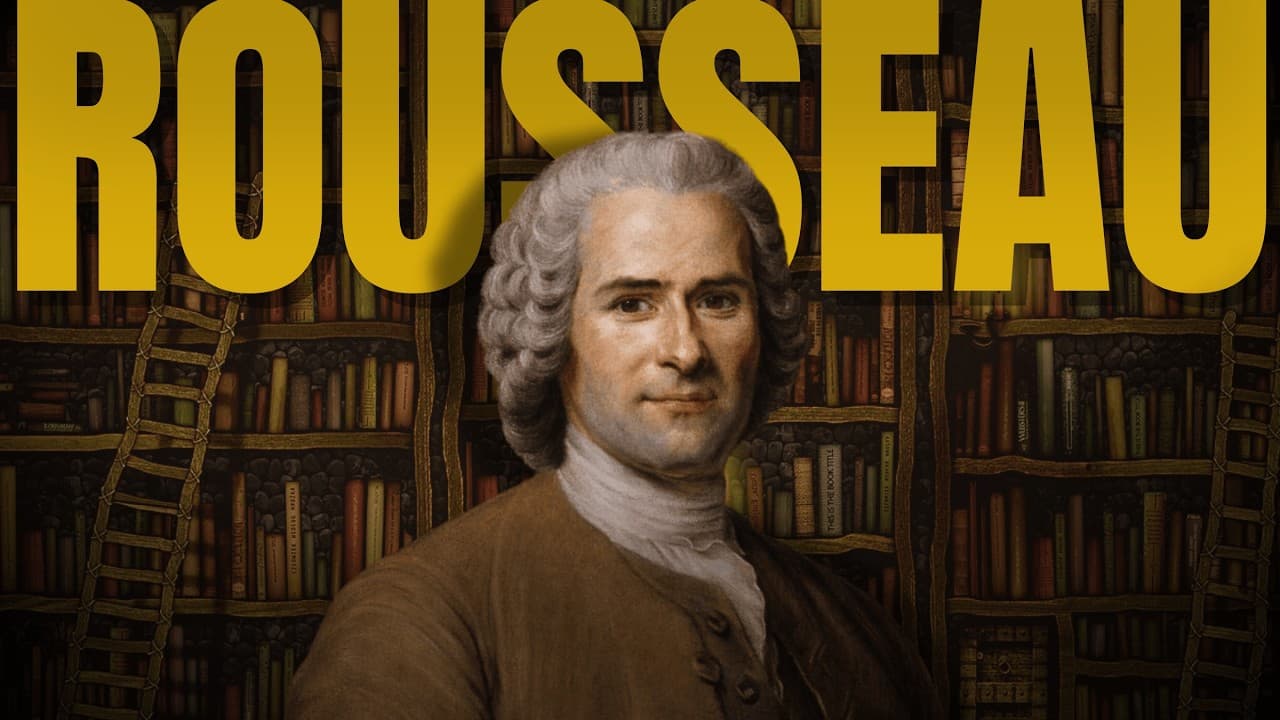
Society Made You Miserable | Rousseau's Complete Philosophy For Sleep
Rousseau's Complete Philosophy
Enjoying the episode?
Occasional letters on philosophy, reading, and the examined life. No spam, ever.
Chapters
- 0:00:00Chapter 1: The Wanderer and the Age of Reason
- 0:15:49Chapter 2: The First Discourse and the Case Against Civilization
- 0:31:32Chapter 3: The State of Nature and the Origins of Inequality
- 0:47:35Chapter 4: Compassion, Self-Love, and the Psychology of Corruption
- 1:03:54Chapter 5: The Social Contract and the General Will
- 1:19:31Chapter 6: Freedom, Authority, and the Paradox of Being Forced to Be Free
- 1:34:34Chapter 7: Emile and the Education of a Free Human Being
- 1:50:18Chapter 8: The Confessions and the Invention of the Modern Self
- 2:05:58Chapter 9: The Break with the Enlightenment and the Road to Romanticism
- 2:21:58Chapter 10: Revolution, Legacy, and the Unfinished Argument
Full Transcript
Chapter 01: The Wanderer and the Age of Reason
In the autumn of 1749, a young man walked along the road from Paris to Vincennes to visit a friend in prison. The October heat pressed down on the dusty path. He carried a copy of the Mercure de France, and as he walked, he read. Somewhere along that road, he came upon a question posed by the Academy of Dijon for its annual prize essay: has the restoration of the sciences and the arts contributed to the purification of morals? What happened next, by his own account, was something like a vision. He later wrote that all at once he felt his mind dazzled by a thousand lights, that crowds of vivid ideas presented themselves with a force and a confusion that threw him into an inexpressible turmoil. He sat down under a tree, unable to walk further. When he rose, the front of his waistcoat was wet with tears he did not remember shedding. The man was Jean-Jacques Rousseau. He was thirty-seven years old, largely unknown, and had spent most of his adult life drifting between occupations, cities, and patrons. Within a year, his answer to that question would make him the most controversial thinker in Europe.
The answer he gave was no. Civilization had not improved humanity. It had corrupted it. This claim, delivered with passionate eloquence and furious moral conviction, would set the course of Rousseau's life and shape the trajectory of modern thought in ways that are still being reckoned with. But to understand why this answer carried such force, and why the man who gave it was so uniquely positioned to deliver it, we need to begin much earlier, in a small republic on the shores of Lake Geneva.
Jean-Jacques Rousseau was born on June 28, 1712, in the city-state of Geneva, a fiercely independent Calvinist republic that prided itself on its civic virtue and its distance from the monarchies that surrounded it. His mother, Suzanne Bernard, died nine days after his birth from complications of the delivery. Rousseau would carry this loss through his entire life, and he was not shy about connecting it to the suffering that followed. His father, Isaac Rousseau, was a watchmaker of modest means and volatile temperament who filled the boy's early years with an unusual education. Together, father and son stayed up through the night reading novels and then the classical histories of Plutarch, tales of Roman virtue and republican heroism that impressed themselves deeply on the young Rousseau's imagination. He would later claim that these early readings gave him the spirit of a free man, a spirit he never entirely lost.
When Rousseau was ten, his father fled Geneva after a quarrel that threatened legal consequences, leaving the boy in the care of relatives. Apprenticed to an engraver at thirteen, Rousseau found the work brutal and the master cruel. He later described how the experience taught him to lie, to dissemble, to covet what others had. He was learning, he believed, what the world does to a naturally good character when it subjects that character to coercion and humiliation. At sixteen, returning one evening to find the city gates of Geneva locked against him, he made a decision that would define his life. He did not wait for the gates to open. He walked away.
What followed were years of wandering through Savoy, Piedmont, and the Italian-speaking cantons, years that Rousseau would later narrate with a vividness that borders on the novelistic. He converted to Catholicism in Turin, a conversion of convenience rather than conviction, and drifted through a series of menial employments. He was a lackey, a secretary, a tutor, a music copyist. He was often hungry, often dependent on the kindness of strangers, and often humiliated by the distance between his intellectual ambitions and his social position.
The most significant figure of these wandering years was Madame de Warens, a Catholic convert and minor aristocrat living near Chambery in Savoy. Rousseau arrived at her door when he was sixteen and she was twenty-eight. She became his protector, his benefactor, and eventually his lover. He called her Maman. Their relationship, which lasted intermittently for more than a decade, provided Rousseau with the closest thing to a stable home he had ever known. At her country house, Les Charmettes, he undertook the extraordinary project of educating himself, reading voraciously in philosophy, mathematics, literature, and music. He was largely self-taught, and the breadth and depth of his eventual learning is all the more remarkable for having been acquired without the guidance of formal institutions. He also taught himself music with a seriousness that would later yield both a successful opera, Le Devin du Village, and his contributions on musical theory to the Encyclopedie. Music remained throughout his life a source of income, solace, and identity. Even in his final years, when paranoia and isolation had consumed much of his world, he earned his living as a music copyist, and he took quiet pride in the neatness of his hand.
By the early 1740s, Rousseau had made his way to Paris, the intellectual capital of Europe and the beating heart of the movement that would come to be called the Enlightenment. Paris in this period was a city electrified by ideas. The great project of the age was the conquest of ignorance and superstition through the application of reason. The philosophes, as the leading thinkers styled themselves, gathered in the salons of wealthy hostesses and in the coffeehouses of the Left Bank. They debated science, politics, religion, and art with an energy and a confidence that reflected their fundamental conviction: that human beings, freed from the shackles of tradition and dogma, could build a better world through knowledge. The salons themselves were remarkable institutions, drawing rooms presided over by women of intelligence and social standing where the boundaries between aristocratic society and intellectual life dissolved into conversation. At the salon of Madame d'Epinay or the dinners hosted by Baron d'Holbach, a gifted writer without a title could find himself seated beside a duke, provided he could hold his own in debate. It was a world that rewarded brilliance, but it also rewarded performance, and the distance between the two was something Rousseau would never stop thinking about.
The intellectual center of this world was the Encyclopedie, the vast collaborative dictionary of the sciences, arts, and trades edited by Denis Diderot and Jean le Rond d'Alembert. Rousseau became part of this circle. He was befriended by Diderot, whose intelligence and warmth drew him in, and he contributed articles on music to the Encyclopedie. He met Voltaire, the most famous writer in France. He encountered Baron d'Holbach, Condillac, and other leading figures of the Parisian intellectual scene.
Yet Rousseau was never comfortable in this world. He was a provincial from a small republic, a man without a university education, without an independent income, without the social graces that the salon culture demanded. The philosophes were, for the most part, men of comfortable means and cosmopolitan manners. They wore fine clothes. They spoke with practiced wit. They navigated the complex social hierarchies of Parisian society with an ease that Rousseau could never manage. He was awkward, he was sensitive, he was proud. He felt keenly the gap between his intelligence and his social position, between what he believed he deserved and what the world was prepared to give him. He later described himself as having been thrown into high society without possessing either its tone or its maxims, and unable to acquire them.
This discomfort was not merely personal. It became philosophical. Rousseau began to see the polish and refinement of Parisian society not as signs of progress but as masks concealing a deeper corruption. The wit of the salons seemed to him a performance designed to win approval rather than to pursue truth. The elaborate courtesy of the aristocratic world struck him as a system of mutual deception in which no one said what they meant and no one could be trusted. The philosophes themselves, for all their talk of liberty and reason, seemed to him more interested in their own reputations than in the genuine welfare of humanity. He was developing, in the crucible of his own social unease, the central insight that would animate his philosophy: that the refinement of civilization is not the same as moral improvement, and that it might in fact be its opposite.
It was during these early Paris years that Rousseau began his relationship with Therese Levasseur, a young laundress of limited education whom he met in 1745. She would remain his companion for the rest of his life, eventually becoming his wife in a civil ceremony in 1768. Their relationship was one of deep mutual dependence, though Rousseau's accounts of it are colored by his characteristic mixture of affection and condescension. Therese bore him five children, all of whom Rousseau placed in the foundling hospital shortly after their birth. This fact, which Rousseau himself later disclosed in his Confessions, remains the most troubling episode in a life marked by many contradictions. The man who would write the most influential treatise on education in the eighteenth century abandoned his own children to an institution from which few emerged alive. He offered justifications: poverty, the unsuitability of his household, the conviction that the children would be better off raised by the state. None of these justifications have been found persuasive by posterity, and Rousseau himself appears to have known it. In the Confessions, he calls the decision the greatest of all his faults.
The visit to Diderot at Vincennes, where this chapter began, occurred because Diderot had been imprisoned for publishing a work that offended the authorities. Rousseau made the journey on foot, and it was during one of these walks that he read the Dijon Academy's question. His response, the Discourse on the Arts and Sciences, argued with startling force that the progress of knowledge had not made human beings more virtuous but less so. He won the prize in 1750, and the essay's publication made him instantly famous and instantly controversial. The paradox was exquisite. A man who depended on the patronage of the wealthy was denouncing the culture that sustained him. A contributor to the great Encyclopedie was arguing that the entire enterprise of Enlightenment learning was morally suspect. Rousseau's relationship with wealth and patronage would remain uncomfortable for the rest of his life. He accepted gifts and lodgings from aristocratic benefactors while insisting on his independence from them, a tension that fed both his creativity and his growing sense of persecution.
What set Rousseau apart from nearly every other thinker of his age was the marriage of personal experience and philosophical argument. He did not arrive at his critique of civilization through abstract reasoning alone. He had lived it. He had felt the sting of inequality in the homes of the wealthy where he served as a lackey. He had experienced the corrupting pressure of a society that valued appearance over substance. He had watched himself become, in the salons of Paris, someone other than who he believed himself to be. His philosophy was, in a sense, an attempt to understand his own life, to find in the story of human civilization an explanation for the suffering and the inauthenticity that he had experienced in his own person. This is what gives his writing its extraordinary emotional power. He is not a detached observer of the human condition. He is a participant, a witness, a man writing from the center of his own pain.
Rousseau's personality was, by nearly all accounts, difficult. He was proud, easily offended, quick to perceive slights where none were intended, and capable of turning on friends with devastating suddenness. He was also capable of extraordinary warmth, of a generosity of spirit that could move those around him to tears. He was, in short, a man of extremes. His defenders have attributed his paranoia to the genuine persecution he later suffered. His critics have seen it as a deep character flaw that was present long before anyone gave him reason to feel persecuted. Both readings contain truth. What is beyond dispute is that Rousseau's temperament shaped his philosophy as decisively as his ideas shaped his age. He thought with his emotions as much as with his intellect, and this fusion of feeling and argument is what makes his work both so compelling and so dangerous.
By the early 1750s, the essential elements of Rousseau's world were in place. He had the biography of an outsider: motherless, self-taught, provincial, uncomfortable among the powerful and the polished. He had the philosophical conviction that civilization was a story of decline rather than progress. He had the emotional intensity to pursue that conviction to its most radical conclusions. And he had the literary genius to communicate it in prose that would move an entire continent. The years ahead would see him develop a body of work that touched on nearly every fundamental question of human existence: the nature of the self, the origins of inequality, the foundations of political authority, the proper education of children, and the possibility of living an authentic life in a corrupt world. These are the questions we will now take up, following the path that Rousseau himself traced from the forests of the state of nature to the cities of modern civilization, from the innocence of childhood to the compromises of maturity, from the solitude of the individual conscience to the collective life of the political community.
Chapter 02: The First Discourse and the Case Against Civilization
The Discourse on the Arts and Sciences, submitted to the Academy of Dijon in 1750, is not Rousseau's most sophisticated work. It is not his most carefully argued. It is, by his own later admission, the weakest of his major writings in terms of logical structure. But it is the work that changed everything, both for Rousseau and for the intellectual culture of the eighteenth century. It asked a question that no one in the heart of the Enlightenment expected to hear answered in the negative, and it answered it with a rhetorical force that made it impossible to ignore.
The Academy's question was whether the restoration of the sciences and the arts had contributed to the purification of morals. The expected answer, in an age that celebrated progress and the power of reason, was an enthusiastic yes. Rousseau said no. He argued that the development of the sciences and the arts, far from improving human morality, had actively corrupted it. Luxury, he claimed, was the companion of the arts. Vanity was the companion of the sciences. Together, they had created a civilization in which appearances mattered more than substance, in which the performance of virtue had replaced the practice of it, and in which human beings had become incapable of the simple honesty and natural goodness that had characterized earlier and less sophisticated ages.
The argument of the First Discourse, as it came to be known, proceeds through a series of historical examples that Rousseau deploys with more passion than precision. He points to ancient Egypt, Greece, and Rome, arguing that each civilization declined morally as its arts and sciences flourished. Sparta, which famously disdained learning and luxury in favor of military discipline and civic virtue, stands as his model of a healthy society. Athens, brilliant and culturally productive, represents the corruption that follows from intellectual refinement. Rome conquered the world when it was simple and virtuous, but fell when wealth and learning softened its character. The pattern Rousseau traces is consistent: wherever knowledge advances, morality retreats.
Rousseau extends his survey beyond the ancient world. He points to the corruption of the later Roman Empire, to the luxury of Renaissance Italy, and to what he sees as the moral emptiness of contemporary France, a nation drowning in elegance and refinement while its peasants starved and its soldiers lost their fighting spirit. He draws a contrast with the supposedly uncorrupted peoples of the ancient world who valued courage and simplicity over learning and sophistication. He even invokes the early Christians, arguing that their moral strength came from their simplicity and their indifference to worldly knowledge.
These historical claims are, by modern standards, highly selective. Rousseau is painting with a broad brush, and his portrait of Sparta omits the brutality of its social system, including the subjugation of the helots, while his portrait of Athens ignores the genuine moral seriousness of Socrates and Plato. His reading of history serves his rhetorical purposes rather than the demands of careful scholarship. But the power of the First Discourse does not rest on the accuracy of its historical examples. It rests on the force of its central provocation, which struck at the deepest assumptions of the age.
The Enlightenment was founded on the conviction that knowledge is liberating. The philosophes believed that ignorance was the root of human suffering and that the spread of education, science, and rational inquiry would gradually eliminate superstition, cruelty, and injustice. This was not a casual belief. It was the organizing principle of an entire intellectual movement, the animating spirit of the Encyclopedie, the justification for decades of philosophical labor. And Rousseau was telling them that they were wrong. Not wrong about particular facts or methods, but wrong about the fundamental relationship between knowledge and virtue. He was arguing that the entire project of Enlightenment, the great mission of the age, was making humanity worse rather than better.
The specific mechanisms of corruption that Rousseau identifies in the First Discourse are revealing. He argues that the arts encourage flattery and the desire to please. A poet or a painter does not seek truth. He seeks applause. His work is shaped not by moral conviction but by the tastes of his audience, and those tastes are themselves corrupted by luxury and idleness. The sciences, meanwhile, encourage a different kind of vanity: the pride of the intellectual who believes that his learning elevates him above ordinary humanity. This pride, Rousseau suggests, destroys the natural equality that should exist among human beings and replaces it with a hierarchy based on cleverness rather than goodness. The learned man looks down on the unlearned. The refined person despises the simple. And in this contempt, the fundamental bond of human sympathy is severed.
There is also the question of military virtue, which looms large in the First Discourse. Rousseau argues that nations devoted to the arts and sciences lose their capacity for war, which in the eighteenth century meant their capacity for self-defense and political independence. He was writing as a citizen of Geneva, a republic that maintained its freedom through the vigilance and martial discipline of its citizenry. The contrast with France, a nation whose professional armies were commanded by aristocrats while its intellectuals composed epigrams, was deeply felt.
Rousseau also argues that the arts and sciences are born from human vices rather than virtues. Astronomy arose from superstition. Eloquence arose from ambition. Geometry arose from avarice. Physics arose from idle curiosity. Even ethics arose from human pride. All of our efforts to polish ourselves, he writes, have produced only an appearance of virtue without any genuine substance. We have learned to speak beautifully of morality while practicing it less and less. Politeness has replaced sincerity. Ceremony has replaced friendship. The progress of civilization has been, in reality, the progress of a vast and elaborate pretense.
The reaction to the First Discourse was immediate and intense. Rousseau had touched a nerve. The essay was discussed in every salon in Paris. It drew responses from some of the most prominent intellectuals of the age, including the Polish king Stanislaw Leszczynski and the naturalist Charles Bonnet, and Rousseau found himself engaged in a series of public debates that only increased his fame. Some critics accused him of primitivism, of wanting to destroy libraries and tear down universities and return humanity to a state of barbarism. Others suspected that the entire essay was an elaborate rhetorical exercise, a paradox defended for the sake of winning a prize rather than from genuine conviction. Diderot himself may have encouraged Rousseau to take the contrarian position, though the question of how much of the argument was originally Diderot's and how much was Rousseau's has never been settled and probably never will be. What is clear is that the ideas expressed in the First Discourse, whatever their origin in conversation, became the foundation of everything Rousseau would write thereafter. He did not abandon his thesis after winning the prize. He spent the rest of his life deepening it, refining it, and living by its consequences. Rousseau denied the charge of primitivism in his replies, insisting that he was not opposing knowledge itself but rather the moral consequences of its pursuit in a corrupt society. He was not calling for a return to ignorance. He was calling for an honest examination of the price that civilization exacts from the human soul.
Voltaire's response was characteristically sharp. After reading the Second Discourse a few years later, he wrote to Rousseau that no one had ever used so much intelligence to try to make us stupid, and that reading the work made him want to walk on all fours. The remark was witty and cutting, but it also revealed something important about the gulf between the two men. Voltaire was the supreme representative of the Enlightenment faith in progress through reason. He had spent his career fighting superstition, injustice, and cruelty with the weapons of wit and knowledge. For Rousseau to suggest that this entire enterprise was misguided was, for Voltaire, not merely an intellectual error but a personal affront. The quarrel between Rousseau and Voltaire, which would deepen over the years into one of the most famous intellectual rivalries in European history, was not merely a clash of personalities. It was a clash of visions, a fundamental disagreement about whether the light of reason was leading humanity toward freedom or toward a new and more insidious form of enslavement.
What the First Discourse reveals, when read carefully, is not a simple rejection of knowledge but a deeply ambivalent meditation on the relationship between intellectual progress and moral character. Rousseau is not arguing that ignorance is bliss. He is arguing that knowledge, in the absence of virtue, becomes a tool of domination and self-deception. He is arguing that a society can be learned and polished and yet profoundly corrupt, that the glitter of civilization can conceal a moral emptiness that is all the more dangerous for being invisible. This is an argument that has lost none of its force in the centuries since Rousseau first made it. Every age that has prided itself on its learning and its sophistication has had to confront the uncomfortable possibility that Rousseau was right, that the things we call progress may be concealing forms of moral regression that we are too refined to recognize.
The deeper implications of the First Discourse become clearer when we consider what Rousseau means by virtue. He does not mean the complex ethical systems of the philosophers. He means something simpler and more immediate: honesty, courage, compassion, loyalty, the willingness to sacrifice one's own interests for the common good. These are the virtues of simple societies, of communities where people live close to one another and depend on one another for survival. They are the virtues that Rousseau associated with his native Geneva, with the idealized Sparta of his imagination, and with the rural communities where he always felt more at home than in the salons of Paris. Civilization, in Rousseau's view, does not eliminate these virtues. It replaces them with their simulacra. The civilized person learns to perform virtue rather than to practice it. He learns the appearance of honesty without its substance, the language of compassion without its feeling. He becomes, in Rousseau's memorable formulation, a man who lives always outside himself, who knows only how to live in the opinion of others, and who draws the sense of his own existence from their judgment alone.
Rousseau reinforced his philosophical stance with a personal one. In the years following the First Discourse, he undertook what he called his reform of manners. He gave up his fine clothes and adopted the plain dress of a man who refused to participate in the comedy of social appearances. He abandoned the pursuit of worldly advancement. He began copying music for a living, a humble trade that allowed him to maintain his independence without relying on patronage. These gestures were sincere, even if they were also theatrical. Rousseau understood that ideas, to be credible, had to be lived. And he was determined to live his.
This critique of inauthenticity, of the gap between appearance and reality in social life, would become one of the defining themes of Rousseau's philosophy. It connects the First Discourse to everything that followed: the analysis of inequality in the Second Discourse, the political theory of The Social Contract, the educational program of Emile, and the radical self-examination of the Confessions. In each of these works, Rousseau returns to the question that first seized him on the road to Vincennes: what has civilization done to us, and what have we lost in the process of becoming civilized?
The First Discourse also established a pattern that would characterize Rousseau's career. He was now a public figure, but a public figure defined by his opposition to the very public he addressed. He denounced luxury while accepting the hospitality of the wealthy. He attacked the arts while practicing them with consummate skill. He condemned the world of letters while depending on it for his livelihood and his reputation. These contradictions were not lost on his contemporaries, and they have not been lost on posterity. Whether they represent hypocrisy or a deeper kind of honesty, the honesty of a man who sees the corruption of his world and acknowledges his own complicity in it, remains one of the central questions in the interpretation of Rousseau's life and thought.
What cannot be denied is the originality and the courage of the argument. In an age that worshipped reason, Rousseau questioned the moral authority of reason itself. In a culture that celebrated refinement, he asked whether refinement was making people better or merely better at concealing their selfishness. In a society that equated progress with improvement, he proposed that progress might be a form of decline. The First Discourse did not answer all the questions it raised. Its historical arguments were shaky, its logic sometimes strained, its rhetoric occasionally overwrought. But it posed the right question, the question that would haunt the modern world for centuries to come: is the story of civilization a story of liberation, or is it a story of loss? Rousseau spent the rest of his life trying to answer that question, and in doing so, he produced some of the most unsettling and consequential ideas in the history of Western thought.
Chapter 03: The State of Nature and the Origins of Inequality
Five years after the First Discourse shook the intellectual world of Paris, Rousseau returned to the Academy of Dijon with a second essay that would prove far more ambitious, far more radical, and far more consequential. The Discourse on the Origin and Basis of Inequality Among Men, published in 1755, asked a question that the philosophers of the seventeenth and eighteenth centuries had been debating for generations: what is the origin of inequality among human beings, and is it authorized by natural law? Rousseau's answer would overturn the assumptions that had guided political philosophy since Hobbes, and it would provide the theoretical foundation for everything he would write thereafter.
The Second Discourse, as it came to be known, begins with a methodological move of striking originality. Rousseau announces that he will set aside all the facts, for they do not affect the question. He is not writing history. He is constructing a hypothetical account of how human beings might have developed from a state of nature to the social and political arrangements of the present day. The state of nature, for Rousseau, is not a historical period that we can locate on a timeline. It is a philosophical thought experiment, a way of stripping away everything that society has imposed on human beings in order to discover what lies beneath. It is, as he puts it, a state that no longer exists, that perhaps never existed, and that probably never will exist, but of which it is necessary to have an accurate idea in order to judge our present condition properly.
This is a crucial distinction. Rousseau is not claiming that human beings once actually lived in the condition he describes. He is using the state of nature as a diagnostic tool, a way of measuring how far humanity has traveled from its original condition and of evaluating whether that journey has been one of improvement or of degradation. The method is philosophical rather than empirical, speculative rather than historical. And it is this method that gives the Second Discourse its enduring power. By imagining what human beings would be like without society, Rousseau forces us to ask which of our characteristics are natural and which are artificial, which are essential to our humanity and which are the products of circumstance and convention.
The portrait Rousseau paints of natural humanity is remarkable for its simplicity and its gentleness. Unlike Hobbes, who had described the state of nature as a war of all against all, a condition of perpetual fear and violence in which human life was solitary, poor, nasty, brutish, and short, Rousseau imagines a very different scene. Natural human beings, in his account, are solitary but not violent. They wander through the forests, satisfying their simple physical needs with the abundance that nature provides. They eat, they sleep, they mate. They have no language, no society, no property, no lasting relationships. They are healthy, strong, and self-sufficient. They are also, crucially, peaceful. They have no reason to harm one another because they have no competition for scarce resources, no envy, no desire for domination. They are, in a word, innocent.
This innocence is not the same as moral goodness. Natural human beings, in Rousseau's account, are not virtuous because virtue requires the capacity for moral reasoning that only develops in society. They are, rather, pre-moral. They exist below the threshold of good and evil. They have no concepts of right and wrong, no sense of justice or injustice. What they have, instead, are two natural sentiments that precede the development of reason. The first is amour de soi, a term that Rousseau uses to describe the natural instinct of self-preservation. This is not selfishness. It is the simple, unreflective desire to maintain one's own existence, a drive that every living creature shares. It is moderate, proportionate to one's actual needs, and it does not require the diminishment of others for its satisfaction. A natural human being desires food when hungry, warmth when cold, rest when tired. These desires are easily met, and once they are met, the desire subsides.
The second natural sentiment is compassion, or what Rousseau calls pitie. This is the instinctive revulsion that every sentient being feels at the sight of another's suffering. Rousseau argues that compassion is not a product of reason or culture. It is a natural feeling, prior to all reflection, that even animals display. A horse will avoid stepping on a living body. A mother will instinctively reach out to protect a child in danger, whether or not the child is her own. This natural compassion serves, in the state of nature, as a check on the potential aggressiveness of amour de soi. It moderates the pursuit of self-interest by making us averse to causing unnecessary harm. Together, amour de soi and natural compassion produce a being that is neither heroically good nor dangerously evil, but simply indifferent to harm and inclined toward a quiet, solitary existence.
The contrast with Hobbes is fundamental. Hobbes had argued that human beings in the state of nature are driven by a restless desire for power, that they are naturally competitive, suspicious, and aggressive, and that only the authority of an absolute sovereign can prevent them from destroying one another. Rousseau considers this portrait a projection of civilized humanity onto natural humanity. The competitive, anxious, power-hungry creature that Hobbes describes is not natural man but social man, a being already corrupted by the institutions and the psychology of civilized life. Hobbes, in Rousseau's view, made the fundamental error of taking the effects of society for the causes, of attributing to nature what was in fact the product of culture. The violence and the competition that Hobbes observed in human life were real, but they were symptoms of corruption, not expressions of nature.
Locke, the other great social contract theorist, fares somewhat better in Rousseau's estimation, but not much. Locke had argued that human beings in the state of nature possess natural rights, including the right to property, and that they form political societies to protect those rights. Locke's natural man is already a rational, sociable, property-owning creature, a figure that Rousseau would regard as already deeply shaped by the conventions of civilized life. Rousseau challenges the assumption that property exists in the state of nature at all. Property, for Rousseau, is an invention, perhaps the most consequential invention in human history. The transition from the state of nature to civil society begins with the act of enclosure. The most famous passage in the Second Discourse imagines this moment with devastating clarity: the first person who, having enclosed a piece of ground, thought of saying this is mine and found people simple enough to believe him, was the true founder of civil society. What crimes, wars, murders, what miseries and horrors would the human race have been spared, Rousseau writes, if someone had pulled up the stakes or filled in the ditch and cried out to his fellows: beware of listening to this impostor.
Between the state of nature and the invention of property, Rousseau traces a series of intermediate stages in which human beings gradually develop the capacities and the needs that make social life both possible and corrupting. The key development is the emergence of a faculty that Rousseau calls perfectibility, the uniquely human capacity for self-improvement. Animals are governed entirely by instinct. They are today what they were a thousand years ago and what they will be a thousand years hence. Human beings, by contrast, are capable of learning, of adapting, of developing new skills and new desires. This capacity is, in Rousseau's view, the source of everything that is best and worst about humanity. It is what makes progress possible, but it is also what makes corruption possible. Without perfectibility, human beings would have remained in the state of nature forever, neither good nor evil, neither happy nor miserable. With it, they set out on a path that leads to civilization, culture, and all the inequalities and oppressions that follow. Perfectibility is, in this sense, the source of all human greatness and all human misery. It is what makes us capable of art, philosophy, and moral reasoning, but it is also what makes us capable of tyranny, exploitation, and self-destruction. No other animal has this capacity, and no other animal pays the price that it exacts.
The process of corruption unfolds gradually, and Rousseau traces it through several distinct stages with a care that gives the Second Discourse much of its narrative power. In the earliest stages of social development, human beings begin to live in small groups, to form families, to build rudimentary shelters, to develop language and the beginnings of culture. The development of language is itself a profound transformation, because language allows human beings to think abstractly, to compare, to remember, and to anticipate. It opens the door to reflection, and reflection, for Rousseau, is the beginning of the end of natural innocence. Rousseau regards the period of early social life, which he calls the youth of the world, as the happiest epoch in human history, a stage in which people enjoyed the pleasures of companionship without the full weight of social competition and inequality. They gathered around fires, they sang, they danced. They began to notice one another. But this golden age could not last. As human beings began to compare themselves to one another, a new and destructive passion emerged: amour-propre.
Amour-propre is the desire to be esteemed by others, to be seen as superior, to occupy a higher place in the social hierarchy. It is fundamentally different from amour de soi. Where amour de soi is a natural, moderate, self-contained instinct of self-preservation, amour-propre is a social, insatiable, comparative passion that depends entirely on the opinions of others. Amour de soi asks: do I have what I need to survive? Amour-propre asks: am I better than my neighbor? Am I more admired, more respected, more envied? This shift, from a self-contained concern with one's own well-being to a competitive obsession with one's relative standing, is the psychological engine of corruption. Once amour-propre takes hold, human beings can never be satisfied. Their happiness no longer depends on meeting their actual needs but on exceeding the achievements of others. And since everyone is engaged in the same competition, the result is a society of universal restlessness, envy, and mutual hostility.
The invention of property accelerates this process dramatically. Once land can be owned, accumulated, and passed down, inequality ceases to be a matter of natural differences in strength or ability and becomes a structural feature of society. The rich need the poor to work their land. The poor need the rich for employment. But this interdependence is profoundly unequal. The rich use their wealth to secure political power, and they use their political power to protect their wealth. The laws and institutions of civil society, which present themselves as neutral and universal, are in reality instruments for the preservation of inequality. The social contract, as it actually exists in history, is not an agreement among free and equal persons. It is a trick by which the rich persuade the poor to accept their own subordination.
This analysis of inequality as a product of social institutions rather than natural differences is one of Rousseau's most radical and enduring contributions to political thought. It challenges the assumption, common in his time and still common in ours, that the inequalities we observe in society reflect the natural order of things. Rousseau insists that they do not. Natural differences among human beings are relatively small and, in the state of nature, of little consequence. It is only through the development of property, language, and social institutions that these small differences are magnified into the vast gulfs of wealth, power, and prestige that characterize civilized societies. The implication is profound: if inequality is not natural but artificial, then it is not inevitable. It is the product of human choices and human institutions, and it could, at least in principle, be otherwise. This insight would echo through the centuries, informing radical political movements, critiques of capitalism, and debates about social justice that continue to this day. Rousseau did not invent the idea that society is responsible for human suffering, but he gave it its most powerful and systematic formulation.
The Second Discourse ends not with a solution but with a diagnosis. Rousseau does not tell us how to return to the state of nature, because he knows that we cannot. The process of social development is irreversible. We cannot unlearn language, dismantle property, or forget the passions that social life has awakened in us. What we can do is understand how we arrived at our present condition, and in understanding it, perhaps find ways to mitigate the worst of its effects. This diagnostic ambition, the desire to understand the origins of our suffering rather than to prescribe a cure, gives the Second Discourse its peculiar power and its lasting relevance. It is a work of philosophical archaeology, digging beneath the surface of civilized life to uncover the layers of development, corruption, and self-deception that lie beneath. The question it leaves us with is not how to go back, but how to go forward with our eyes open to the costs of the world we have built.
Chapter 04: Compassion, Self-Love, and the Psychology of Corruption
The Second Discourse gave Rousseau's critique of civilization its theoretical scaffolding. But the argument rests on a set of psychological claims that deserve closer examination, because it is in his account of human motivation, feeling, and moral development that Rousseau makes some of his most original and most enduring contributions. Rousseau is, above all else, a moral psychologist. His deepest insights concern not the structure of society but the structure of the soul, the inner landscape of desire, comparison, and self-deception that makes social corruption possible in the first place.
Natural compassion, or pitie, occupies a central place in this psychology. Rousseau argues that compassion is not a product of civilization, not a learned behavior, not a moral achievement. It is a natural sentiment, older than reason, shared with other animals, and woven into the fabric of sentient existence itself. It is the feeling that makes a person wince at the sight of another's pain, that makes a crowd gasp when a child stumbles near a ledge, that makes even the hardened criminal uneasy in the presence of suffering he has caused. Rousseau insists that this feeling is universal and that it operates prior to any process of moral reasoning. We do not calculate that suffering is bad and then feel compassion. We feel compassion first, and only later do we construct moral theories to explain why suffering matters.
This is a philosophical move of considerable significance. By grounding morality in feeling rather than reason, Rousseau challenges the dominant tradition of rationalist ethics that stretches back to the ancient Greeks and forward through Kant. For the rationalists, morality is fundamentally a matter of correct thinking. We discover moral truths through the exercise of reason, and we become moral agents by learning to govern our passions with our intellect. Rousseau reverses this order. He suggests that feeling is more fundamental than reasoning in the moral life, that the heart knows things that the mind discovers only later, and that a person who has lost the capacity for compassion has lost something more essential than any intellectual virtue. This idea would reverberate through the next two centuries of moral philosophy, from Adam Smith's Theory of Moral Sentiments, with its account of sympathy as the foundation of moral life, to the twentieth-century ethics of Emmanuel Levinas, with its insistence that the encounter with the face of the other precedes and grounds all moral reasoning. Rousseau stands at the headwaters of this tradition, the first modern thinker to place the feeling heart at the center of the moral universe.
The connection to David Hume's moral philosophy is instructive but also illuminating of the differences between the two thinkers. Hume, writing in the same period, also argued that morality is grounded in sentiment rather than reason. His famous dictum that reason is, and ought only to be, the slave of the passions echoes Rousseau's conviction that feeling precedes and grounds moral judgment. Both thinkers reject the idea that morality can be derived from pure reason alone. But their accounts diverge in important ways. Hume's moral sentiments are social in origin. They arise from the experience of living in communities, from the habits of approval and disapproval that are cultivated through social interaction. For Hume, there is no pre-social morality because morality is itself a social phenomenon. Rousseau, by contrast, insists that compassion is pre-social, that it exists in the state of nature before any community has been formed. This distinction matters because it allows Rousseau to do something that Hume cannot: to use natural compassion as a standard against which to measure the moral quality of social life. If compassion is natural, then a society that suppresses or distorts it is working against human nature rather than with it.
Rousseau also draws attention to the way that reason itself, when it operates in the service of amour-propre, can become an instrument for suppressing compassion rather than supporting it. A person who witnesses suffering may, instead of responding with immediate sympathy, begin to reason about whether the sufferer deserves their fate, whether intervention would be wise, whether the costs of compassion outweigh the benefits. Reason, in such cases, does not enhance moral response. It delays and diminishes it. Rousseau famously writes that it is reason that engenders amour-propre and reflection that strengthens it, that it is philosophy that isolates a man from others and leads him to say in secret, at the sight of a suffering person, perish if you will, I am safe. This is one of Rousseau's most radical claims: that the development of reason, rather than making us more moral, can actually make us less compassionate by interposing calculation between the impulse of sympathy and the act of response.
The mechanism by which natural compassion is suppressed is one of Rousseau's most psychologically acute analyses. In the state of nature, compassion operates freely because there is nothing to obstruct it. Natural human beings are not competing with one another, not comparing themselves to one another, not calculating their relative standing in a social hierarchy. They encounter the suffering of others directly, without the mediation of social categories, and they respond to it with immediate, unreflective sympathy. But as society develops and amour-propre takes root, compassion is gradually overlaid and obscured by other, more powerful motivations. The desire to be seen as superior, the fear of being seen as inferior, the need to maintain one's position in the social hierarchy, these preoccupations crowd out the simple, natural response to another's pain.
Rousseau traces this process with remarkable precision. As human beings begin to live in proximity to one another, they begin to compare. Comparison is the seed of amour-propre, and once it germinates, it grows without limit. At the fireside gatherings of early social life, the best singer, the strongest dancer, the most attractive face begins to attract attention and admiration. Those who are admired begin to expect admiration. Those who are not admired begin to resent those who are. The equality of the state of nature gives way to a hierarchy of esteem, and this hierarchy, once established, becomes self-reinforcing. Those who are admired use their status to acquire further advantages. Those who are not admired become envious, resentful, and desperate to improve their standing. The result is a society in which everyone is measuring themselves against everyone else, in which happiness depends not on the satisfaction of actual needs but on the perception of relative success.
The psychological toll of this transformation is enormous. Rousseau argues that amour-propre, in its corrupted form, makes genuine happiness impossible. A person driven by amour-propre can never be satisfied because the standard by which they measure themselves is always shifting. No matter how much they achieve, someone else will always have achieved more. No matter how high they rise, the fear of falling is always present. And because their sense of self-worth depends entirely on the opinions of others, they are perpetually vulnerable to the judgment of people they may not even respect. They live, as Rousseau puts it, outside themselves. Their inner life is colonized by external evaluation. They perform for an audience rather than living from their own center. This is the condition that Rousseau calls alienation, though he does not use that exact term. It is the state of being estranged from one's own nature, of living in a way that satisfies the demands of society while leaving the deepest needs of the self unmet.
The role of imagination in this process is worth pausing over. Rousseau recognizes that imagination is a double-edged faculty. On the one hand, imagination is what makes compassion possible in the first place. We feel for others because we can imagine ourselves in their position. We project ourselves into their experience, and this projection generates the sympathetic response that Rousseau calls pitie. On the other hand, imagination is also what makes envy, jealousy, and amour-propre possible. We imagine what others have that we lack. We imagine how we appear in their eyes. We imagine ourselves as we wish to be rather than as we are. Imagination is the faculty that allows human beings to transcend their immediate experience, but it is also the faculty that makes them perpetually dissatisfied with it. A creature without imagination would never develop compassion, but it would also never develop vanity. Rousseau does not resolve this tension. He presents it as a fundamental feature of the human condition, a duality that cannot be eliminated but only managed. The same faculty that enables our highest moral achievements also enables our deepest moral failures. This is why education, as Rousseau will argue in Emile, must be so careful in its cultivation of the imagination, nurturing its capacity for sympathy while guarding against its capacity for envy and competitive self-measurement.
The connection between amour-propre and what we might now call status anxiety is difficult to miss. Rousseau's analysis of the psychology of social comparison reads, at times, like a description of contemporary life written three centuries in advance. The relentless measurement of oneself against others, the cultivation of an image designed to win approval, the anxiety that accompanies every social encounter, the nagging suspicion that one's real self is somehow inadequate, these are experiences that any inhabitant of a competitive, status-conscious society will recognize. Rousseau would not have been surprised by a world in which people curate idealized versions of their lives for public display while privately suffering from loneliness and self-doubt. He would have seen it as the logical endpoint of the psychological dynamics he described in the Second Discourse. The specific technologies change, but the underlying mechanism remains the same: the transformation of natural, self-contained contentment into an endless, anxious quest for external validation. Rousseau understood that this quest is not merely uncomfortable. It is self-defeating. The more desperately we seek the approval of others, the less capable we become of knowing what we ourselves actually want or need. We lose contact with amour de soi, the quiet, reliable compass of natural self-love, and we are left navigating by the shifting, unreliable signals of amour-propre. The result is not merely unhappiness. It is a kind of spiritual homelessness, a condition of being perpetually displaced from one's own inner life.
But it is important to note that Rousseau does not regard amour-propre as entirely negative. In its moderate form, the desire for recognition and esteem can motivate moral development and genuine achievement. A person who wants to be respected by others has a reason to behave well, to develop their talents, to contribute to the common good. The problem arises when amour-propre becomes inflamed, when the desire for recognition overwhelms all other motivations and becomes an end in itself. Inflamed amour-propre turns the desire to be respected into the need to dominate, the wish for recognition into the demand for submission. It is the difference between wanting to be a good citizen and wanting to be a king, between hoping to be admired for one's virtues and needing to be envied for one's possessions. Rousseau's later political and educational works can be understood, in part, as attempts to create institutions and practices that channel amour-propre toward its healthier expressions while preventing it from degenerating into its destructive ones. The distinction between moderate and inflamed amour-propre is one that later scholars, particularly Nicholas Dent and Frederick Neuhouser, have emphasized as essential to understanding Rousseau's thought. Without it, Rousseau appears to be a simple primitivist who wants to abolish society and return to the woods. With it, he emerges as a more nuanced thinker who recognizes that social life is both inevitable and potentially valuable, but only if its psychological effects can be kept within bounds that do not destroy the natural sentiments on which genuine morality depends.
The implications of Rousseau's moral psychology extend far beyond his own century. By arguing that the roots of human suffering lie not in some innate depravity but in the distortions imposed by social institutions and social comparison, Rousseau opened the door to a radically different way of thinking about morality, politics, and education. If human beings are naturally compassionate but become cruel through social corruption, then the task of the moralist, the educator, and the legislator is not to restrain natural evil but to protect natural goodness. This represents a fundamental break with the Christian doctrine of original sin and with the Hobbesian conviction that human nature is essentially aggressive and must be restrained by force. Rousseau replaces the idea of fallen humanity with the idea of corrupted humanity, and the difference is decisive. A fallen being needs redemption from above. A corrupted being needs reform from within, or rather, from a restructuring of the social conditions that produced the corruption. The problem is not in the human heart. The problem is in the world that the heart inhabits. This is a profoundly optimistic vision in one sense, because it suggests that human suffering is not inevitable but contingent on social arrangements that could, in principle, be changed. But it is also a profoundly disturbing vision, because it implies that the institutions we have built to civilize ourselves may be the very things that are destroying us. The question of whether this implication can be resolved, whether it is possible to have civilization without corruption, is the question that drives everything Rousseau would write from this point forward.
Chapter 05: The Social Contract and the General Will
If the Second Discourse was Rousseau's diagnosis, The Social Contract was his attempt at a prescription. Published in 1762, it opens with one of the most famous sentences in the history of political thought: man is born free, and everywhere he is in chains. The sentence captures the central paradox of Rousseau's philosophy. Human beings are naturally free, yet every existing society constrains that freedom through laws, customs, hierarchies, and institutions that most people accept without question. The task of The Social Contract is to determine whether there is a form of political association that can be legitimate, one that binds its members without enslaving them, that creates obligations without destroying freedom.
This is not the same question that earlier social contract theorists had asked. Hobbes had asked how sovereign authority could be established to prevent the chaos of the state of nature. His answer was the absolute sovereign, a ruler to whom the people surrender their natural rights in exchange for security. Locke had asked how political authority could be limited to protect individual rights, especially the right to property. His answer was constitutional government, a system of checks and balances designed to prevent the abuse of power. Rousseau asks a different and more radical question. He wants to know whether political authority can be constructed in such a way that obedience to the law is compatible with genuine freedom. He wants, as he puts it, to find a form of association that defends and protects the person and goods of each associate with the common force of all, and in which each, while uniting with all, nevertheless obeys only himself and remains as free as before.
The solution Rousseau proposes is the social contract, but his version of the contract is fundamentally different from those of his predecessors. In Rousseau's account, the social contract is not a transfer of rights from the people to a sovereign. It is a mutual agreement among all the members of a community to subordinate their individual wills to the collective will of the whole. Each person gives himself entirely to the community, along with all of his rights, and in return receives the protection and the collective power of the entire association. Because the terms are the same for everyone, and because everyone gives up everything, no one has any interest in making the conditions burdensome for others. The social contract creates a collective body, a public person, that Rousseau calls the sovereign. The sovereign is not a king or a parliament. It is the community itself, acting together through the exercise of what Rousseau calls the general will.
The general will is the most important and the most contested concept in all of Rousseau's political philosophy. Understanding what Rousseau means by it is essential to understanding everything else in The Social Contract. The general will is not the same as the will of all. The will of all is simply the sum of individual preferences, the aggregate of each person's private desires. If every citizen were asked what they personally wanted, and all their answers were collected and tallied, the result would be the will of all. The general will is something different. It is the will that each citizen would have if they set aside their private interests and considered only the common good. It is, in other words, the answer to the question: what is best for the community as a whole, considered apart from what is best for any particular individual within it?
This distinction is crucial because Rousseau recognizes that individual preferences are often shaped by selfishness, ignorance, and the corrupting influence of amour-propre. A citizen might want a particular law because it benefits them personally, even if it harms the community as a whole. The will of all, being merely the sum of such preferences, could easily produce unjust outcomes. The general will, by contrast, always tends toward the common good because it is defined as the will that each citizen would have if they looked beyond their private interest to the interest of the whole. It is not an empirical fact about what people actually want. It is a normative standard for what they ought to want as members of a political community. Rousseau uses a mathematical metaphor to clarify. If one takes the individual wills and cancels out the pluses and minuses, the opposing interests that destroy one another, what remains is the general will. It is the residue of common interest that survives when private interests are stripped away. This metaphor suggests a process of abstraction, a distillation of what is truly shared from what is merely particular. But it also raises the question of who performs this distillation and by what method, a question that Rousseau answers with more confidence than clarity.
How is the general will to be discovered? Rousseau's answer is through a process of collective deliberation in which each citizen considers the common good and votes accordingly. He insists that for this process to work, certain conditions must be met. There must be no factions or partial associations within the community, because factions distort the deliberative process by organizing private interests into collective blocs that overwhelm the voices of individual citizens. Each citizen must vote according to their own judgment of the common good, not according to the dictates of a party or a leader. And the community must be small enough that every citizen can participate directly in the process of legislation. Rousseau is profoundly skeptical of representative government. He argues that sovereignty cannot be delegated. The moment the people elect representatives to make laws on their behalf, they cease to be free. Legislative authority must remain in the hands of the people themselves, exercised directly through periodic assemblies.
The concept of popular sovereignty that emerges from this argument is radical even by modern standards. Rousseau is not merely arguing that the people should have a voice in government. He is arguing that the people are the government, that there is no legitimate political authority other than the people acting collectively through the general will. The executive power, what Rousseau calls the government, is merely an agent of the sovereign, appointed to carry out the decisions that the people have made. If the government exceeds its mandate or acts against the general will, it can and should be replaced. No monarch, no parliament, no institution of any kind has a right to rule except insofar as it expresses the will of the people. This is a vision of political life that would inspire revolutionaries, democrats, and radicals for centuries. It is worth noting that Rousseau was influenced in this thinking by his own experience of Geneva, or at least by his idealized memory of it. Geneva was a small republic in which citizens participated directly in the governance of their community. Rousseau dedicated the Second Discourse to the Republic of Geneva, praising it as a model of the kind of political community he admired. The reality of Genevan politics was considerably more complex and less democratic than Rousseau's tribute suggests, but the ideal of a self-governing community of free and equal citizens remained central to his political vision throughout his life.
There is another dimension of The Social Contract that deserves attention: Rousseau's concept of civil religion. He argues that every well-ordered state needs a set of simple religious beliefs that all citizens affirm, not because these beliefs are metaphysically true, but because they are necessary for social cohesion. The articles of this civil faith include the existence of a powerful, benevolent deity, the reality of an afterlife, the sanctity of the social contract, and the rejection of religious intolerance. Citizens who refuse to accept these articles may be banished from the state. Citizens who affirm them publicly but violate them in practice may be punished with death. This proposal has struck many readers as deeply inconsistent with Rousseau's emphasis on freedom and tolerance. It seems to subordinate individual conscience to collective authority in exactly the way that the rest of The Social Contract seeks to avoid. Rousseau appears to recognize the tension, but he does not resolve it. He seems to believe that without some shared religious foundation, the bonds of civic life will dissolve into selfishness and factionalism.
The relationship between Rousseau's social contract and Locke's deserves careful examination, because the differences illuminate the distinctive character of Rousseau's political thought. For Locke, the social contract is an agreement to protect pre-existing natural rights, especially the right to property. Individuals enter civil society with their rights intact and surrender only enough of their natural freedom to make collective security possible. The resulting government is limited. It exists to serve the interests of the individuals who created it, and if it fails in this task, the people have a right to overthrow it. Rousseau's social contract is far more demanding. It requires each individual to alienate all of their rights to the community. There is no residual sphere of individual freedom that the collective cannot touch. In Locke's system, the individual retains certain rights against the state. In Rousseau's system, the individual and the state are, in principle, identical: the citizen is the state, and the state is the citizen. This means that obedience to the law is not a sacrifice of freedom but an expression of it, because the citizen is obeying laws that they themselves have made. But it also means that there is no private sphere that the general will cannot reach, and this implication has troubled readers from Rousseau's own time to the present day.
The Social Contract is, by design, a work of ideal theory. Rousseau acknowledges that the conditions necessary for a legitimate political order may be extremely difficult to realize in practice. The community must be small. The citizens must be virtuous. The general will must be correctly identified. Factions must be prevented. The legislator, a semi-mythical figure whom Rousseau introduces as the founder of political communities, must be wise enough to design institutions that shape the character of the citizens without coercing them. These conditions are so demanding that some commentators have read The Social Contract as a deliberately utopian text, a description of what politics ought to be rather than a blueprint for what it can be. The figure of the legislator is particularly puzzling. He is not a ruler but a designer of constitutions, a figure of extraordinary wisdom who can perceive the passions of the people without experiencing them, who has no relationship with human happiness but is willing to devote himself to creating the conditions under which others can achieve it. Rousseau seems to have in mind figures like Moses, Lycurgus, and the great lawgivers of antiquity, men who shaped entire peoples through the force of their wisdom. The legislator cannot compel. He can only persuade, and he must do so without recourse to ordinary argument, since the people he is addressing are not yet ready to understand the reasons for his proposals. He must therefore appeal to divine authority, claiming that his laws come from the gods. This is a remarkable admission: even in his ideal state, Rousseau acknowledges that reason alone may not be sufficient to establish legitimate political order.
Others have read it as something more dangerous. The insistence that the general will is always right, combined with the admission that citizens may not always know what the general will actually is, creates a space for authoritarian interpretation. If the general will can be right even when the people do not recognize it, then someone must decide what the general will actually demands. And that someone could be a dictator, a committee, a revolutionary vanguard, anyone who claims to know the common good better than the people themselves. This interpretive danger is real, and it has haunted the reception of The Social Contract from the French Revolution to the twentieth century. Whether Rousseau intended this reading is another matter, and it is a question that has occupied political philosophers for more than two centuries. Rousseau's own view seems to have been that the general will emerges organically from the deliberation of a virtuous citizenry and that it cannot be imposed from above. But the gap between this ideal and any actual political practice leaves room for dangerous appropriations of the concept.
What remains powerful about The Social Contract, regardless of these interpretive difficulties, is its insistence that political legitimacy rests on consent, that the people are the ultimate source of political authority, and that no government can rightfully claim the obedience of citizens who have not freely agreed to its terms. These principles are now so widely accepted in democratic societies that it is easy to forget how revolutionary they were when Rousseau first articulated them. In an age of absolute monarchs who claimed to rule by divine right, the idea that sovereignty belongs to the people was not an abstraction. It was a provocation, an invitation to revolution, a philosophical bomb placed at the foundations of the old regime. Montesquieu had already argued for the separation of powers and the rule of law, but Rousseau went further. He did not merely argue for better government. He argued for a fundamentally different relationship between the individual and the state, one in which the citizen is not a subject to be governed but a participant in self-governance. The implications of this argument were incendiary, and within three decades of Rousseau's death, they would help to ignite one of the most transformative and violent revolutions in human history.
Chapter 06: Freedom, Authority, and the Paradox of Being Forced to Be Free
Whoever refuses to obey the general will shall be forced to do so by the whole body. This means nothing less than that he will be forced to be free. These words, appearing early in The Social Contract, have been the subject of more debate, more outrage, and more interpretive labor than perhaps any other sentence Rousseau ever wrote. They seem to contain a fundamental contradiction. How can a person be forced to be free? Is this not an oxymoron, a betrayal of the very freedom that Rousseau claims to defend? For some readers, this sentence reveals the totalitarian core of Rousseau's political thought. For others, it represents a profound insight into the nature of political freedom that only appears paradoxical when freedom is misunderstood.
To engage seriously with this paradox, we need to examine the three distinct types of freedom that Rousseau identifies in The Social Contract. The first is natural freedom, the unrestricted liberty that human beings possess in the state of nature. Natural freedom is the freedom to do whatever one has the power to do, limited only by physical strength and opportunity. It is the freedom of the animal, the freedom of the child, the freedom that exists before any social rules have been established. It is also, in Rousseau's view, a freedom of limited value. A person who possesses only natural freedom is governed by appetite and impulse. They are slaves to their desires, even if they are not slaves to any other person. Natural freedom is not real autonomy. It is merely the absence of external constraint.
The second type is civil freedom, which Rousseau defines as the freedom that arises from the social contract. Civil freedom is the freedom of the citizen: the freedom to participate in the making of the laws by which one is bound. It is more limited than natural freedom in one sense, because it is bounded by the general will. But it is more valuable in another sense, because it is freedom within a framework of justice and mutual obligation. The citizen who obeys the law is not submitting to an alien will. He is obeying a law that he himself has helped to create. His obedience is therefore not servitude but self-governance.
The third type, and the most philosophically significant, is what Rousseau calls moral freedom. Moral freedom is the freedom of a person who acts according to a law that they have prescribed to themselves, rather than being driven by appetite, habit, or external pressure. It is, in a sense, the freedom to be rational, to act on principle rather than impulse, to govern oneself from within rather than being governed from without. Rousseau writes that obedience to a law which we prescribe to ourselves is liberty. This formulation anticipates, with remarkable precision, the concept of autonomy that Immanuel Kant would develop two decades later. For Kant, as for Rousseau, genuine freedom is not the absence of constraint but the capacity for self-legislation, the ability to act according to principles that one's own reason has endorsed.
It is within this framework of three freedoms that the paradox of being forced to be free begins to make sense. When Rousseau says that a person who refuses to obey the general will shall be forced to be free, he is not saying that physical coercion is the same as freedom. He is saying that a person who acts against the general will is acting on their private interest rather than their rational judgment of the common good. They are being governed by their appetites rather than by their reason. They are, in the deepest sense, unfree, because they are slaves to their own selfishness. When the community compels them to obey the general will, it is, from Rousseau's perspective, compelling them to act as they would act if they were truly rational and truly virtuous, if they were capable of seeing past their private interests to the common good. The force is directed not against their freedom but against their enslavement to private desire. There is a domestic analogy that may help clarify the logic, even if Rousseau does not use it in exactly this form. When a parent prevents a child from touching a hot stove, the parent is using force against the child's immediate desire. But we do not regard this as an infringement of the child's freedom. We regard it as an act of care, because we recognize that the child's desire does not reflect the child's genuine interest. Rousseau's argument about the general will operates on a similar principle, but applied to adults in a political community, and it is precisely this application that makes it so controversial. Children are not yet capable of rational self-governance. Adults presumably are, and to treat them as if they are not raises profound questions about paternalism and the limits of political authority.
This argument is ingenious, but it is not without serious problems. The most obvious problem is that it depends on the assumption that the general will is always right, that it always corresponds to the genuine common good. If the general will can be mistaken, then forcing a person to conform to it is not liberating them from their selfishness. It is subjecting them to the collective error of the majority. Rousseau insists that the general will never errs, but this claim is difficult to sustain in practice. Even if the general will is defined as the will that aims at the common good, the process of collective deliberation by which it is identified is fallible. Citizens may be ignorant, prejudiced, or manipulated by demagogues. The majority may confuse its own interests with the common good. And in such cases, the person who dissents may be right and the community may be wrong.
Isaiah Berlin, in his famous essay "Two Concepts of Liberty," identified Rousseau's argument as a paradigmatic example of what he called positive liberty, the idea that genuine freedom consists not in the absence of constraint but in the realization of one's higher or rational self. Berlin argued that positive liberty is inherently dangerous because it allows those who claim to know what the higher self demands to impose their will on others in the name of freedom. The tyrant who forces you to be free is, from Berlin's perspective, simply a tyrant who has learned to speak the language of liberation. Berlin was not arguing that all conceptions of positive liberty are totalitarian. He was warning that they contain a logical structure that can be exploited by authoritarian regimes, and he cited the French Revolution and the Soviet Union as historical examples of this exploitation. Berlin contrasted positive liberty with negative liberty, the simple absence of interference by others. For the liberal tradition that Berlin defended, freedom means being left alone to pursue one's own conception of the good life without interference from the state or from other individuals. On this view, the state that forces its citizens to be free is not merely mistaken. It is dangerous, because it replaces the individual's own judgment about what constitutes a good life with the judgment of the collective.
The force of Berlin's critique is real, and it cannot simply be dismissed. But it is also possible to read Rousseau's argument more sympathetically, as many scholars have done. On this reading, Rousseau is not describing the forced imposition of a particular ideology on unwilling subjects. He is describing the enforcement of laws that the citizens themselves have made through a process of collective deliberation. The analogy is not with a dictator who knows better than his subjects what they really want. The analogy is with a community that enforces its own laws against those who would break them. When a democratic society punishes a tax evader, it is, in a sense, forcing the evader to contribute to the common good that the community as a whole has decided to pursue. The evader's private interest conflicts with the general will, and the community insists that the general will must prevail. This is not tyranny. It is the ordinary operation of democratic governance.
The distinction between these two readings, the authoritarian and the democratic, turns on the question of how the general will is identified. If the general will is determined through genuine democratic deliberation, with full participation, free expression, and no manipulation by factions or elites, then compelling obedience to it may be no more oppressive than enforcing any other democratically enacted law. But if the general will is determined by a leader, a party, or an ideology that claims to speak for the people without actually consulting them, then the phrase "forced to be free" becomes a justification for tyranny. Rousseau himself seems to have envisioned the former scenario, but the vagueness of his account left the door open for the latter.
The historical context in which Rousseau was writing adds another layer of complexity. He was writing against the backdrop of European absolutism, a system in which monarchs claimed unlimited authority over their subjects and justified that authority through appeals to divine right, tradition, or the natural order. In this context, Rousseau's insistence that legitimate authority rests only on the consent of the governed, and that the people themselves are the sovereign, was a revolutionary claim. His argument that obedience to the law can be a form of freedom, rather than a sacrifice of it, was directed against a political order in which obedience was demanded without consent and freedom was understood as the privilege of the powerful. The tension in his thought between freedom and authority reflects the tension of his age, a period in which the old structures of power were beginning to crumble but the new structures had not yet been imagined.
There is also an educational dimension to Rousseau's concept of freedom that connects The Social Contract to Emile. Rousseau believed that genuine freedom requires the development of moral character, the capacity to resist the pull of appetite and act according to reason and conscience. This capacity is not innate. It must be cultivated through education, through the careful development of the individual's rational and moral faculties. A person who has not been properly educated, who is governed entirely by impulse and desire, is not truly free, no matter how few external constraints they face. They are, in the language of the ancients, a slave to their passions. Freedom, in its fullest sense, is an achievement, not a given. It requires the development of capacities that allow a person to govern themselves, to resist temptation, to act on principle rather than appetite.
This conception of freedom as self-mastery has deep roots in the Western philosophical tradition. It connects Rousseau to the Stoics, who argued that the only true freedom is the freedom of the wise person who has learned to control their desires. It connects him to Spinoza, who identified freedom with the power of the intellect to govern the passions. And it connects him, most directly, to Kant, who would formalize Rousseau's insight into the concept of moral autonomy: the idea that a free person is one who acts according to a law that their own reason has recognized as valid, rather than being driven by external forces or internal impulses. Kant himself acknowledged the debt. He famously kept a portrait of Rousseau above his writing desk, and he credited Rousseau with teaching him that the worth of a human being lies not in intellectual ability but in moral character. The philosopher who would become the supreme champion of reason in ethics learned from Rousseau to respect the moral dignity of the common person, the unlearned farmer or artisan whose goodness of heart mattered more than any philosophical sophistication.
The tension between freedom and authority in Rousseau's thought is not a flaw to be corrected. It is a genuine philosophical problem that has no easy resolution. On the one hand, individual freedom is the highest political value, the foundation of legitimate authority, the purpose for which the social contract exists. On the other hand, genuine freedom requires the subordination of private interest to the common good, the willingness to be bound by laws that one may not personally prefer, the acceptance of collective authority as a condition of individual autonomy. Rousseau holds both of these commitments simultaneously, and they pull in opposite directions. The result is a political philosophy that is genuinely difficult, genuinely provocative, and genuinely unfinished. It raises questions that neither Rousseau nor any subsequent thinker has been able to answer definitively, questions about the relationship between the individual and the community, between personal desire and collective purpose, between the freedom to do what one wants and the freedom to become what one ought to be. These questions did not disappear after the eighteenth century. They reappeared in the debates over the French Revolution, in the conflicts between liberalism and socialism in the nineteenth century, in the struggle against totalitarianism in the twentieth, and in the contemporary debates over the relationship between individual rights and the common good. Rousseau did not create these tensions. He revealed them, and in revealing them, he made it impossible for any subsequent political philosophy to ignore them.
Chapter 07: Emile and the Education of a Free Human Being
In the same year that The Social Contract appeared, 1762, Rousseau published another work of equal ambition and arguably greater influence. Emile, or On Education is a treatise on how to raise a child, but to call it merely that is like calling The Social Contract a pamphlet on government. Emile is a philosophical novel, a thought experiment in human development, and one of the most audacious works of the eighteenth century. It imagines the education of a single boy, Emile, from birth to adulthood, guided by a tutor whose methods are designed to protect the child's natural goodness from the corrupting influence of society. The book was banned and publicly burned in both Paris and Geneva within weeks of its publication. The arrest warrant that followed forced Rousseau to flee France, beginning a period of exile and wandering that would last for much of the rest of his life. The authorities were offended not primarily by the educational content but by a section of the book called "The Profession of Faith of the Savoyard Vicar," in which Rousseau articulated a natural religion based on feeling and conscience rather than on the doctrines of any established church. This passage enraged both Catholic and Protestant authorities, who saw in it a threat to their institutional power. And yet, despite the burnings and the condemnations, within a generation Emile had transformed the way Europe thought about childhood, education, and the relationship between nature and culture.
The central principle of Emile is what Rousseau calls negative education. This does not mean doing nothing. It means doing less of what conventional education does and more of what nature requires. Conventional education, in Rousseau's view, begins too early and in the wrong way. It fills the child's head with information before the child is capable of understanding it. It forces the child to sit still, to memorize, to repeat, to perform for adults. It subjects the child to the artificial expectations of society before the child has had time to develop its own faculties. The result is a creature who is learned but not wise, obedient but not free, polished but not genuine. Negative education, by contrast, means protecting the child from premature exposure to the ideas, values, and expectations of society. It means allowing the child to develop naturally, at its own pace, guided by its own curiosity and its own experience of the world.
Rousseau divides the education of Emile into several stages, each corresponding to a phase of natural human development. In the earliest years, from birth to about age five, the focus is entirely on the body. The child should be allowed to move freely, to explore its physical environment, to develop its senses and its motor capacities without the interference of swaddling clothes, nursemaids, or anxious parents. Rousseau was writing at a time when it was common practice to bind infants tightly in swaddling bands that restricted their movement, and he opposed this practice with characteristic vehemence. He argued that the body is the instrument of the mind and that a child whose body has been constrained will develop a mind that is equally constrained.
The second stage, from about five to twelve, is devoted to the education of the senses. The child should learn not from books but from direct experience of the natural world. He should learn to see by looking, to hear by listening, to judge distances, weights, and textures by handling objects and moving through space. He should learn geography not from maps but from walks in the countryside. He should learn physics not from textbooks but from observing the natural phenomena around him. Rousseau is emphatic that no books should be introduced during this period, with one exception: Robinson Crusoe, which he admires because it tells the story of a man who must survive by his own resourcefulness, without the assistance of society. The child who reads Robinson Crusoe learns the value of practical knowledge, of self-reliance, of the direct confrontation with nature that Rousseau regards as the foundation of all genuine education.
This emphasis on learning through experience rather than instruction is one of Rousseau's most influential ideas, and it places him at the origin of what would later be called progressive education. The insight is deceptively simple: children learn best when they are actively engaged with their environment, when they are pursuing questions that genuinely interest them, when they are discovering things for themselves rather than being told things by adults. This principle, which seems obvious to many modern educators, was revolutionary in the eighteenth century. Education in Rousseau's time was almost exclusively a matter of rote memorization, drilling in classical languages, and strict discipline enforced through corporal punishment. Rousseau proposed something radically different: an education built around the child's natural development, respecting the child's own rhythms of growth and curiosity, treating the child not as a miniature adult to be molded but as a developing being with its own needs and its own timeline. Rousseau writes that nature wants children to be children before they are men. If we try to reverse this order, we produce premature fruits that are neither ripe nor flavorful, fruits that will rot before they mature. The metaphor of organic growth is central to Rousseau's vision. The educator is not an engineer but a gardener, not a sculptor imposing form on inert matter but a cultivator creating the conditions under which a living thing can grow according to its own nature.
The third stage, from about twelve to fifteen, introduces the element of intellectual education, but always grounded in practical experience and concrete problems. The child begins to study the natural sciences, not as abstract disciplines but as tools for understanding and manipulating the physical world. He learns a trade, because Rousseau believes that every person should be capable of supporting himself through manual labor, regardless of his social station. The choice of trade is significant. Rousseau recommends carpentry, because it is useful, physically demanding, and requires no servility to others. The education of this period is guided by the principle of utility: the child learns only what is useful, only what serves a practical purpose, only what connects to the concrete realities of life. Abstract knowledge, speculation, and theoretical learning are postponed until the child has developed the rational capacities necessary to engage with them meaningfully. Rousseau offers a vivid example. Rather than teaching a child about the movement of the sun through lectures on astronomy, the tutor should take the child to a hilltop at sunrise and sunset and let the child observe for himself. The child who discovers that the sun rises in one place and sets in another, and who is then guided to ask why, has learned something more deeply and more durably than the child who has merely been told the answer.
The fourth stage, from fifteen to about twenty, is the stage of moral and social education. It is only at this point that Emile enters society and begins to learn about human relationships, moral obligations, and the complexities of social life. Rousseau believes that moral education must be delayed because morality depends on capacities, especially the capacity for sympathy and the capacity for rational reflection, that develop only in adolescence. A child who is taught moral rules before he can understand their basis will merely learn to obey without understanding, and obedience without understanding is not virtue but servility. Emile's moral education begins with the development of compassion, the natural sentiment of pitie that Rousseau described in the Second Discourse. The tutor cultivates this sentiment by exposing Emile to the suffering of others, by taking him to visit the sick and the poor, by encouraging him to feel what others feel. Only after this foundation of compassion has been established does the tutor introduce the concepts of justice, duty, and the social contract.
The fifth and final stage of Emile's education involves his introduction to romantic love and his eventual marriage to Sophie, a young woman who has been educated according to very different principles. And it is here that Rousseau's educational philosophy encounters its most persistent and justified criticism. Rousseau's account of Sophie's education is based on the assumption that women are fundamentally different from men in their nature, their capacities, and their proper social roles. Sophie is educated not for independence but for dependence, not for intellectual achievement but for domestic virtue, not for public life but for the private sphere of the household. She is taught to please, to be modest, to be obedient. Her education is designed to make her a good wife and mother, not a free and autonomous individual.
Rousseau justifies this differential education by arguing that the natural differences between the sexes require different forms of cultivation. He writes that the man should be strong and active, the woman weak and passive. He argues that a woman's power lies not in her strength but in her charms, and that her education should be directed toward developing those charms rather than toward the cultivation of her intellect. These claims were controversial even in Rousseau's own time, and they have been subjected to devastating critique in the centuries since. Mary Wollstonecraft, in her Vindication of the Rights of Woman, published in 1792, thirty years after Emile, attacked Rousseau's account of women's education with a force and a clarity that remain compelling today. She argued that Rousseau's prescription for Sophie was a prescription for slavery, that it denied women the rational autonomy that Rousseau himself had identified as the essence of freedom, and that it reduced half of humanity to the status of ornamental dependents. Wollstonecraft did not reject everything in Rousseau's educational philosophy. She admired his emphasis on natural development and learning through experience. But she insisted that these principles should apply to girls as well as boys, that women were rational beings capable of the same moral and intellectual development as men, and that an education designed to make women pleasing to men rather than autonomous in their own right was an education designed to perpetuate injustice. The tension here is stark. Rousseau, who argued more passionately than anyone before him that human beings are born free and that education should cultivate that freedom, denied freedom to half the human race on the basis of arguments about natural difference that even his most sympathetic readers have struggled to defend. It is one of the deepest contradictions in a body of work that is full of contradictions, and it is a contradiction that Rousseau's own principles should have made him capable of recognizing.
The irony of Rousseau's pronouncements on education cannot be left unmentioned. The man who wrote with such eloquence and insight about the proper raising of children had placed his own five children in a foundling hospital, an institution from which the vast majority of inmates did not survive to adulthood. Rousseau was aware of this irony, and it haunted him. In the Confessions, he wrestles with the decision, offering explanations that range from financial necessity to philosophical principle. He argued that the children would have been corrupted by the influence of Therese's family, that they would have been better off raised by the state than in his own disordered household. These justifications are unconvincing, and most readers have found them so. Even Voltaire, not known for his tenderness, was appalled, and he used the information to attack Rousseau publicly. The facts speak plainly enough. Rousseau chose his work over his children. He chose the idea of education over the practice of it. And this choice, whatever its motivations, stands as a permanent counterweight to the moral authority of his educational writings.
Yet the influence of Emile is undeniable and vast. Johann Heinrich Pestalozzi, the Swiss educational reformer, credited Rousseau with inspiring his own approach to child-centered education. Friedrich Froebel, the inventor of the kindergarten, drew heavily on Rousseau's ideas about the importance of play and physical activity in early childhood. Maria Montessori, whose educational methods have shaped the experience of millions of children around the world, acknowledged Rousseau as a precursor. John Dewey, the most influential American philosopher of education, situated his own work in a tradition that begins with Rousseau's insistence that education must be grounded in the experience and the interests of the child rather than in the demands of the curriculum.
What all of these educators share with Rousseau is the conviction that the child is not a blank slate to be inscribed by adults but a developing organism with its own internal logic of growth. Education, on this view, is not a matter of imposing knowledge from without. It is a matter of creating the conditions under which the child's natural capacities can unfold. This is a profoundly hopeful vision, because it implies that the corruption Rousseau diagnoses in civilized society is not inevitable. If children can be raised in a way that protects their natural goodness, that cultivates their compassion, that develops their reason without destroying their authenticity, then perhaps it is possible to have civilized human beings who are not corrupted by civilization. Emile is Rousseau's answer to the question that has haunted his philosophy from the beginning: is there a way out of the trap that civilization has set for us? His answer is yes, but only if we begin at the beginning, with the education of the young.
Chapter 08: The Confessions and the Invention of the Modern Self
I have resolved on an enterprise which has no precedent and which, once complete, will have no imitator. My purpose is to display to my kind a portrait in every way true to nature, and the man I shall portray will be myself. With these words, Jean-Jacques Rousseau opens the most remarkable autobiography ever written in the Western tradition. The Confessions, composed between 1765 and 1770 and published posthumously, is not merely a record of one man's life. It is a philosophical act, an attempt to do something that no writer before Rousseau had ever attempted with such thoroughness or such recklessness: to tell the complete truth about a single human being, concealing nothing, excusing nothing, presenting the self in all its contradictions, weaknesses, desires, and shames.
The title invites comparison with Augustine's Confessions, written in the fourth century, the most famous autobiography in the Christian tradition. But the differences between the two works are as important as the similarities. Augustine confesses his sins before God. His narrative moves from darkness to light, from error to truth, from the bondage of sin to the freedom of grace. The structure is that of conversion: a sinful youth, a moment of divine illumination, and a life transformed by faith. Rousseau confesses before humanity. His narrative moves not from darkness to light but from innocence to experience, from natural goodness to social corruption. There is no conversion in Rousseau's story because, in his telling, he was never fundamentally wrong about who he was. The world was wrong about him. Society misunderstood him, persecuted him, failed to see the goodness of his heart. Rousseau's confession is not an act of penitence. It is an act of self-justification, though the line between the two is more blurred than Rousseau himself seems to realize.
The philosophical significance of the Confessions lies in its radical claim about the nature of the self. Rousseau asserts that the inner life of an individual, the private world of feeling, memory, desire, and experience, is worthy of the most serious attention. This claim, which seems obvious to modern readers, was far from obvious in the eighteenth century. The dominant philosophical traditions of the Enlightenment were concerned with universal truths: the laws of nature, the principles of reason, the foundations of morality. The particular experiences of a particular individual were regarded as philosophically insignificant, mere accidents of circumstance that contributed nothing to the understanding of what is permanent and essential in human nature. Rousseau challenges this assumption. He argues that the particular is essential, that the truth about a human being lies not in the abstract categories that can be applied to all people but in the concrete details that make each person unique. To understand humanity, we must understand individuals. And to understand individuals, we must be willing to look at them in all their messy, contradictory, embarrassing specificity. Rousseau announces in the opening pages that he is unlike anyone he has ever met and that he dares to believe he is unlike anyone in the whole world. If he is not better, at least he is different. This is a staggering claim, and it introduces a concept that would become central to Romantic and post-Romantic culture: the idea that each human being is unique, that this uniqueness is itself a form of value, and that the task of self-understanding is not to discover what one has in common with everyone else but to discover what sets one apart.
The Confessions delivers on this promise with an honesty that still has the power to unsettle. Rousseau tells us about his early sexual experiences, including his discovery that he derived pleasure from being punished by a woman, a revelation he delivers with a mixture of shame and analytical detachment. He tells us about his conversion to Catholicism, which he presents as an act of desperation rather than conviction. He tells us about his years of dependence on Madame de Warens, including the sexual dimension of their relationship, which he describes with a tenderness that coexists uncomfortably with the knowledge that she was simultaneously involved with other men. He tells us about his petty thefts, his lies, his moments of cowardice and moral failure. He describes the strange mixture of desire and inhibition that characterized his emotional life, his capacity for passionate attachment combined with a profound social awkwardness that made him perpetually ill at ease in the company of others. He records moments of spontaneous happiness, walks in the countryside, afternoons spent botanizing, evenings of music and conversation, with a sensuous immediacy that conveys the texture of lived experience in a way that no previous autobiography had achieved.
The most famous single episode in the Confessions is the theft of the ribbon. As a young servant in a noble household, Rousseau stole a small ribbon. When the theft was discovered, he blamed it on a young maidservant named Marion. Marion was confronted, denied the accusation, and was dismissed in disgrace. Rousseau knew that she was innocent and that he was guilty, but he did not speak. He allowed an innocent person to be punished for his crime. This episode, trivial in its outward detail, becomes in Rousseau's telling a moment of profound moral significance. He does not excuse himself. He analyzes his motivation with a precision that anticipates the methods of modern psychology. He was not motivated by malice, he says, but by shame. He named Marion not because he wished to harm her but because she was the first person who came to mind, and because the unbearable pressure of the moment made him desperate to deflect suspicion from himself. The shame of the theft was compounded by the shame of the accusation, and both shames have stayed with him for decades. The episode haunts the Confessions as an emblem of everything that social life does to a naturally good character: it creates situations in which the desire to preserve one's reputation overwhelms the desire to do what is right.
Rousseau also addresses, with considerably less analytical success, his decision to place his children in the foundling hospital. He returns to this episode repeatedly, as if compelled by the very guilt he is unable to fully acknowledge. He offers the same justifications he offered before: poverty, the unsuitable influence of Therese's mother, the belief that the children would be better raised by the state. But the repetition itself suggests that Rousseau knows these arguments are insufficient. The guilt leaks through the self-justification, and the reader is left to decide whether Rousseau's willingness to expose his greatest failure is an act of genuine honesty or a more subtle form of self-exoneration, a way of controlling the narrative of his own shame.
This tension between sincerity and self-justification runs through the entire work. Rousseau claims to be telling the complete truth, but every reader notices the way he shapes that truth to serve his own purposes. He is the hero of his own story, even when he is confessing his sins. His enemies are always wrong. His persecutors are always unjust. His failures are always the result of circumstances beyond his control or of the natural weaknesses that any honest person would acknowledge. Jean Starobinski, in his brilliant study of Rousseau, described this tension as the coexistence of transparency and obstruction: Rousseau genuinely wants to be transparent, to show himself as he is without concealment, but the very act of self-presentation introduces distortions that make full transparency impossible. The self that narrates is not the same as the self that lived, and the gap between the two cannot be bridged by any amount of honesty.
This insight has implications that extend far beyond Rousseau's own life. The Confessions raises fundamental questions about the nature of autobiography, of self-knowledge, and of the relationship between experience and narration. Can any person tell the complete truth about themselves? Is self-knowledge even possible, or is the self always partly opaque to itself? When we construct the story of our own lives, are we discovering the truth or creating it? These questions, which Rousseau was among the first to raise in their modern form, remain central to philosophy, psychology, and literature. The entire tradition of first-person narrative, from the novels of the nineteenth century to the memoirs and autofiction of the twenty-first, owes something to Rousseau's audacious claim that the inner life of a single individual is a subject worthy of the most serious and sustained attention. The Romantic movement, which would sweep through European culture in the decades following Rousseau's death, took from him the conviction that feeling, sincerity, and authentic self-expression are the highest values of the artistic and the moral life. When Goethe's Young Werther pours out his heart in letters of agonizing emotional intensity, when Wordsworth traces the growth of a poet's mind through the landscape of memory, when Byron cultivates his persona as a tortured, passionate outsider, they are all working within a tradition that Rousseau established. He did not merely write about the self. He invented a new way of being a self, a way that centers on authenticity, on the refusal to perform for society's approval, on the insistence that what one truly feels matters more than what one is expected to say.
The Confessions also reveals the growing paranoia that would darken Rousseau's later years. As the narrative progresses, the accounts of persecution become more frequent and more elaborate. Rousseau becomes convinced that his former friends, including Diderot, d'Holbach, and Grimm, have formed a conspiracy against him. He believes that they are intercepting his mail, turning his patrons against him, spreading lies about him throughout Europe. Some of these suspicions had a basis in reality. Diderot and others did turn against Rousseau, and some of them did speak ill of him in public. But Rousseau's response exceeded anything that the facts warranted. His sense of persecution became totalizing, a lens through which every event, every encounter, every silence was interpreted as evidence of hostile intent. This paranoia, whether it was a feature of Rousseau's personality that emerged under stress or a genuine mental illness that worsened over time, makes the later portions of the Confessions painful to read. The voice that began the work with such confidence and self-possession becomes increasingly anxious, defensive, and isolated. And yet even the paranoid passages have a philosophical significance that should not be overlooked. They show us what happens when the self can no longer trust its relationship to the world, when the gap between inner reality and outer appearance becomes unbridgeable, when the transparency that Rousseau sought in all his relationships proves impossible. The paranoia of the late Confessions is, in a sense, the logical culmination of Rousseau's own philosophy. If society is fundamentally corrupt, if the masks of civilization conceal hostility and deception, then the sensitive soul who perceives this truth will inevitably feel persecuted by a world that refuses to be honest.
The Reveries of the Solitary Walker, Rousseau's final work, written in the last two years of his life and left unfinished at his death in 1778, can be read as a coda to the Confessions. Where the Confessions is addressed to humanity and demands to be heard, the Reveries is addressed to no one. It is a series of meditations written for the author alone, reflections on memory, nature, solitude, and the experience of being alive in a world that has rejected him. The tone is quieter, more contemplative, more resigned. Rousseau walks alone through the countryside, observing plants, recording his thoughts, and trying to achieve a state of inner peace that has eluded him throughout his turbulent life. The fifth walk, in which he describes the experience of drifting in a boat on the Lake of Bienne and losing himself in the sensation of pure existence, is one of the most beautiful passages in all of French literature. He describes a state in which the soul finds a resting place solid enough to rest on entirely, where time means nothing, where the present lasts forever, with no sign of passing, no other feeling of privation or pleasure, of pain or desire, than this one feeling of existence. This passage anticipates, by more than a century, the phenomenological investigations of consciousness that would become central to twentieth-century philosophy.
The Confessions and the Reveries together constitute Rousseau's most personal legacy. They are the works in which the philosopher turns his gaze inward and attempts to understand himself with the same rigor and the same honesty that he brought to his analysis of society and politics. Whether he succeeded in that attempt is a question that each reader must answer for themselves. What cannot be disputed is that, in making the attempt, he created a new form of writing and a new way of thinking about what it means to be a self. Before Rousseau, autobiography was a record of public life, of achievements and events. After Rousseau, autobiography became an exploration of inner life, of feelings and desires and the private experience of being human. This shift, from the outer to the inner, from the public to the personal, is one of the defining movements of modern culture, and Rousseau is its most important originator.
Chapter 09: The Break with the Enlightenment and the Road to Romanticism
On November 1, 1755, a catastrophic earthquake struck Lisbon, killing tens of thousands of people and destroying much of the city. The disaster shook not only the physical landscape of Portugal but the intellectual landscape of Europe. For a civilization that had increasingly placed its faith in a benevolent God and a rational universe, the Lisbon earthquake posed an agonizing question: how could a just and omnipotent deity permit such indiscriminate suffering? Voltaire responded with a poem that rejected the optimistic philosophy of Leibniz and Pope, the idea that this is the best of all possible worlds. Rousseau responded with a letter to Voltaire that, in its quiet way, marked one of the decisive moments in the intellectual history of the eighteenth century.
Rousseau's Letter on Providence, written in 1756, did not dispute the reality of the suffering or the difficulty of reconciling it with the existence of a good God. But it challenged Voltaire's conclusions in a way that reveals the fundamental disagreement between the two men. Rousseau argued that the earthquake itself was a natural event and that much of the devastation was caused not by nature but by human choices. The people of Lisbon had chosen to build a dense city of tall buildings on a known fault line. They had chosen to crowd together in structures that amplified the destruction. If they had lived more simply, more dispersed, closer to nature, the earthquake would have killed far fewer people. The suffering, in other words, was not God's fault. It was civilization's fault. The letter was, in miniature, the argument of the Second Discourse applied to a specific catastrophe. Nature is not the enemy. We are.
Voltaire was not persuaded, and with good reason, for Rousseau's argument, however philosophically suggestive, rested on a questionable counterfactual. People had not chosen to build Lisbon on a fault line out of moral weakness. They had built it where commerce and geography demanded. The suggestion that a simpler way of life would have prevented the catastrophe was, at best, speculative. Nevertheless, the letter touched something that purely empirical objections could not reach. It raised the possibility that the human relationship to nature had gone wrong in a way that made human beings more vulnerable, not less, to the forces they sought to master. The exchange between the two men, conducted with surface courtesy but deep philosophical hostility, marks the beginning of their definitive estrangement. The difference between them was not merely a matter of temperament, though temperament played a role. It was a difference of fundamental conviction about the relationship between human progress and human happiness. Voltaire believed that reason, education, and the advancement of knowledge were the best tools humanity possessed for reducing suffering and increasing well-being. He acknowledged that the world was imperfect, but he believed it could be improved through human effort and enlightened governance. Rousseau believed that much of the suffering in the world was caused precisely by the kind of progress that Voltaire championed, that the more civilized humanity became, the more miserable it made itself, and that the path forward lay not in more knowledge but in a return to simpler, more natural ways of living and feeling.
The quarrel with Voltaire was the most public of Rousseau's breaks with the Enlightenment, but it was not the most painful. That distinction belongs to his break with Denis Diderot, the man who had been his closest friend and intellectual companion during his early years in Paris. The friendship between Rousseau and Diderot had been one of the most productive in the history of ideas. They had stimulated each other, challenged each other, and sharpened each other's thinking through years of intense conversation and collaboration. But by the late 1750s, the friendship had become strained beyond repair.
The causes of the rupture were multiple and entangled, and they illustrate the way that philosophical disagreements and personal grievances can become inextricable. Diderot was hurt by what he perceived as Rousseau's ingratitude and his increasing withdrawal from Parisian intellectual life. Rousseau, who had moved to a cottage at the Hermitage on the estate of Madame d'Epinay in 1756, was trying to live according to the principles he had articulated in his philosophical works, away from the corruption of the city, in proximity to nature. Diderot saw this retreat as an affectation and said so publicly. He included a pointed remark in his play The Natural Son to the effect that the good man lives in society and only the wicked man lives alone. Rousseau took this as a direct attack, and perhaps it was. The quarrel escalated through a series of misunderstandings, accusations, and interventions by mutual acquaintances that left both men feeling betrayed. By 1758, the friendship was over. They never reconciled.
The break with Diderot was followed by breaks with nearly every other figure in the Parisian intellectual establishment. Rousseau quarreled with Grimm, with d'Holbach, with d'Alembert, with Madame d'Epinay herself. Each quarrel had its own specific causes, but the underlying pattern was always the same: Rousseau felt misunderstood, persecuted, and morally superior to those who had rejected him, while those who had rejected him regarded him as ungrateful, paranoid, and impossible to deal with. The truth, as is usually the case with such conflicts, lies somewhere between these two accounts. Rousseau was genuinely difficult, and his suspicions often exceeded any reasonable response to the slights he experienced. But it is also true that some of his former friends did plot against him, did spread damaging gossip about him, and did make concerted efforts to undermine his reputation. The conspiracy was not as vast as Rousseau imagined, but it was not entirely imaginary either. D'Holbach and Grimm did work to isolate Rousseau socially. Voltaire did publish attacks against him. The question of where justified suspicion ends and pathological paranoia begins is one that biographers of Rousseau have debated without resolution. What is clear is that by the early 1760s, Rousseau was a man increasingly alone, cut off from the intellectual community that had nurtured him and defined by his opposition to the very movement that had given him a platform.
The publication of Emile and The Social Contract in 1762 brought a more serious form of persecution. Both works were condemned by the French authorities, and Emile was publicly burned by the executioner of Paris. An arrest warrant was issued, and Rousseau fled to Switzerland. But Geneva, his beloved native city, was no more welcoming. The Genevan authorities also condemned his works and burned them publicly. Rousseau was forced to take refuge in the territory of Neuchatel, then under Prussian jurisdiction, where he was given the protection of Frederick the Great, a monarch whose patronage Rousseau accepted with characteristic ambivalence. He then moved to the tiny island of Saint-Pierre in the Lake of Bienne, where he experienced the brief period of tranquility described in the fifth walk of the Reveries. But he was driven from there as well, and by 1766, he had run out of refuges on the continent.
It was at this point that David Hume, the great Scottish philosopher, offered Rousseau sanctuary in England. The invitation was well-intentioned, and Hume seems to have genuinely admired Rousseau's work and genuinely wished to help him. But the visit was a disaster. Rousseau arrived in England in January 1766, and within months, the relationship had deteriorated into mutual suspicion and public acrimony. Rousseau became convinced that Hume was part of the conspiracy against him, that Hume was in league with d'Holbach and the Parisian philosophes, and that the offer of sanctuary had been a trap. Hume, bewildered and hurt, published their correspondence in an attempt to vindicate himself, which only made things worse. The affair became a public scandal, debated in the press on both sides of the Channel. What makes the episode philosophically interesting, beyond its biographical sadness, is the collision between two fundamentally different philosophical temperaments. Hume was a man of equanimity and social grace, a philosopher whose skepticism extended to his own emotions and who regarded the world with amused detachment. Rousseau was a man of passionate conviction and wounded sensitivity, a philosopher who experienced ideas as matters of life and death and who could not separate his intellectual commitments from his emotional needs. Their inability to understand each other was not merely a failure of personality. It was a failure of philosophical communication between two world-views that shared a commitment to empiricism and sentiment but differed radically in their understanding of what those commitments required. Rousseau returned to France in 1767 under a false name, spending his final years in increasing isolation and mental distress.
The philosophical significance of Rousseau's break with the Enlightenment extends far beyond the personal quarrels. Rousseau's disagreement with the philosophes was not about particular facts or particular policies. It was about the fundamental direction of Western culture. The philosophes represented modernity in its most confident form: faith in reason, faith in science, faith in progress, faith in the capacity of human beings to understand and improve their world through the exercise of their intellect. Rousseau challenged all of these faiths, not by rejecting reason entirely, but by insisting on its limits and its dangers. Reason without feeling is cold and cruel. Progress without moral direction is blind. Knowledge without wisdom is vanity. The Enlightenment project, in Rousseau's view, was building a civilization that was intellectually brilliant and morally bankrupt, a civilization of clever, unhappy people who had forgotten what it meant to live simply, feel deeply, and treat one another with genuine compassion.
This critique made Rousseau the founding father of a counter-tradition that would come to be called Romanticism. The Romantics took from Rousseau the conviction that feeling is as important as reason, that nature is as important as culture, that the individual is as important as society, and that authenticity, the courage to be oneself in defiance of social expectations, is the highest human virtue. When Wordsworth wrote that poetry is the spontaneous overflow of powerful feelings, he was articulating a principle that Rousseau had lived and embodied decades before. When Goethe's Young Werther chose death rather than compromise his passion, he was acting out a Rousseauian drama of the authentic self destroyed by the conventions of a heartless society. When Thoreau retreated to Walden Pond to live deliberately, to front only the essential facts of life, he was following a path that Rousseau had traced a century earlier. The line that runs from Rousseau to Thoreau and beyond, to the environmental movements of the twentieth and twenty-first centuries, to the critique of consumer culture, to the longing for a more natural and less mediated existence, is one of the most significant threads in the intellectual history of the modern world.
But Rousseau's influence on Romanticism was not merely a matter of ideas. It was a matter of sensibility. Rousseau taught Europe to feel differently about nature, about childhood, about solitude, about the inner life. Before Rousseau, nature was a backdrop, a resource, a stage on which human dramas were played out. After Rousseau, nature became a teacher, a refuge, a source of spiritual renewal. Before Rousseau, childhood was a period of incompleteness, a mere preparation for the real business of adult life. After Rousseau, childhood became a state of grace, a time of innocence and natural wisdom that adulthood inevitably corrupts. Before Rousseau, solitude was a punishment or a sign of social failure. After Rousseau, solitude became a spiritual practice, a way of recovering one's authentic self from the distortions imposed by social life. These transformations of sensibility are so deeply embedded in modern culture that we can scarcely imagine the world without them. We are all, in some sense, Rousseau's children, shaped by ways of feeling and valuing that he articulated more powerfully than anyone before him.
Rousseau's final years were marked by loneliness, poverty, and mental suffering. He and Therese moved from place to place, never settling, always under the shadow of real or imagined persecution. He turned increasingly to botany as a source of consolation, spending long hours collecting and cataloging plants with a meticulous care that seems entirely at odds with the turbulence of his inner life. He composed the Reveries, his most tranquil and most inward work. And on July 2, 1778, at the age of sixty-six, he died at the estate of the Marquis de Girardin at Ermenonville, outside Paris. The cause of death was likely a stroke, though the precise circumstances remain unclear. He was buried on a small island in the park at Ermenonville, in a setting that could not have been more Rousseauian: a quiet island surrounded by water, sheltered by trees, at a distance from the world that had given him so much pain. His body would not remain there long. The Revolution was coming, and it would claim him as its own. The wanderer who had spent his life searching for a home, for a place where he could be himself without apology or performance, found his final resting place on a small island, surrounded by water, in the landscape of nature that he had loved and championed above all else. It was a fitting end, though Rousseau himself might have noted the irony that even in death, he could not escape the world's attention.
Chapter 10: Revolution, Legacy, and the Unfinished Argument
Eleven years after Rousseau's death, the Bastille fell. The French Revolution that erupted in 1789 transformed Europe and remade the political landscape of the modern world. And no thinker was more closely associated with that revolution, both in its noble aspirations and in its terrible excesses, than Jean-Jacques Rousseau. His ideas about popular sovereignty, the general will, and the social contract provided the revolutionaries with their philosophical vocabulary. His vision of a republic of free and equal citizens gave them their ideal. And his insistence that the corrupt institutions of the old regime had no legitimate authority gave them their justification for tearing those institutions down.
Maximilien Robespierre, the most powerful figure of the Revolution's most radical phase, was a devoted reader of Rousseau. He called Rousseau the most eloquent and the most virtuous of men. He kept a copy of The Social Contract on his desk. He quoted Rousseau in his speeches to the Convention. And he attempted to implement Rousseau's ideas with a literalness that Rousseau himself might have found alarming. The cult of the Supreme Being, which Robespierre instituted in 1794 as a state religion to replace the abolished Catholic Church, was directly inspired by Rousseau's chapter on civil religion in The Social Contract. The festivals of Reason and Nature that the revolutionaries staged in the streets of Paris were celebrations of Rousseauian ideals. Even the vocabulary of the Revolution, its constant invocation of the people, of the general will, of civic virtue, was borrowed from Rousseau's political writings.
But the Revolution also demonstrated the dangers latent in Rousseau's philosophy. The Terror, the period from 1793 to 1794 during which thousands of people were executed by the revolutionary government, revealed what could happen when the concept of the general will was placed in the hands of men who believed they alone understood what it demanded. Robespierre justified the Terror by arguing that the enemies of the Revolution were enemies of the people, and that eliminating them was an act of popular sovereignty. Those who dissented were not merely wrong. They were traitors to the general will, obstacles to the realization of the republic of virtue. The logic was chillingly consistent with the most authoritarian reading of Rousseau's philosophy: if the general will is always right, and if those who oppose it must be forced to be free, then the guillotine becomes an instrument of liberation. This is not what Rousseau intended, but it is what his ideas, filtered through the passions and the pressures of revolutionary politics, produced.
In 1794, during a brief lull in the Terror, the Revolution paid Rousseau its ultimate tribute. His remains were exhumed from the island at Ermenonville and transferred with great ceremony to the Pantheon in Paris, the temple of the nation's heroes. His sarcophagus was placed directly across from Voltaire's, an arrangement that would have amused and horrified both men in equal measure. The two great antagonists of the Enlightenment, united in death in a building that symbolized the nation they had both, in very different ways, helped to create. The procession that accompanied Rousseau's remains to the Pantheon was attended by vast crowds who sang, wept, and carried copies of his works. It was the kind of public spectacle that Rousseau, who had spent his life fleeing public attention, would have found unbearable.
The question of whether Rousseau bears responsibility for the violence of the French Revolution has been debated for more than two centuries. Edmund Burke, writing his Reflections on the Revolution in France in 1790, argued that the Revolution was the direct consequence of the abstract theorizing of philosophers like Rousseau, men who constructed ideal political systems on paper without regard for the messy realities of human nature and historical circumstance. Burke believed that the attempt to remake society according to philosophical principles was inherently destructive, that it swept away the accumulated wisdom of tradition and left nothing but chaos and violence in its place. His critique remains one of the most powerful conservative arguments against revolutionary politics, and it inaugurated a tradition of anti-revolutionary thought that stretches from Burke through Joseph de Maistre to the conservative critics of utopian politics in the twentieth century. Burke's objection was not merely practical. It was philosophical. He argued that political wisdom is embodied in institutions, customs, and traditions that have been tested by time, and that the philosopher who proposes to replace them with a rational blueprint is committing a form of intellectual hubris that can only end in catastrophe.
The opposite view holds that Rousseau was a democratic theorist whose ideas were distorted by the revolutionary context in which they were applied. On this reading, Rousseau's political philosophy is fundamentally a philosophy of consent, participation, and collective self-governance. The fact that revolutionaries misused his ideas does not make those ideas responsible for the misuse, any more than the misuse of Christianity by the Inquisition makes the teachings of Christ responsible for the torture of heretics. Rousseau himself warned against the dangers of factionalism, of the substitution of private interests for the common good, of the concentration of power in the hands of a few. The Terror violated every one of these principles. To blame Rousseau for the Terror is to blame the author of a philosophy of freedom for its betrayal by those who claimed to act in its name.
The debate between these two readings of Rousseau's political legacy was given its most rigorous formulation in the twentieth century by Ernst Cassirer and Isaiah Berlin. Cassirer, in his 1932 study The Question of Jean-Jacques Rousseau, argued that Rousseau was fundamentally a moral thinker, not a political one, and that his philosophy aimed at the internal transformation of the individual through education and moral development rather than the external transformation of society through political revolution. Berlin, as we have seen, argued that Rousseau's concept of positive liberty, the idea that true freedom consists in acting according to one's rational or moral nature rather than one's immediate desires, contains the seeds of totalitarianism, because it allows those who claim to know what rationality requires to impose their will on others in the name of freedom. This debate has never been settled, and it is unlikely ever to be, because both readings capture something genuine in Rousseau's thought. The tension between freedom and authority, between the individual and the community, between democracy and its potential for tyranny, is not a flaw in Rousseau's philosophy. It is its most honest feature.
Rousseau's influence extends far beyond the French Revolution and the debates it generated. Immanuel Kant, the greatest philosopher of the late eighteenth century, acknowledged Rousseau as a decisive influence on his moral philosophy. Kant wrote that Newton had taught him to understand the physical world, but Rousseau had taught him to understand the moral world. Specifically, Rousseau taught Kant to respect humanity, to see in every human being, however humble or uneducated, a moral dignity that transcends all differences of rank, wealth, or learning. This insight became the foundation of Kant's categorical imperative, the principle that every person must be treated as an end in themselves, never merely as a means. The connection between Rousseau's emphasis on the moral equality of all persons and Kant's formal articulation of that equality as a principle of reason is one of the most important intellectual genealogies in the history of philosophy.
Karl Marx, writing a century after Rousseau, drew on Rousseau's critique of property and inequality to develop his own analysis of class struggle and capitalist exploitation. Rousseau's argument that property is the origin of social inequality, that the laws and institutions of civil society serve primarily to protect the interests of the wealthy, and that the apparent freedom of modern society conceals a deep structure of domination, all of these claims find echoes in Marx's thought. Marx went further than Rousseau in calling for the abolition of private property and the revolutionary transformation of economic relations, but the starting point of his analysis, the conviction that inequality is not natural but socially produced, is Rousseauian through and through. The difference is that Rousseau located the problem in the corruption of the human heart by social comparison, while Marx located it in the structure of economic relations. One is a psychological diagnosis, the other an economic one, but both begin from the same foundational insight: that the suffering of the many is not a law of nature but a consequence of arrangements that human beings have made and that human beings could, in principle, unmake.
Mary Wollstonecraft's critique of Rousseau's views on women deserves further reflection in the context of his legacy. Wollstonecraft did not reject Rousseau's philosophy wholesale. She admired his emphasis on natural development, on learning through experience, on the cultivation of moral feeling. What she rejected was his refusal to extend these principles to women. Her argument was devastatingly simple: if freedom, reason, and moral autonomy are the birthright of all human beings, then they are the birthright of women as well as men. To deny women education, independence, and political participation is to deny their humanity, and it is to do so on the basis of exactly the kind of arbitrary social convention that Rousseau himself had spent his career attacking. Wollstonecraft turned Rousseau's own principles against him, and in doing so, she launched the tradition of feminist philosophy that would transform the world in the centuries to come. Rousseau's failure on the question of women is not a marginal blemish on an otherwise admirable philosophy. It is a serious failure, one that reveals the limits of even the most radical thinker's ability to see past the prejudices of his own time.
The influence of Rousseau on educational theory, on democratic thought, on the environmental movement, on the Romantic tradition in literature and art, and on the modern concept of authenticity is so pervasive that it is difficult to measure. We live in a world that Rousseau helped to create, a world in which the language of rights, equality, and popular sovereignty is the common currency of political discourse, a world in which childhood is regarded as a precious and distinct phase of life rather than a mere prelude to adulthood, a world in which the appeal to nature carries moral weight, a world in which the ideal of the authentic self, the person who lives according to their own convictions rather than the expectations of others, is one of the most powerful cultural forces in existence.
And yet the question that Rousseau posed on the road to Vincennes remains unanswered. Has civilization made us better? Has the progress of knowledge, technology, and social organization improved the human condition, or has it created new forms of suffering, new kinds of inequality, new and more subtle mechanisms of control? Rousseau did not answer this question definitively, and no one since has managed to do so either. The evidence points in both directions. The modern world has achieved feats of science, medicine, and social justice that would have been unimaginable in Rousseau's time. But it has also produced weapons of mass destruction, environmental catastrophe, and forms of social alienation that Rousseau, with his acute sensitivity to the costs of civilization, would have recognized immediately. The technologies that connect us to billions of other people also isolate us from the person sitting across the table. The economies that produce unprecedented abundance also produce unprecedented inequality. The freedoms that allow us to shape our own lives also leave us anxious, rootless, and uncertain of who we are. These are Rousseauian problems, and they suggest that his diagnosis, whatever its limitations, touches something real and enduring about the human situation.
The enduring power of Rousseau's philosophy lies precisely in this unresolved tension. He does not offer comfortable answers. He does not promise that progress will save us or that a return to nature will redeem us. He insists, with a stubbornness that borders on the prophetic, that the question must be asked, that the costs of civilization must be counted, that the price of comfort and convenience must be weighed against what has been lost. He was a deeply flawed person, paranoid, hypocritical, capable of great cruelty to those who loved him. He was also a thinker of extraordinary originality and courage, a man who saw truths that his more balanced and more temperate contemporaries could not see, or would not say. The tension between the man and the work, between the philosopher who wrote about freedom and the person who could not achieve it in his own life, is itself a Rousseauian problem: the problem of a being born for goodness but trapped in a world that makes goodness almost impossible.
His question still stands. It is a question for every age that prides itself on its achievements while sensing, in the quiet hours, that something essential has been lost. It is a question without a final answer, and perhaps that is as it should be. The asking of it is itself an act of moral seriousness, a refusal to accept the surface of things, a commitment to looking beneath the glitter of progress for the human cost it conceals. Rousseau asked it first, and he asked it with a force and a passion that still resonate across the centuries. The argument he began is unfinished, and it falls to each generation to take it up again.
Sources & Works Cited
- 1.Rousseau, Jean-Jacques. The Social Contract
- 2.Rousseau, Jean-Jacques. A Discourse on Inequality
- 3.Rousseau, Jean-Jacques. The Confessions
- 4.Rousseau, Jean-Jacques. Emile, or On Education
- 5.Rousseau, Jean-Jacques. Reveries of the Solitary Walker
- 6.Damrosch, Leo. Jean-Jacques Rousseau: Restless Genius
- 7.Wokler, Robert. Rousseau: A Very Short Introduction
Related Episodes
All of Vladimir Lenin's Philosophy
Vladimir Lenin transformed Marxism from a theory of historical inevitability into a theory of revolutionary action, and in doing so reshaped the twentieth century. This episode traces his intellectual development from his provincial childhood in Simbirsk through the trauma of his brother's execution, his radicalization, and his years of exile and organizing. It covers his major works including What Is to Be Done?, Imperialism: The Highest Stage of Capitalism, and State and Revolution, examining key concepts such as the vanguard party, democratic centralism, and the dictatorship of the proletariat. The narrative follows the events of 1917 from the February Revolution through the October seizure of power, the Civil War, War Communism, the Red Terror, the Kronstadt rebellion, and the New Economic Policy. It concludes with Lenin's final struggle, his Testament warning against Stalin, and the long debate over his contested legacy.
The Kingdom of God Is Within You
Leo Tolstoy was born on a vast Russian estate in 1828, a place of quiet and privilege that would shape everything he became and everything he later sought to destroy. He wrote two of the greatest novels in any language: War and Peace, which dismantled the myth of great men by showing that history is made by the countless small decisions of ordinary people, and Anna Karenina, which asked whether passion alone could ever carry a life. But his novels were only the beginning. In his fifties, the foundations of meaning collapsed beneath him entirely, and he turned to the Gospels with genuine seriousness for the first time. What he found there was not a theology but a practice: nonresistance to evil, love without exception, simplicity, and labor. These teachings cost him his marriage, his comfort, and his standing in the Orthodox Church, which excommunicated him in 1901. They also inspired Gandhi and Martin Luther King Jr., who built movements on the same tradition Tolstoy began.
Life Is Not A Problem To Be Solved
This episode is a long, gentle walk through the thought of Soren Kierkegaard, the Danish philosopher who believed existence is not a puzzle to be solved but something lived inwardly, one anxious choice at a time. Writing under a constellation of pseudonyms, each embodying a different mode of life, Kierkegaard staged philosophical dramas rather than building systems. We explore his three stages of existence, the concept of anxiety as the dizziness of freedom, despair as the sickness unto death, and the radical leap of faith. From his broken engagement to Regine Olsen to his fierce attack on institutional Christianity, and from the indirect communication of Either/Or to the raw devotion of Works of Love, Kierkegaard's ideas resonate with striking force for anyone lying awake wondering what it all means.